I Lit a Stick of Agarwood, and the Whole Room Went Quiet
A friend gave me agarwood incense. The night I couldnt sleep, I lit one, and everything stopped. Agarwood is the scent of a tree slowly healing its wounds—and that thought stayed with me.

I Lit a Stick of Agarwood, and the Whole Room Went Quiet
A friend gave me a small box of agarwood incense sticks recently. A plain paper box, no fancy packaging. Inside, dark brown slender sticks arranged neatly in a row. He said, "You keep saying you can't sleep. Try this."
I didn't think much of it at the time. To be honest, burning incense felt a bit... how do I put this... a bit too much ceremony. In my mind, incense was either the thick smoke coils at temples, or those strong-smelling essential oils at malls. It didn't seem connected to daily life.
But that night, I couldn't sleep again.
Around eleven thirty, tossing and turning in bed, my head full of the day. An unfinished draft, a meeting to prepare for tomorrow, three unread messages on my phone. I stared at the ceiling. The harder I tried to sleep, the more awake I felt. My heart seemed to be beating faster than usual.
Then I remembered the incense.
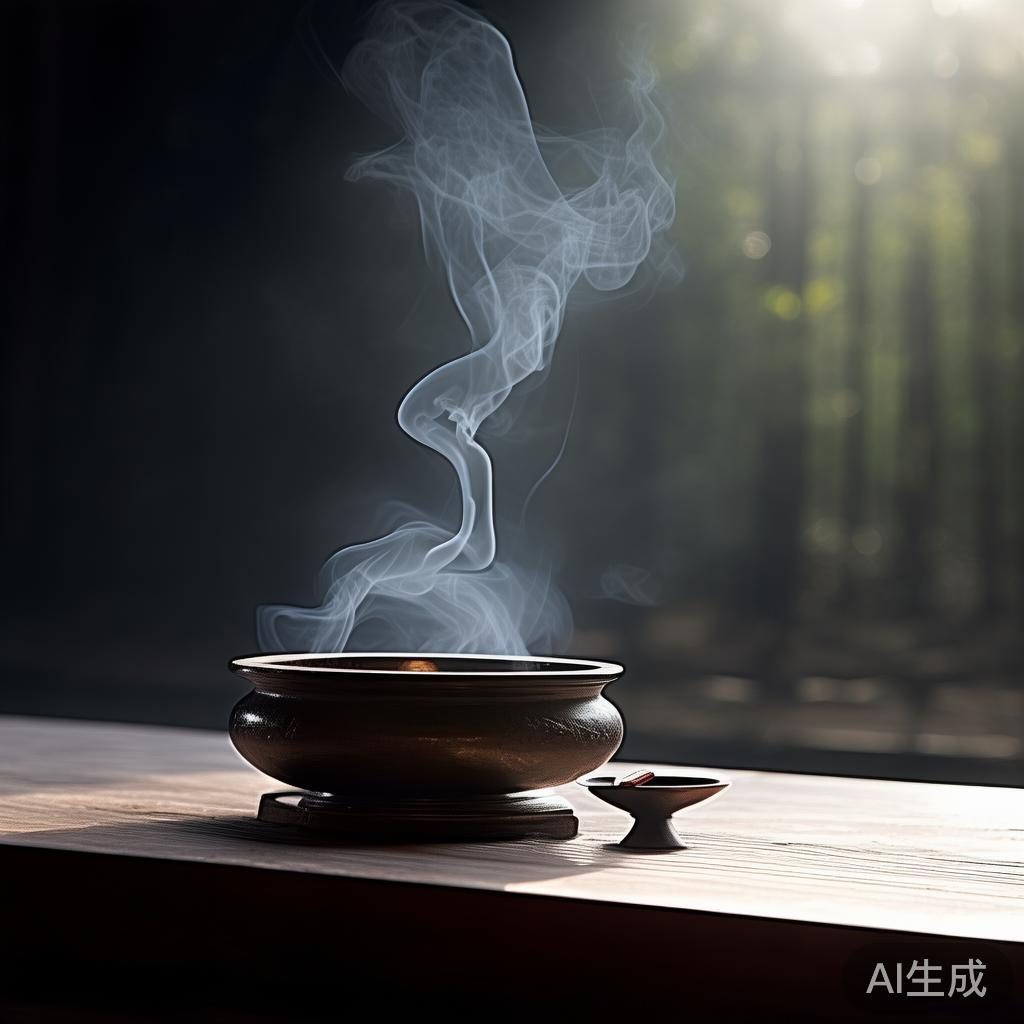
I got up, felt my way to the living room in the dark, took the box from the shelf, and pulled out a stick. The lighter clicked, the flame jumped, the tip glowed, and a thin thread of white smoke rose. The first time I breathed it in, I froze.
How to describe it — it wasn't a "wow, that smells nice" feeling. It was more like... something stopped.
That Thread of Smoke
The scent of agarwood is hard to describe. It's not as direct as a flower fragrance, not as heavy as pure wood. It's a very "deep" smell. If you close your eyes, it feels like walking into an old forest — the kind with thick layers of fallen leaves on the ground, moss covering the trunks, damp air, a place no one has disturbed for a very, very long time.
I looked it up on my phone later. Agarwood is actually resin that a tree secretes when it's been injured. It's not normal wood — it's something that grows over a wound. A tree gets struck by lightning, eaten by insects, broken by wind, and it secretes resin into the wound. Slowly, over many years, it hardens into what we call "agarwood."
After learning this, the scent felt different.
What you're smelling isn't a fragrance. It's the scent of a wounded piece of wood that spent a dozen years slowly forming a scar.
That thought kept me sitting quietly on the living room sofa for a long time.
Why Did Ancient People Love Incense?
Later I read up a bit and found that the history of incense in China is ridiculously long. I'm not talking about the temple offering sticks — that's something else. I mean "appreciating incense" — treating it as an everyday, aesthetic thing.
By the Han Dynasty, nobles were already using incense. They imported borneol and storax from the South Seas and burned them in boshan censers. Have you seen a boshan censer? It looks like a small mountain, carved with immortals and clouds. Smoke drifts out through the crevices of the mountain, like clouds flowing down from a fairy peak. The ancients probably felt that watching smoke rise from a boshan censer transported them to another world.
By the Tang and Song dynasties, incense appreciation reached its peak. Song dynasty people lit incense the way we make coffee today. Su Shi burned incense while writing poetry. Huang Tingjian burned incense while doing calligraphy. Even judges would burn a censer of incense before hearing cases, to calm their minds.
Huang Tingjian said something wonderful about incense. He listed ten benefits, and one stayed with me clearly: "It calms the mind, so it is not turned by external circumstances."
Not turned by external circumstances.
These five words, in our era, are a luxury.
Think about it — how many times a day are you "turned" by external things? Your phone buzzes, you turn. Your boss messages, you turn. You scroll past a video that makes you anxious, and your mood turns with it. We seem to be turning constantly, spinning after things outside us, until we're dizzy.
But a stick of incense, a wisp of smoke — it doesn't go anywhere. It just stays there, burning slowly, drifting slowly. It doesn't rush. It doesn't seek attention. It doesn't preach. It just quietly burns itself.
When you watch it, your heart slowly follows, slowing down.
Chinese Incense and Japanese Incense
At this point, some people might think of Japanese kōdō, the way of incense. Japanese kōdō is indeed refined, full of ritual, with a strict step-by-step process for appreciating incense, much like the tea ceremony. But here's the interesting thing — Japanese incense culture originally came from China.
During the Tang Dynasty, the monk Jianzhen crossed to Japan and brought large quantities of incense materials and implements. Later, the Japanese developed their own kōdō system on this foundation. So if you look at Japanese kōdō, you'll find that much of its aesthetic core — wabi, sabi, simplicity — traces back to the literati aesthetic of the Tang and Song period.
But China's own incense culture, it was interrupted.
From the late Qing to the Republic era, with constant war and chaos, who had the heart for incense? Then came reform and opening up, everyone was busy making money, even less time. So for a long time, "appreciating incense" became niche in China, and many people even thought burning incense was superstition.
Until recently, it seems to be coming back.
I've seen quite a few young people getting into incense online. Some collect agarwood from different regions. Some learn to make incense seals — pressing incense powder into brass molds shaped like flowers or characters, then lighting them. Others combine incense with meditation, lighting a stick every morning and sitting quietly for ten minutes.
One comment I remember clearly: "I'm not religious. I just need ten minutes a day where I think about nothing."
Yeah. Who doesn't.
It Doesn't Have to Be Expensive
When people hear "agarwood," the first reaction is usually: is it expensive?
Honestly, yes. Good agarwood is sold by the gram, more expensive than gold. Top-grade qinan agarwood can cost thousands per gram. For ordinary people like us, there's really no need to go there.
But there are good inexpensive options too.
The box my friend gave me cost just over a hundred yuan, he said. Sandalwood stick incense, very clean scent, not overwhelming. I checked online — sandalwood, cypress, and mugwort incense in the thirty-to-hundred-yuan range, plenty of choices. The key is the ingredient list — look for ones made with natural incense powder, not chemical fragrances. Chemical incense smells fake and harsh, and gives you a headache after a while. Natural incense has a "mellow" quality, like water seeping in slowly, unhurried.
But what I really want to talk about isn't agarwood or sandalwood. What I want to say is —
Have you ever tried, at some point in your day, doing absolutely nothing?
Not scrolling your phone, not listening to a podcast, not doing a meditation app course. Just sitting. Lighting a stick of incense, watching the smoke rise, thinking about nothing. If a thought pops up, let it pop up, then watch it float away.
This is probably what the ancients called "nourishing the spirit."
In Chinese medicine, there's a concept called "the heart governs the spirit." It means the heart, as an organ, governs our mental state, consciousness, and thinking. If the heart is constantly being depleted — anxiety, tension, information overload — the spirit becomes "ungrounded," floating on the surface. Then you get insomnia, irritability, nightmares, scattered focus.
The scent of incense, the ancients believed, has a "descending" quality. Good incense scent moves downward, gently pulling the floating spirit back down. That's why ancient people didn't take sleeping pills for insomnia — they lit a censer of incense.
I used to think this was mysticism. But after trying it, I found it's not entirely mysticism.
At least for me, the act of lighting incense — getting up, finding the box, pulling out a stick, lighting it, sitting down — is itself a ritual that pulls me out of the chaos. You can't light incense while scrolling short videos at the same time. The act forces you to slow down.
Then there's the smoke. You watch it slowly rise, and your attention goes with it. Your breathing slows down. Then your shoulders relax.
It's not magic. It's just that your attention finally has a place to rest.
Afterwards
Since then, I've developed a habit.
Every night around ten, I put my phone on the charger in the living room and don't touch it. Then I go to my room and light a stick of incense. Sometimes agarwood, sometimes sandalwood, sometimes just cheap mugwort. After lighting it, I sit in a chair, or lean against the headboard in bed, and do nothing.
Not meditation, not sitting practice. I sit poorly, often slouched and leaning. Sometimes my mind still wanders. Sometimes I actually zone out for fifteen minutes thinking about nothing at all. The incense burns down, the last thread of smoke slowly disperses, and the room keeps a faint, gentle scent.
Then I turn off the light and go to sleep.
Honestly, I'm not sure if it's really because of the incense. But since then, I do fall asleep a little faster. Maybe it's because I put the phone down. Maybe it's the scent. Maybe it's just a placebo effect.
But who cares. Fifteen minutes of quiet a day is never a bad thing.
I messaged my friend later: "That box of incense you gave me — I'm almost out." He replied: "Then buy more, it's not expensive."
I said: "Okay."
Sometimes I think about it — the ancients actually understood life better than we do. They didn't have phones, algorithms, 24-hour information feeds. What they had was time. The time for a censer of incense. The time for a cup of tea. The time to watch the moon rise from the east.
We have everything, but it seems we've lost that "art of doing nothing."
Today I lit a stick of agarwood, and the whole room suddenly went quiet. It wasn't the room that went quiet. It was me.
Three questions for you:
- When was the last time you did absolutely nothing, thought about nothing?
- If you had to choose one scent to represent "quiet," what would it be?
- Do you think the world outside is too loud, or are we just too full inside?