The Sword in the River: A Buddhist Version of the Boat-Marker
A man drops his sword from a boat and marks the gunwale. When the boat reaches shore, he dives in to search. But the boat has moved on while the sword stayed behind. Clinging to past experience — aren't we all marking the boat?
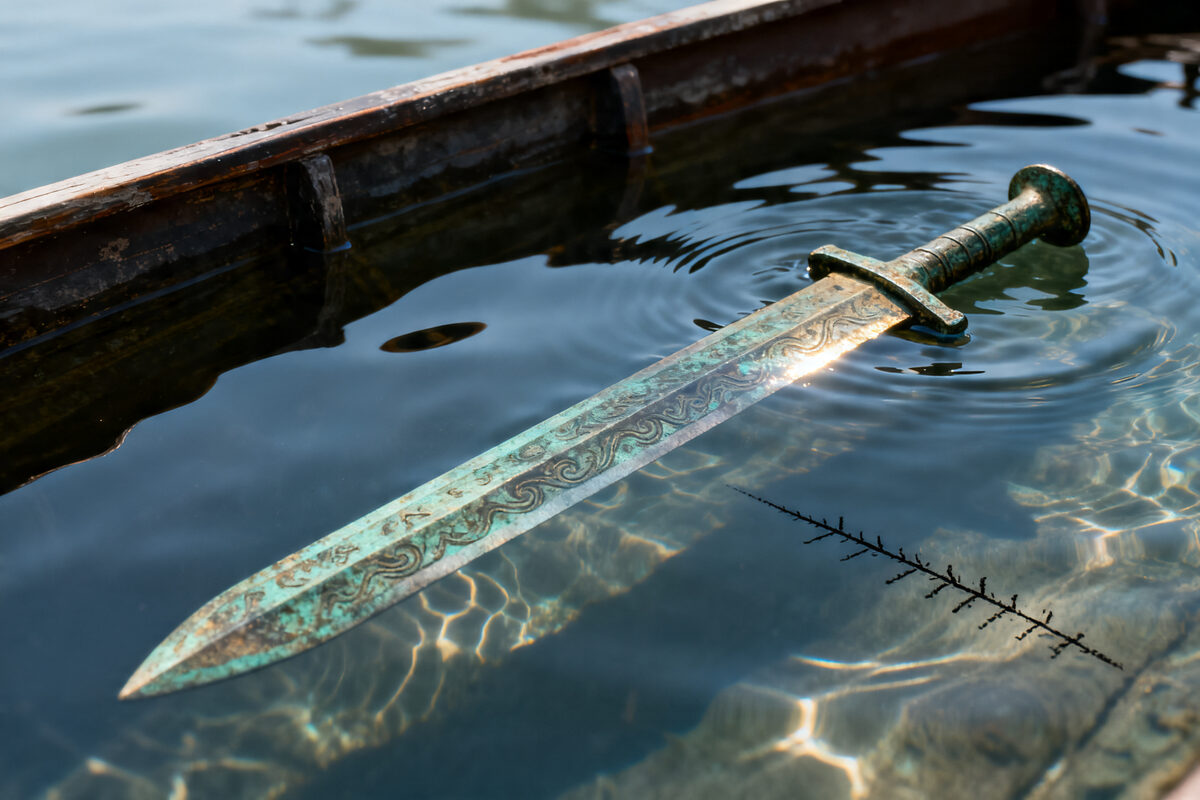
The Sword on the Ferry
Once, a man boarded a ferry to cross a great river.
The day was calm, the water flowing gently eastward. He stood at the bow, a cherished sword hanging at his waist.
Midway across, the boat gave a sudden lurch.
The sword slipped from its sheath and with a sharp splash, sank into the deep water below.
The other passengers urged him: Jump! Dive in now — you might still retrieve it!
But he, unhurried, drew a small knife from his robes and carefully carved a notch into the gunwale.
A bystander stared in disbelief: What are you doing?
He smiled, confident and composed:
"My sword fell from right here. I've marked the spot. When the boat reaches shore, I'll dive in from this mark and find it for certain."
The boat sailed on.
The green hills on either bank slid slowly backward. The river never stopped flowing.
He sat by the gunwale, glancing at his notch from time to time, waiting patiently.
The boat finally reached the far shore.
He stood up, leaped from the marked spot, and plunged into the water.
He felt along the riverbed, searching again and again.
Nothing.
The boat had traveled dozens of li downstream. But the sword remained where it had fallen, motionless in the mid-river silt.
He stood in waist-deep water, thoroughly bewildered.
The people on shore roared with laughter.
The Buddha's Gaze
This story comes from the Hundred Parables Sutra, told by the Buddha to help his disciples understand attachment.
The Buddha said: You laugh at him, yet every one of you is this same man, marking the boat.
The boat represents the passage of time — everything flows in impermanence, never pausing.
The sword represents our past experiences, memories, emotions, and fixed ideas.
The notch we carve is our clinging to unchanging views:
"This is how things should be done."
"He loved me then, so he must love me still."
"This method worked before, so it will work again."
The boat has long since moved on. The water is no longer the same water.
Yet we cling to the gunwale, staring at the notch, believing it to be the fixed coordinate of our world.
We Are All on the Boat
Think about it — how many times have we used yesterday's experience to handle today's life?
"This worked before." — But the circumstances have changed.
"He used to treat me this way." — But the person has changed.
"This is how I succeeded before." — But the moment has passed.
We cling to the marks of the past, forgetting that the river flows, the boat moves, and everything changes.
Impermanence is not pessimism. Impermanence is simply the truth.
To see impermanence is to let go of attachment. To let go is to truly live in the present.
This doesn't mean you cannot learn from the past.
It means: do not treat past experience as eternal, unchanging truth.
Experience is the sword — it has fallen into the river of time. You may remember it, but do not expect it to wait for you at the spot you marked.
Reflections
-
Is there a "notch" in your life — something you keep diving back to find? Is it still where you left it?
-
If everything is changing, on what should we build our sense of security?
-
Letting go is not forgetting. Can you carry gratitude for the past, while gently turning to face the river of this moment?