A Friend Asked Why I Look Better Lately. I Said: I've Been Standing Still.
An 80-year-old TCM doctor taught me zhan zhuang — Chinese standing meditation. I didn't believe it at first. How can standing still heal anything? After 100 days, my insomnia is gone, my hands are warm, my temper softened. This is my honest record of those hundred days.
A Friend Asked Why I Look Better Lately. I Said: I've Been Standing Still.
Where It Began
A friend saw me a while back and said, "You look better lately. What have you been doing?"
I had to think for a moment.
Because I really hadn't done anything special. No supplements, no facials, no new skincare. The only thing that had changed was that every morning when I got up, I would stand on the balcony and do nothing. Just stand there.
Fifteen minutes.
Sometimes twenty.
It's called zhan zhuang. Standing pole. Standing like a tree.
The First Time I Heard About It
I first heard about zhan zhuang from an old Chinese medicine doctor.
At the time, I had severe insomnia. I couldn't sleep night after night, and I was groggy all day. I went to the hospital, and they couldn't find anything wrong. The doctor said I had "vegetative nervous system dysfunction," prescribed some vitamins, and told me to "relax."
Relax. Of all the useless advice you can give an anxious person, "just relax" has to be the worst. It's like telling a drowning person, "Don't panic."
A friend introduced me to an old doctor—eighty-something years old, still seeing patients himself. He took my pulse, looked at my tongue, asked a few questions, and said, "You're not sick. You're deficient. Qi and blood, both deficient."
I figured, okay, then I need to supplement them.
He said, "No medicine. Go home and stand."
"Stand where?"
"Zhan zhuang. Just stand. Don't move."
I was skeptical. Standing still can cure things? Isn't that just daydreaming? Do I need someone to teach me how to daydream?
But he looked at me with this calm look, as if to say: Just try it. You'll see.
Day One
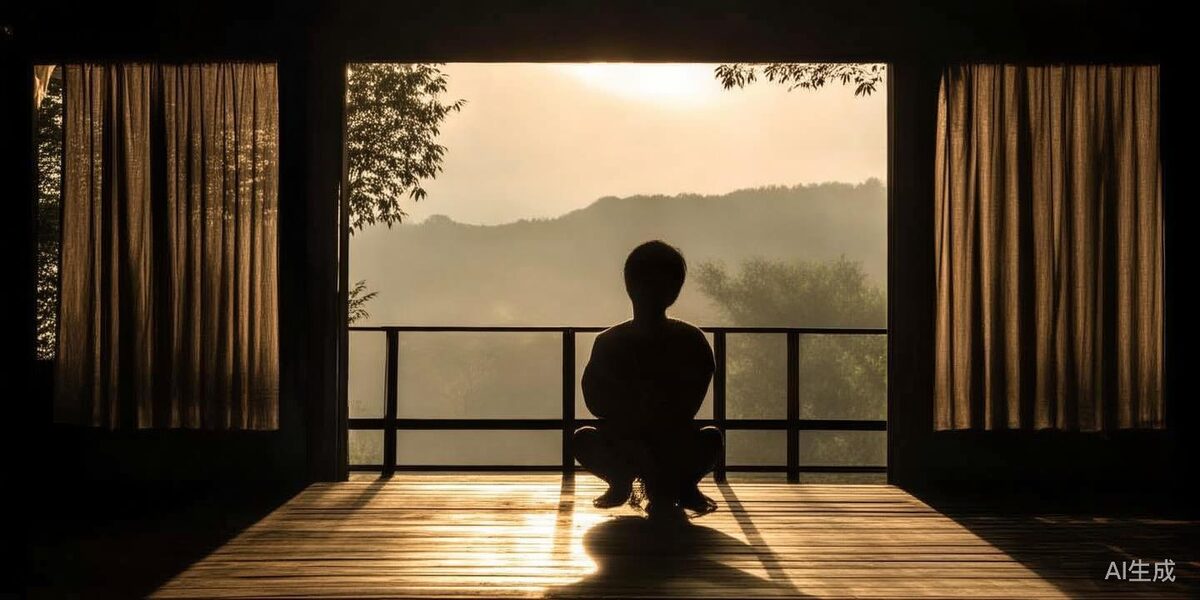
I went home and did what he said. I stood on the balcony.
Feet shoulder-width apart. Knees slightly bent, as if sitting on an invisible chair. Hands held in front of the chest, as if cradling a large ball—even though there was nothing there.
Then—do nothing.
Just stand.
For the first five minutes, I felt quite fresh. Sunlight came through the window. I could hear the breakfast shop downstairs calling out. Birds were singing. I thought, this is nice. Like being on vacation.
At minute six, things changed.
My legs started to ache. The muscles just above my knees trembled faintly.
And my mind started throwing up all kinds of thoughts: Did I reply to that email? What am I going to say at the afternoon meeting? Is the milk in the fridge about to expire? My mom called last week and I didn't pick up—should I call her back now?
One thought after another, like a pot boiling over.
I almost quit. But I remembered the old doctor's words: "Just try it. You'll see." So I gritted my teeth and kept standing.
Around minute twelve, something strange happened.
The thoughts were still there, but I wasn't chasing them anymore. They'd pop up in my mind and then dissolve on their own, like soap bubbles.
My legs still ached, but inside the ache there was a strange heat. Not burning—warm. Rising slowly from the soles of my feet, up through my calves, up through my thighs.
By minute twelve, my palms were sweating.
I hadn't done anything—just stood there—and yet I was covered in sweat.
Not the heavy sweat of running, but a fine, dense sweat seeping out from my back, my palms, my forehead.
At minute fifteen, I stopped.
The feeling in that moment—how do I describe it—something inside me had loosened. Not my muscles. Something deeper.
I stood on the balcony, looking down at the breakfast shop, and the morning sunlight seemed brighter than usual.
One Hundred Days
So I started standing every day.
At first fifteen minutes, then twenty, then thirty.
There was a stretch when I was really diligent—up at six to stand, then again before bed. Later, when I got busier, I just did the morning session.
As of today, it's been about a hundred days.
In those hundred days, I've noticed some changes.
First, I sleep better. Not the "knocked out by a pill" kind of sleep, but genuine tiredness, natural sleep. I lie down and drift off after a while. And when I wake up, I'm actually awake—not groggy.
Second, I'm less sensitive to cold. I used to have freezing hands and feet. In winter, I'd wear socks to bed. After about a month of zhan zhuang, I noticed my hands were warm. Not warm from being covered—warm from the inside out.
Third, I'm less short-tempered. This is what my wife said. She said I used to be impatient, but now I seem "half a beat slower." I didn't notice it myself, but when she said it, I thought about it—yeah, maybe it's true. Things that used to set me off—traffic, long lines, someone saying the wrong thing—don't bother me as much anymore.
Fourth, the most embarrassing change. I used to have mild constipation—only every three or four days, and each time was painful. After zhan zhuang, it became once a day, every morning, smooth as if I'd become a different person.
I don't want to make this sound magical. I know these changes aren't necessarily "cured" by zhan zhuang. Maybe my overall state improved, and my body adjusted on its own. Zhan zhuang might just be a switch—a switch that lets the body return to its natural rhythm.
Why Standing Still Works
Later, I looked into it, trying to understand why "standing still" could be so effective.
Zhan zhuang has a long history. It originated as a foundational practice in martial arts. Martial artists say, "Practice forms without foundation, and by old age you'll have nothing." That "foundation" is largely zhan zhuang. Tai Chi, Xingyi, Bagua—they all require it. Shaolin too.
Later, a man named Wang Xiangzhai extracted zhan zhuang on its own and founded Yiquan (also called Dachengquan). He said zhan zhuang isn't an accessory to martial arts—it's the best health practice in itself.
After that, zhan zhuang became a wellness method recommended by many old Chinese medicine doctors and martial arts masters.
As for why it works, there are many theories. My own understanding is roughly this:
First, "song"—relaxation.
We modern people are tight in our bodies. Sitting in front of a computer all day, shoulders hunched, neck stiff, lower back collapsed. We don't even realize how tight we are.
When you do zhan zhuang, you deliberately relax. But this relaxation isn't collapsing—it's "loose but not slack." Knees are bent but not squatting; hands are cradling but not gripping. The whole body is in a state of "both tense and relaxed."
Slowly, you start to notice how tight you usually are. And you learn how to let go.
Second, "qi."
I don't want to make qi sound mystical. My understanding of qi is simply the flow of energy in the body. When your posture is right and you're relaxed, blood and energy flow more smoothly to where they need to go.
Chinese medicine says, "Where there is flow, there is no pain; where there is pain, there is no flow." Zhan zhuang might just be slowly clearing the places in the body that are blocked.
Third, "jing"—stillness.
This stillness isn't about the body not moving, but the mind not moving.
We have too many thoughts every day. Work, family, future, past, anxiety, fear... They buzz like flies, never stopping.
When you do zhan zhuang, your body is there, but you can't move. Thoughts will come, but you can't chase them—because you have to "guard" the body, feel the posture of standing.
Slowly, the thoughts decrease. Not gone—just fewer. You'll experience a very quiet kind of quiet. Not the quiet outside, but the quiet inside.
I think that "inner quiet" is the most valuable part of zhan zhuang.
Misconceptions
In these hundred days, I've taken some wrong turns.
The first misconception: chasing duration.
When I started, I thought "the longer, the better." Once I stood for forty-five minutes and my knees hurt for three days.
Later I learned: zhan zhuang isn't about how long, but how correct. With the right posture, fifteen minutes is enough. With the wrong posture, two hours just damages your knees.
Old martial artists say zhan zhuang should be "as if smiling, as if not smiling; as if needing to pee, as if not needing to pee." The first half means the face should be relaxed—like a smile but not quite. The second half... a bit awkward to explain, but roughly: the lower body should be loose, like you sort of need the bathroom but not urgently.
The second misconception: chasing perfect form.
I watched many videos about "standard posture." How high to hold the hands, how many degrees to bend the knees, where to point the toes. It made my head spin.
Then I realized: being too fussy makes you tense. The body is alive, not a machine. The essence of zhan zhuang is "song" and "jing"—not hitting a specific angle.
My approach now: set up the posture roughly, then put your attention on the breath and body sensations. Wherever feels tight, relax there. Don't obsess over angles.
The third misconception: chasing "qi sensations."
At a certain point in zhan zhuang, you'll have various "qi sensations"—hot palms, swelling body, something flowing... Some people online describe it in mystical terms, like "opening the Governor Vessel" or "opening the heaven eye."
I've experienced some of it. My palms do get hot, and sometimes my whole arms feel swollen. But I've stopped paying attention to it.
Why? Because the moment you chase these things, your mind is no longer still. You start thinking, "Why is the qi sensation so weak today?" "Did I stand wrong?"—and you're right back in anxiety.
Zhan zhuang is for relaxation and stillness, not for chasing sensations. When they come, let them come. When they go, let them go.
About the Fact That Foreigners Are Doing It Too
Recently I was scrolling through TikTok and noticed something interesting.
A lot of foreigners are practicing zhan zhuang.
There's an American military veteran who said he had PTSD, medication didn't help, but after trying zhan zhuang he slowly got better. In his video, he said with tears in his eyes: "This saved my life."
There's a British yoga instructor who'd practiced yoga for twenty years, stumbled upon zhan zhuang, and said, "Yoga is about stretching, but this is about being."
There's a German physical therapist who analyzed zhan zhuang from a biomechanics perspective and said the posture "activates the deep muscle chain"—something modern rehabilitation medicine is just starting to study.
When I saw these, I felt complicated.
On one hand, a little proud—this is from our ancestors.
On the other hand, a little ashamed. Because in China, zhan zhuang feels a bit "outdated." Young people think it's for old folks, for martial arts types. If that old doctor hadn't told me to try it, I might never have.
We're often like that. We don't value the good things around us until foreigners discover them. Then we look back.
How I Stand Now
I'll write down my method, for reference only. Every body is different—finding what works for you is what matters.
Time: After getting up in the morning, on an empty stomach, about fifteen to twenty minutes.
Place: Balcony or by a window—sunlight is best.
Posture:
- Feet shoulder-width apart, toes pointing slightly outward
- Knees slightly bent, not past the toes (important—otherwise you hurt your knees)
- Imagine your tailbone sinking down, as if sitting on a tall stool
- Hands cradled in front of the chest forming a circle, as if holding a balloon—not too tight (the balloon will pop), not too loose (the balloon will float away)
- Shoulders dropped, not hunched
- Chin slightly tucked, crown of the head as if lifted by a string
- A faint smile on the face—relaxed
Mind:
- Think of nothing, but don't force thoughts away
- When thoughts come, see them, let them go
- Rest attention on the breath, or on the sensation in the palms
- If somewhere feels tight (usually the shoulders), relax there
Finishing:
- Don't stop abruptly—slowly straighten up
- Rub palms together until warm, then wash the face, rub the neck, rub the lower back
- Drink a cup of warm water
Persistence:
- You don't have to do it every day, but try to be regular
- A little every day beats a lot once in a while
- If you're not feeling it one day, five minutes still counts
On Being Lazy
I have to admit one thing: zhan zhuang is especially friendly to lazy people.
Because you don't move.
No running, no jumping, no forced sweating (though you'll sweat in the end), no workout clothes, no gym, no equipment.
Just stand there.
My balcony is two square meters. That's enough. Pajamas, barefoot is fine (socks in winter).
Get up, drink some water, walk to the balcony, stand.
That's the main reason I've kept it up—it's so simple there's no excuse not to.
I've bought gym memberships before. Went three times and quit. Downloaded running apps. Ran twice and deleted them. But zhan zhuang—I've done it for a hundred days.
Maybe because it's not just "exercise." It's—how to put it—a way of being with yourself.
Those fifteen minutes every day are truly mine. No phone, no work, no family, no one else. Just me and my body, and the morning sun, and the calls from the breakfast shop downstairs.
In those fifteen minutes, I don't have to do anything. I don't have to be anything.
Just standing.
Just being.
The Old Doctor
Writing this, I suddenly think of that old doctor.
I went back to see him once, to thank him. He took my pulse, smiled, and said, "Your pulse is much better. Keep standing."
I asked him, "How many years have you been standing?"
He thought for a moment: "Over sixty years."
I was startled. Sixty years.
He said his master taught him. He started at around thirteen and has stood every day until now, at eighty-five. Never stopped.
I asked him, "What do you think is the most important thing about zhan zhuang?"
He said something I still remember. He said:
"It's not the posture. It's not the time. It's 'not fighting yourself.' Don't fight yourself, don't fight your body, don't fight your thoughts. The pole is dead. The person is alive. When you relax, it works."
I didn't fully understand then.
After a hundred days, I think I'm starting to.
Not fighting.
Not just during zhan zhuang. In life too.
We fight too many things. We fight our work, our kids, our partners, ourselves. We always think that if we just try harder, push longer, never give up, we'll get what we want.
But sometimes, when you let go, you actually go further.
That's the most important thing zhan zhuang has taught me.
A Few Questions
Before I end, I want to leave a few questions for you, if you've read this far:
1. When was the last time you stood and did absolutely nothing?
2. Is there somewhere in your body that's always been tight, and you never noticed?
3. If, starting tomorrow, you gave yourself fifteen minutes to do nothing—would you be willing to try?
You don't have to answer.
Just think about it.
Written one morning after standing. The sunlight was good.