Zhuangzi's Butterfly Dream: After Waking, I Can't Tell Dream from Reality
I had a dream last night. I became a butterfly. When I woke up, I thought of Zhuangzi from two thousand years ago — he had the same dream, and then asked a question people have been quoting ever since: was it me dreaming of the butterfly, or the butterfly dreaming of me?
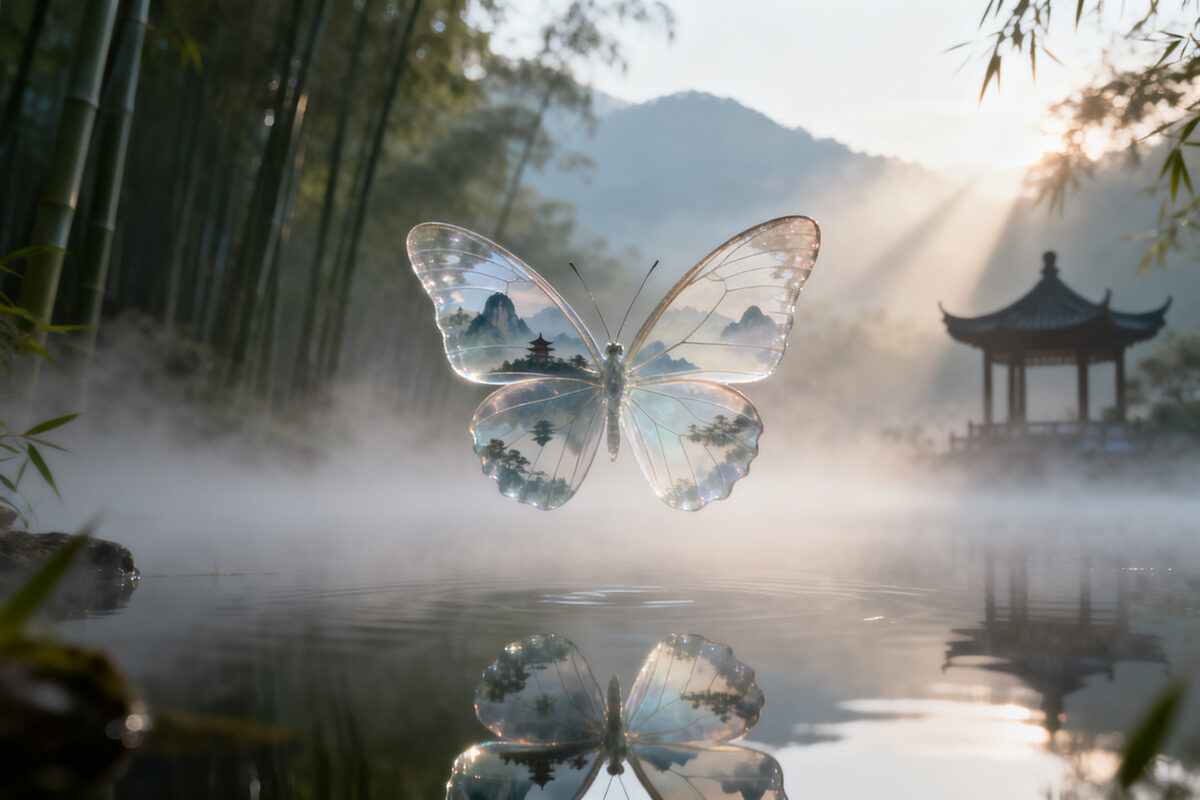
I had a dream last night.
In the dream, I was walking across a field of flowers. I can't remember what kind — just that the colors were pale, like they'd been washed in water. Then I looked down at my hands, except they weren't hands. They were wings. Thin, translucent, with delicate veins running through them.
I had become a butterfly.
The feeling was hard to describe. Not fear, not excitement. Something closer to... ease. No need to think about tomorrow, no need to hold on to anything. Just flying across that field, going wherever the wind carried me.
When I woke up, I sat on the edge of the bed for a long time.
Dawn was just breaking outside. Someone downstairs was walking their dog. A delivery truck rumbled in the distance. Everything felt real — more real than that field of flowers in my dream. But something inside me had shifted, like a pebble dropped into still water.
I thought of Zhuangzi.
More than two thousand years ago, on a morning much like this one, a minor official in Song — a man who tended the royal lacquer garden — had the same dream. He dreamed he was a butterfly, fluttering about, completely content. When he woke up, he sat there and said something that people have been quoting ever since:
"I do not know whether I was Zhuangzi dreaming I was a butterfly, or whether I am now a butterfly dreaming I am Zhuangzi."
The first time I read those words, I was in my early twenties. I thought it was a clever thing to say, but nothing more. When you're twenty, reality is reality and dreams are dreams. The line between them seems clear enough.
It's different now.
Not because I've read more books. Not because I've "awakened" to anything. Just because I've lived a little longer, been through a few things, and realized that this thing called "reality" isn't as solid as I once thought.
A while back, I went to a temple and spent an entire afternoon sitting in the courtyard in front of the sutra library. There's an old ginkgo tree there — they say it's three hundred years old. When the wind blew, the leaves fell one by one.
Watching those leaves, a question popped into my head: does this tree "know" it's losing its leaves?
Of course not. A tree is a tree. It doesn't think. It doesn't distinguish between what's real and what's illusion. It just stands there — budding when it's time to bud, shedding when it's time to shed.
But Zhuangzi was different. He insisted on asking: was it me dreaming of the butterfly, or the butterfly dreaming of me?
It sounds like a word game, but it touches something deep — how do we know we're not dreaming right now?
Don't laugh. I'm serious.
Have you ever had one of those moments — walking down a street, the sun warm on your face, when suddenly everything feels strange? Like you're seeing that tree for the first time, walking that street for the first time, noticing that the clouds are shaped exactly like that.
In Zen, they call this "beginner's mind."
Zhuangzi's butterfly dream is getting at something similar. When you genuinely start to wonder, "Is any of this real?" — that's when you start seeing more. Like how you think you know a place inside out, until the day you get lost and discover a hidden alley with a noodle shop that's been there for twenty years, with two pomegranate trees by the door.
I have a set of prayer beads, sandalwood. I've used them for years, and the surface of each bead has been worn smooth by my fingers. Sometimes, rolling them between my hands, I slip into a very quiet state. Nothing in my head at all — just the feeling of fingertips against wood.
At those moments, I feel more "real" than at any other time.
Funny, isn't it? Thinking about nothing, and feeling real. When I'm busy, rushing around, my mind full of plans and worries — that's when I feel like I'm sleepwalking.
Zhuangzi must have felt something similar. He had a dream. In the dream, he was a butterfly, and the butterfly knew nothing of Zhuangzi. It was simply a butterfly — alive, flying, untroubled by questions of identity.
Then he woke up, and he was Zhuangzi again — a man with a wife, a child, a job, and all the usual troubles. And he started to wonder: which one was real?
Maybe the answer is — neither. Or both.
There's a Zen koan that has something in common with Zhuangzi's butterfly dream.
A monk asked Zhaozhou: "All things return to the One. Where does the One return?"
Zhaozhou said: "When I was in Qingzhou, I had a cloth robe made. It weighed seven jin."
You ask an abstract philosophical question, and he tells you about a piece of clothing he had made. It sounds like a non sequitur, but what Zhaozhou was really saying was: stop floating around thinking about lofty things. Look down at what's right in front of you.
Zhuangzi's butterfly dream ultimately points in a similar direction.
He's not saying "nothing is real, so nothing matters." He's saying: since you can't tell the difference between dream and waking, you might as well be fully present in this moment. When you're Zhuangzi, be Zhuangzi. When you're a butterfly, be a butterfly.
That sounds simple. It's actually quite hard.
Because our minds are always running — thinking about the past, worrying about the future, comparing ourselves to others. Very few people can truly just be here, now.
I read more about Zhuangzi later and found him to be a fascinating person.
He was terribly poor. The King of Chu once sent messengers to offer him a government position. Zhuangzi was fishing by the river. He said to the messengers: "I've heard there's a sacred tortoise in Chu that's been dead for three thousand years, wrapped in silk and enshrined in the ancestral temple. Tell me — would that tortoise rather be dead and honored, or alive and wagging its tail in the mud?"
The messengers said: "Alive and wagging its tail in the mud, of course."
Zhuangzi said: "Then go away. I'm going to keep wagging my tail in the mud."
You see, this man was wide awake. It wasn't that he didn't understand power and wealth. He saw through all of it and chose the slowest, least impressive, most unremarkable path.
His butterfly dream wasn't him being profound for the sake of it. He was genuinely asking: in this one life we have, what is actually real?
All those things you chase — status, security, recognition — in the end, they might not be as real as those few minutes a butterfly spends flying over a field.
That sounds a bit bleak, but Zhuangzi isn't telling us to give up everything and become butterflies. He's saying something more like: don't take "yourself" so seriously.
This thing called "self" is fluid, always changing. The you of today is different from the you of yesterday. The you when you're happy is different from the you when you're sad. The you in a dream is different from the you awake. But through all these differences, is there something that stays the same?
Zhuangzi never gives an answer.
I think that's what makes him remarkable. A man from more than two thousand years ago asked a question and then honestly said: I don't know.
This morning, while making tea, the sound of the water boiling reminded me of that dream. Steam rose from the kettle's spout and caught the sunlight, forming a tiny cloud that dissolved after traveling a few centimeters.
In that moment, it occurred to me: the steam is real, the dream was real, and this person sitting here drinking tea is real too. There's no need to decide which is more real. They're all things that happened in my life.
Zhuangzi spoke of "transformation of things" — wuhua. Everything is constantly transforming. There's no hard boundary between butterfly and Zhuangzi, just as there's no hard boundary between that wisp of steam and the air.
I'm not Zhuangzi. I can't put things that beautifully. But I do feel that being alive is remarkable enough on its own. You become a butterfly. You become a person staring out the window. You become someone watching ginkgo leaves fall at a temple. You become someone holding prayer beads, thinking about nothing.
All of these are you. All of them are dreams. And none of them are quite just dreams.
By the time I finish writing this, full daylight has come. The person walking their dog has gone home. The delivery truck has moved on. There's a real butterfly on the windowsill — no, it's a moth, sitting there with its wings opening and closing.
I look at it, and it looks at me — well, it probably isn't looking at me. Moths don't have great eyesight.
But it's there, and I'm here, and this morning is real.
At least, this moment is.
A few questions, for myself and for you:
-
Have you ever had a dream that felt more "real" than waking life?
-
If you couldn't tell the difference between dream and reality, how would you spend "right now"?
-
Zhuangzi spoke of transformation — do you think the you of this moment and the you from ten years ago are the same person?