The Wounded Dog — Asanga and Maitreya
Asanga meditated in a cave for twelve years and saw nothing. Until one day, he met a wounded dog on the road. In that moment, he did something without thinking of the consequences.
Today I pulled an old book off my shelf. The pages have yellowed. I picked it up years ago at a temple's free distribution shelf. I flipped to a page and found the story of Asanga. I've read it more than once, but every time, something in my chest shifts a little.
Maybe because it's about something I find very hard to do.
Asanga was a practitioner in India, around the 4th century. He had a younger brother named Vasubandhu, who also became someone remarkable. But that came later.
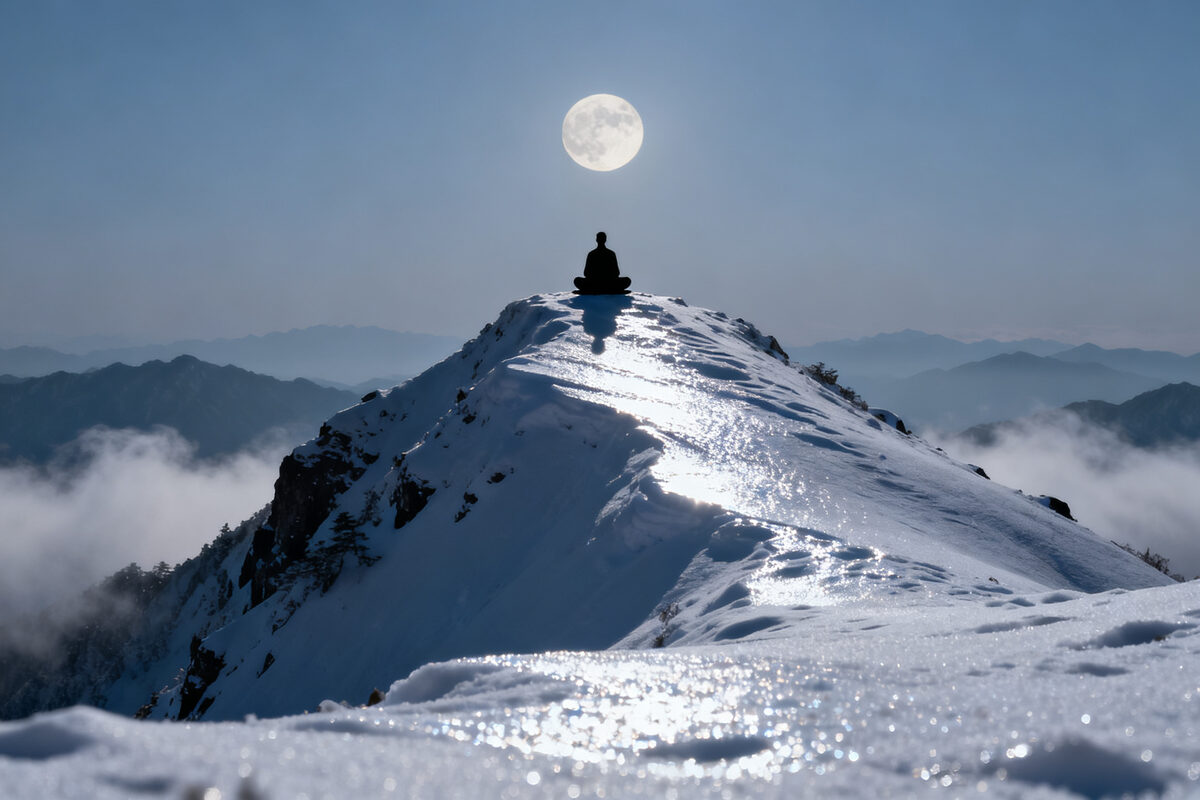
When Asanga was young, he left home to practice. He wanted to realize the state of Maitreya Bodhisattva. He wanted to see Maitreya face to face and hear the Dharma directly from him. So he went to a cave on Vulture Peak and began a long retreat.
He practiced for three years.
Three years. Every day sitting in meditation, reciting mantras, doing visualizations. Nothing happened. He didn't see Maitreya. No signs, no feelings, not even a single dream. The seasons changed outside the cave three times over, but inside, his heart was like a drum nobody came to strike.
He thought, maybe my karmic obstacles are too heavy. He left the cave.
Halfway down the mountain, he noticed a stone with a shallow groove in it. The groove wasn't deep, but it was smooth. He asked an old man passing by. The old man said someone had been rubbing that stone with a piece of cloth, day after day, year after year, until the groove formed.
Asanga stood there looking at it for a long time.
He thought: if someone can wear down a stone with a piece of cloth, is my determination really weaker than cloth?
He went back.
He practiced for another three years.
Still nothing.
Six years now. He left the cave. This time he really wanted to give up.
On the way down the mountain, he saw a man sharpening an iron rod. The rod was already quite thin, but it wasn't a needle yet. Asanga asked him what he was doing. The man said, I'm going to sharpen it into a needle.
Asanga didn't say anything. He stood there for a while, watching the man's focused movements. Then he turned around and walked back to the cave.
The third retreat. Another three years.
Twelve years. He had waited for nothing. No Maitreya, no light, no voice. He sat in the cave and thought, maybe this is just how it is. Some people simply don't have the capacity. No matter how much they practice, it won't come.
He gathered his things and walked out.
This time, he didn't meet anyone rubbing a stone or sharpening a rod. He didn't meet anyone. He just walked, out of the mountain, into the world of people.
If this were someone else's story, it might end here. Twelve years of practice, nothing to show for it. Go home, live a regular life. That's fine too.
But on the road, Asanga saw a dog.
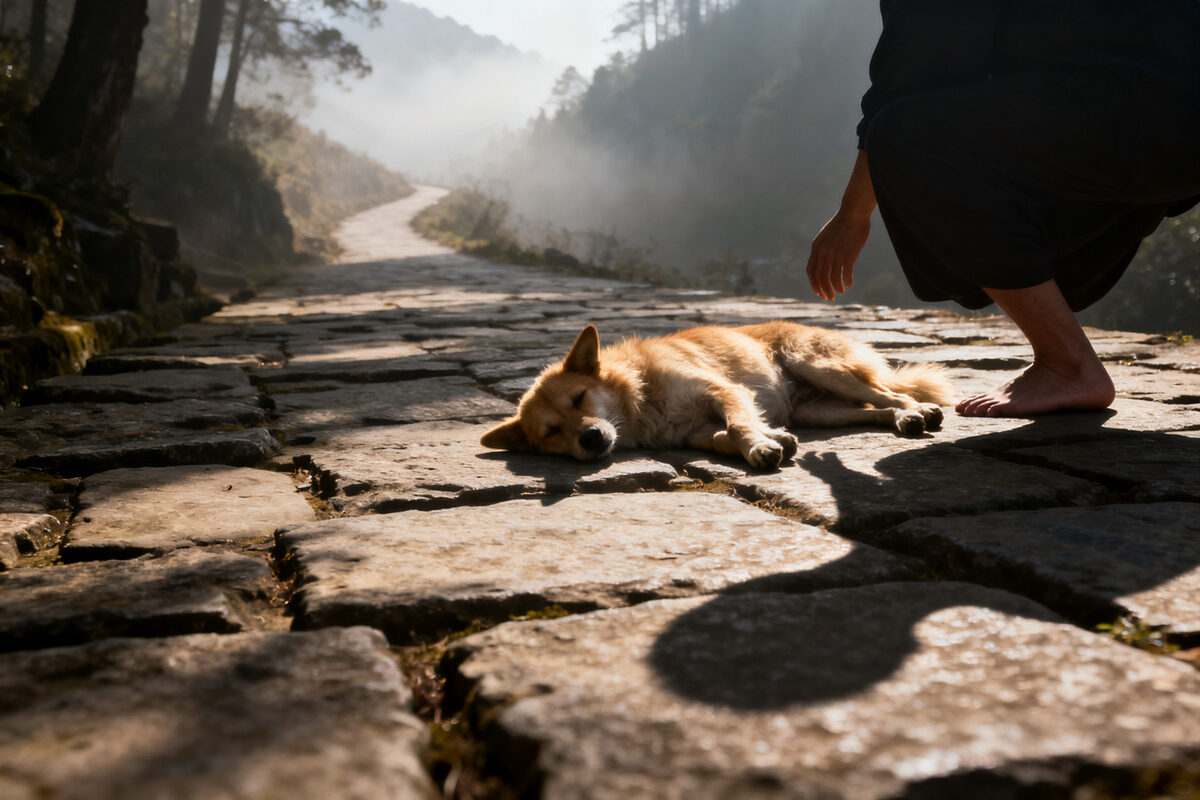
The dog was lying by the side of the road. Its body was covered with festering wounds, crawling with maggots. It couldn't move, but it was still alive. It looked at him. There was no resentment in its eyes. Just a quiet, weak gaze.
Asanga stopped.
He crouched down and looked at the dog. Maggots were eating its flesh. It was enduring a kind of pain I can't even imagine. He wanted to help. But if he used his fingers to pick out the maggots, he would hurt the dog's flesh. If he didn't, the maggots would keep eating.
He did something that makes me catch my breath every time I read it.
He took out the knife he carried with him, cut a piece of flesh from his own thigh, and placed it on the ground. Then he crouched down, leaned forward, and used his tongue to lick the maggots out of the dog's wounds, one by one, transferring them onto the piece of his own flesh.
He did this with his eyes closed. The taste, the sensation, the nausea of facing decay and suffering—he bore all of it.
His tongue touched the dog's wound.
In that instant—the dog disappeared.
Standing before him was Maitreya Bodhisattva.
Golden light filled the entire road. Maitreya stood there, looking at him with compassion, with gentleness.
Asanga cried. He said: I practiced for twelve years, and you never came to see me. Why?
Maitreya said: I was always right beside you. You just couldn't see me.
You couldn't see me.
Not because your practice wasn't enough. Not because your karmic obstacles were too heavy. But because there was still a barrier in your heart that even you hadn't noticed. You still had the thought "I am practicing" and "I want to see you." As long as that thought is there, you can't see.
Until just now. You forgot yourself. You forgot your practice. You forgot about wanting to see me. You only saw the dog's suffering. You only wanted to help it. In that moment, there was no "I" in your heart. Only compassion.
In that moment, you could truly see.
Asanga asked: If I can see you now, why can't others?
Maitreya said: Carry me on your shoulders and walk into the city. See if anyone else can see me.
Asanga actually hoisted Maitreya onto his shoulders and walked into the city. People on the street saw him. Some laughed, saying he'd gone mad, carrying nothing but air. Others couldn't see anything on his shoulders at all. Only one old woman saw a golden glow, but she just found it strange and didn't know what it was.
Most people couldn't see.
It wasn't that Maitreya wasn't there. Their eyes were covered by their own things.
After I finished reading this story, I sat there for a long time without moving.
Not because the image of the dog made me uncomfortable—though it did. But because I was thinking: if I were Asanga, could I do that?
The answer is no.
Forget about cutting my own flesh and licking maggots. When I see an injured stray cat on the street, I feel sad for a moment, then I walk away. I think "that's so sad" in my head, and then I keep going. Occasionally I'll buy a sausage and put it in front of the cat, but I won't crouch down and stay with it.
This isn't self-blame. It's just the truth.
But the story raises a question for me: Asanga practiced for twelve years—meditation, mantras, visualization—and got nothing. Then he encountered a rotting dog and did something without any thought of reward, and in that moment he received what he'd been seeking for twelve years.
What does that mean?
I don't think it means practice is useless. Those twelve years of retreat must have changed Asanga, making his heart softer and more open, even if he didn't notice. Like the stone that was finally worn down after three years of rubbing—the change was real, just too slow, so slow you'd think nothing was happening at all.
But it also says something: true seeing doesn't come from striving. It happens in the moment you forget you're striving.
Like how you can't fall asleep when you're trying desperately to sleep, but the moment you give up, get up, pour a glass of water, and sit by the window spacing out—sleepiness comes.
Compassion is like that too. It's not something you "practice" into existence. It's something that was already in your heart, just covered up by too many other things. When you forget all those other things, it naturally emerges.
Later I thought about what that dog really was.
Some people say it was Maitreya's manifestation. In other words, Maitreya had been testing Asanga all along—not a malicious test, but a kind of waiting. Waiting for his heart to truly open.
But I prefer another reading: the dog was just a real dog. A real injured dog, in real pain. Maitreya didn't deliberately turn into a dog to test anyone. Maitreya was always there, but when Asanga truly felt unconditional compassion for a real, rotting, abandoned dog that nobody wanted to go near—only then was his heart finally clear enough to see.
Not because the bodhisattva finally appeared. But because his eyes were finally clean.
I like both readings. The first makes me feel there's some kind of arrangement in the universe. The second makes me feel that compassion itself is the path to everything.
I'm writing this story down today for no particular reason. Just some things in my heart that wanted to come out.
Sometimes when I sit in meditation, my mind is full of noise. I think, maybe my karmic obstacles are too heavy. Maybe I'm not suited for this. Maybe I just don't have the capacity.
Then I think of Asanga. Twelve years. Nothing. He must have had these same thoughts. He must have doubted himself. He must have wanted to quit.
But he didn't.
Not because he was extraordinary. But because he saw that stone worn down by rubbing, saw that iron rod being sharpened into a needle, and something in him was moved. Not the fixation of "I must succeed," but the simplicity of "this path is right, I'll keep walking."
This is different from effort. Effort demands results. When Asanga finally licked that dog's wounds, he wasn't thinking "if I do this, I'll see Maitreya." If he had been thinking that, he wouldn't have seen anything.
He just felt sorry for the dog.
That's all.
If you've ever had moments like this—practiced for a long time and felt nothing, tried for a long time and nothing changed—maybe Asanga's story can offer you something.
Not hope. Hope is too heavy.
Maybe just a quiet comfort: the things you can't see might have always been there. You just can't see them yet. Don't rush. Keep walking your path. Maybe one day, in some unexpected place, in front of an injured dog, in something you're completely unprepared for—you'll suddenly see.
Three questions to sit with:
- When was the last time you completely forgot yourself and only saw someone else's pain?
- Are you also waiting for something that's always been there—you just can't see it yet?
- If there were an injured dog by the side of the road, what would you do?