Pang the Layman: The One Who Wove Bamboo Baskets, Practiced at Home
Pang was a lay practitioner in the Tang Dynasty who sank his fortune into the river and lived by weaving bamboo baskets. His daughter Lingzhao said: When hungry, eat. When tired, sleep. That is practice.
A few days ago, I was flipping through an old book and came across the story of Pang the Layman. I couldn't put it down.
Not because the story was particularly dramatic, but because this person reminded me so much of people I know — or maybe, of myself.
Pang lived during the Tang Dynasty. His family had money, land, and property. By today's standards, you'd call him "successful." What moved me most about his story wasn't some profound enlightenment experience. It was the fact that he was an ordinary person — a layperson, someone who had to deal with the same daily grind as the rest of us — and he managed to weave his practice into the fabric of his everyday life.
Sometimes I wonder: does practice have to mean going up a mountain? Sitting in meditation for hours? Shaving your head and wearing robes? I'm a lay practitioner myself. I get up early, chant for a while, and then it's off to work, off to cook. Some days I'm so busy I skip morning chanting altogether, and I feel a little guilty — like I'm "not devoted enough."
But Pang showed me it doesn't have to be that way.
A Family of Zen
The most famous stories about Pang involve his whole family.
Pang himself, his wife, and their daughter Lingzhao. A family of three (some versions say four, with a son), and every one of them was a genuine practitioner. Not the kind of "dad believes in Buddhism so everyone burns incense together" thing. Each person was truly putting in the work.
After his enlightenment, Pang made a decision that surprised everyone: he loaded all his family's wealth onto a boat, rowed to the middle of the river, and sank it all.
Everything.
Not a single coin left.
When I first read this, my reaction was — isn't that a bit extreme? But thinking about it later, maybe he wasn't "abandoning" anything. Maybe he was just making a clean break. It's like when your drawer is stuffed full of things you tell yourself you'll need someday, but really those things are weighing on your mind, keeping you from moving forward. Pang simply made a choice: he wasn't going to let those things hold him anymore.
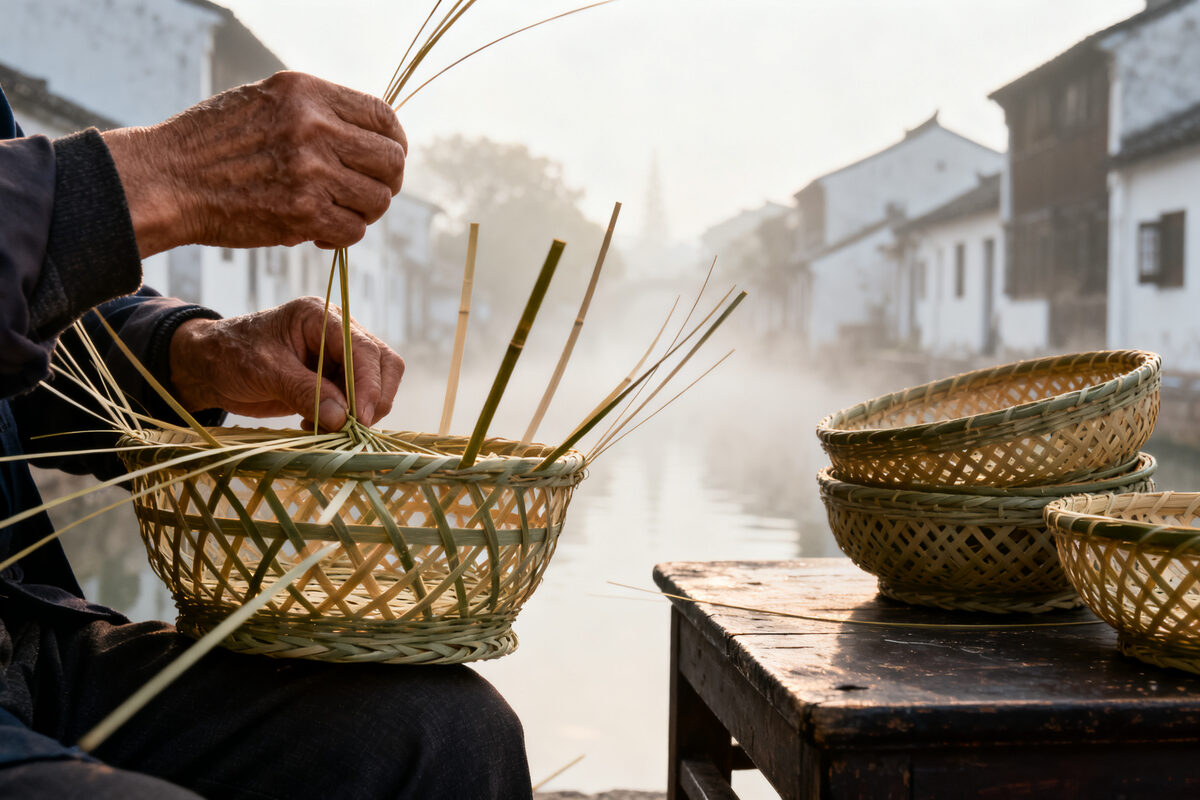
After sinking the money, how did the family survive? By making bamboo baskets. Pang wove them, and Lingzhao sold them. Life was modest, but it seems they were content.
Sometimes I imagine that scene: a small house, freshly woven baskets drying by the door, sunlight falling on the bamboo strips, catching fine lines of light. Pang sits there weaving, and nearby his wife is cooking. Nobody's in a rush to go anywhere. Nobody feels like something is missing.
That image brings me peace.
Lingzhao
Lingzhao, Pang's daughter, is my favorite person in the whole story.
She wasn't some grand Zen master. But she had a natural, effortless sharpness. Those complicated Buddhist concepts that scholars write whole commentaries about — she could cut right to the heart of them in a single sentence, and do it playfully.
Once, Pang sighed and said: "Difficult, difficult, difficult — like scattering ten loads of sesame seeds on a tree."
He meant: practice is so hard. Like trying to stick sesame seeds to a tree trunk — not a single one stays.
His wife overheard and said: "Easy, easy, easy — it's like closing your eyes when you lie down to sleep. Nothing to it."
Lingzhao, standing nearby, said: "Not difficult, not easy. When hungry, eat. When tired, sleep."
Hungry? Eat. Tired? Sleep.
I laughed when I read that. Not because it was clever, but because it's so incredibly simple — simple enough that we all do it every day, yet we never think of it as practice.
We always assume practice means something special, something extraordinary. When we meditate, we expect light, sensations, some deep state. But Lingzhao was saying: just eat when you're hungry, sleep when you're tired.
Sounds obvious. But think about it — how often do we eat while thinking about something else? How often do we lie in bed worrying about tomorrow? To eat when hungry, to sleep when tired — to do just that one thing, fully and simply — is actually not easy at all.
Pang's Last Lesson
There's a beautiful detail from Pang's final days.
He knew he was about to pass away, so he said to Lingzhao: "Go check the sun for me. Tell me when it reaches noon."
Lingzhao went outside, looked, and came back. "It's noon, but there's a solar eclipse."
Pang thought that was strange, so he got up and went to the window to see for himself.
In that moment, Lingzhao sat down in Pang's seat, put her hands together, and passed away.
When Pang turned around, he found his daughter sitting there, gone.
He smiled and said: "My daughter was faster than me."
He lived for a few more days, then passed away peacefully.
I read this story over and over. At first I didn't understand why Lingzhao did that. Later, I started to think maybe she wasn't competing with her father. She was showing him: to leave is to leave. No preparation needed, no waiting for the "right moment." You asked me to check the sun, and I did. You asked me to tell you the time, and I did. And then I did something even more direct.
And Pang's response — "My daughter was faster than me" — wasn't grief or regret. He smiled. It was the smile of a father who truly understood his child.
That smile moves me deeply.
Weaving Bamboo Baskets, and Coming Back to My Own Days
Back to my own life.
When I chant in the morning, my mind sometimes drifts. Thoughts float to today's work, yesterday's conversations, tomorrow's plans. I used to get so frustrated with myself, thinking I had "no concentration." Then I read about Pang and thought: when he was weaving baskets, didn't his mind wander too? Didn't he sometimes think about the wealthy days? Didn't a bamboo splinter catch his finger and make him think, "how annoying"?
Probably.
But practice doesn't mean never getting distracted, never feeling restless, never making mistakes. It means: when you drift, come back. When you're annoyed, notice you're annoyed. Then keep weaving the next basket.
I think that's what makes Pang extraordinary. He didn't hide in the mountains. He didn't cut himself off from the world. He sold baskets at the market, haggled with customers, came home, ate dinner, washed dishes, and then sat down to meditate. His practice and his daily life grew together — you couldn't separate them.
Sometimes I think the best practice might be this: whatever you're doing, do it well.
Cook when you're cooking — don't rush to finish. Walk when you're walking — don't rush to arrive. Talk when you're talking — don't rush to make your point.
That simple. And that difficult.
Questions for You
Writing about Pang today leaves me with a warmth I can't quite name. Not because he did anything earth-shattering, but because he makes me feel that the path of lay practice is walkable. You don't need to go to a mountain. You don't need to give up everything. You don't need to become someone else. Just be in your own days, weave your own baskets, live your own life.
If this resonates with you, maybe sit with these questions:
- What's the "bamboo basket" you're weaving right now? Where is your mind when you weave it?
- "When hungry, eat. When tired, sleep." — When was the last time you truly did either of those things with your whole attention?
- If you had to let go of something, what would be the hardest thing to release?
No right answers. Just something to sit with.
Ru Shi