Seven Purple Circles on My Back: My First Cupping Therapy
After three weeks of overtime, my back started protesting. My mom pulled out a bamboo cup inherited from my grandmother and gave me my first cupping session. Seven circular marks — purple, black, red, pink — like moons on my back, like a map of my body.
Seven Purple Circles on My Back: My First Cupping Therapy
It started last week.
Three weeks into a brutal work stretch, my back started sending signals. Not sharp pain — more like a dull pressure, as if someone was pushing a fist outward from the inside. I'd twist my neck — crack. Rotate my waist — crack. I remember thinking: I'm in my thirties, and I sound like a broken printer.
My mom came to visit, took one look at me, and said: "Your face is green."
I said, Mom, don't scare me, it's just the lighting.
She pulled me to the window, studied my face again, and said with absolute certainty: "It's not the lighting. You're blocked."
Blocked. My mom has been using this word my entire life. When I caught a cold as a kid — blocked. Period cramps — blocked. Ate too much, stomach upset — blocked. For years I thought it was too vague, too unscientific. Blocked what? Blocked where? How can one word explain everything?
But then she reached into her bag and pulled something out.
A bamboo cup. Shorter than a tea cup, round mouth, edges worn smooth. The color had deepened with age — it was old. Old because she'd inherited it from my grandmother. I'd seen it as a child and always assumed it was a tiny kimchi jar.
"Lie down," she said.
I lay face down on the bed, resistant.
I'd seen foreigners try cupping on TikTok. A muscular blonde blogger, seven cups on his back, his expression morphing from "what the f—" to "actually… that feels… okay." The comments were a wall of amazement: What is this suction therapy? Voodoo? Ancient magic?
None of the above. It's something much simpler.
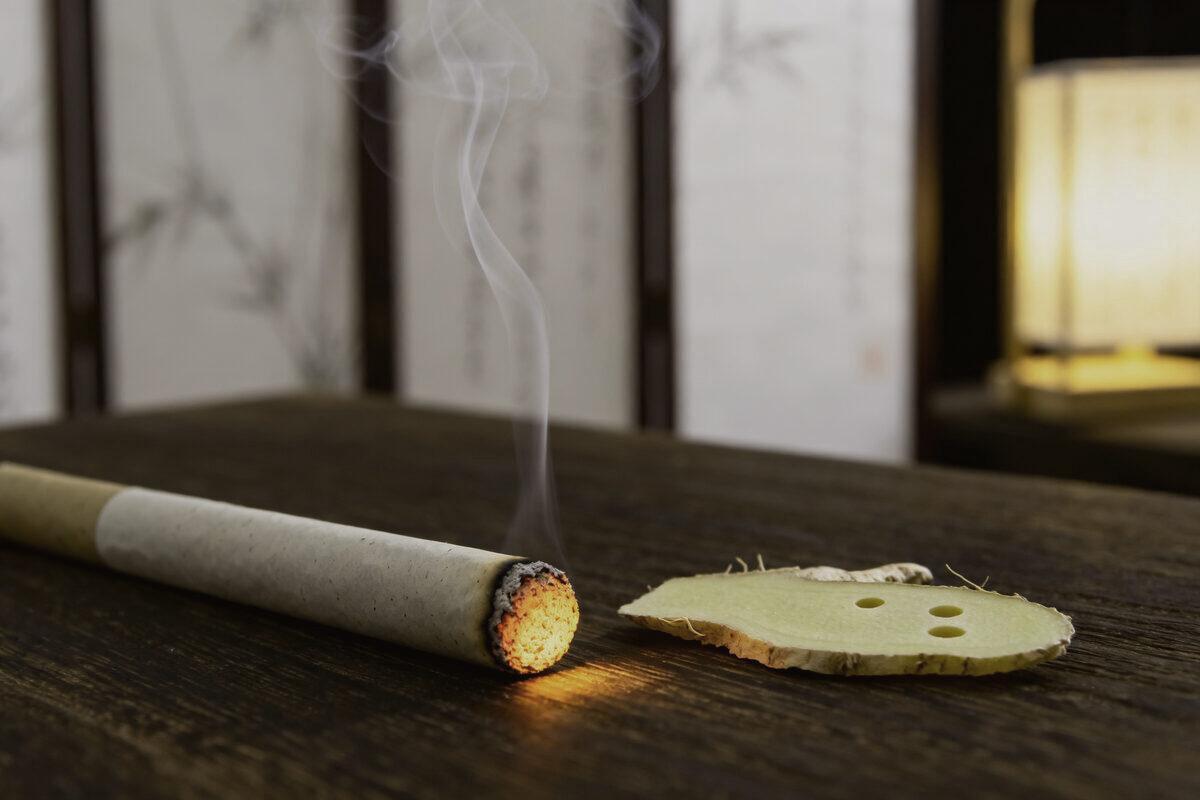
My mom used a lighter to heat the inside of the bamboo cup — I later learned this is called "flash fire." The flame burns away the oxygen inside, creating a vacuum when the cup cools against the skin. The principle is basically the same as the Magdeburg hemispheres experiment from physics class — except those were made of copper, and my mom's is made of bamboo.
When the first cup landed on my back, I hissed.
Not from pain. From a strange, unfamiliar pulling sensation. Like someone reaching under your skin and gently tugging outward. Or like a hand slipping inside and slowly drawing out whatever had been stuck there.
She placed them one by one. I had no idea which acupoints she was targeting — I looked them up later: Jianjing, Dazhui, Fengmen, Feishu, Geshu. At the time, all I felt was the slow accumulation of warm points on my back, like someone playing chess on my body, each piece landing exactly where it should.
After placing them all, she told me to stay still for fifteen minutes.
Those fifteen minutes were strange.
At first my mind was racing — work, deadlines, unread messages. But gradually, the thoughts quieted. Not driven away — soothed. Settled by that steady, warm pull. I heard my breathing slow down, deepen. Wind moved the curtain. My mom sat beside me, scrolling her phone, quiet as a shadow.
When the time was up, she removed the cups one by one.
"The color is a bit dark," she said. No alarm, just observation. She took a photo and showed me.
I looked at the photo — seven circular marks on my back. Different shades. The two darkest were purplish-black, right at the junction of neck and shoulder — the exact spot that had been hurting for weeks. The medium ones were dark red. The lightest, near my lower back, were barely pink.
"Purple means the blockage is deep," my mom said. "Red is okay. Pink means it's not really blocked."
I stared at that photo for a long time.
Seven circles. Like seven moons arranged across my back. Different shades — a map of my body, marking where things had accumulated and where things still flowed.
I realized the logic was actually quite beautiful.
Not the Western approach of "this number is too high, that number is too low." Not "you have X disease, take Y pill." Something more intuitive, more gentle — your body is speaking, and the cups help translate. Those dark purple marks were my shoulders — three weeks of overtime — saying: Here. This is too full. It's been full too long. So full it's turned purple.
My mom looked at the marks and said something very simple: "Your job is too intense. People are made of water, and water needs to move. When water stops flowing, it becomes dead water. Dead water, given enough time, starts to rot."
I didn't think much of it then. But later that night, lying in bed after a shower, I remembered Zhuangzi's line: "Running water never goes stale; a door hinge never gets worm-eaten."
What my mom called "blocked" wasn't just physical. It was emotional. It was about life itself.
The next day at work, a colleague saw the marks peeking above my collar in the pantry and gasped: "Were you attacked by an octopus?"
I said, it's cupping.
"I heard that hurts."
I thought for a second. "It doesn't hurt, actually. It's more like… someone gently unclenching a fist you've been holding tight for too long. One finger at a time."
She nodded, half-understanding.
Later that afternoon, she came by my desk and whispered: "Those bamboo cups — can you buy them online?"
I smiled.
A few things I've learned since then.
Cupping isn't exclusive to China. Ancient Greek, Egyptian, and Middle Eastern medicine all had similar practices. Hippocrates — yes, the Hippocrates of the oath — wrote about using cups to draw out harmful substances. So this isn't any single culture's invention. It's a very old human instinct: that layer between skin and muscle, the in-between place, needs care.
But Chinese medicine gave it its own language.
In TCM, cupping works by "promoting the movement of qi and blood, dispelling wind and cold, unblocking meridians." In plain terms: getting stuck things flowing again. When qi moves and blood moves, when wind and cold are drawn out, the channels open.
And the color of the marks means something:
- Purplish-black — cold and blood stasis, deep blockage, possibly old injury or chronic strain
- Bright red — heat, possibly inflammation or "internal fire"
- Dark red — circulation is okay-ish, but some stagnation
- Light pink — basically healthy, not much blockage at all
- Blisters — heavy dampness (be careful with these, don't pop them yourself)
My purple marks took about five days to fade. First they turned yellowish, then lighter, then disappeared entirely — as if my body had metabolized whatever was trapped there.
I've been thinking about something these past few days.
We modern people are so used to "fixing." Car breaks down, fix the car. Phone glitches, fix the phone. Body breaks, go to the doctor and get fixed — adjust the abnormal numbers back to normal range, then go back to the life that caused the problem.
Cupping isn't fixing. It's more like a conversation.
You lie there for fifteen minutes, quiet, and let a bamboo cup ask your body: Where have you been tight lately? Where is too full? Where has something been stuck so long that you forgot it was there?
The circular marks are your body's letter to you. The depth of color, the location — all saying things you've been ignoring for too long.
Before she left, my mom said: "You don't need to wait for me. You can do it yourself."
I said I don't know the flash fire technique.
"There are vacuum cups online now," she said. "No fire needed. But bamboo is still best. Fire has warmth. Air doesn't."
I looked it up later. There are indeed plastic cupping sets with a hand pump. Convenient, safe, easy for home use. But I think my mom is right — fire has warmth. That moment when the fire-heated bamboo cup first lands on your skin — warm, with a faint fragrance of bamboo kissed by flame — that's not something plastic can give you.
One last thing.
If you're reading this and want to try it, here are a few small suggestions (not medical advice — just sharing what I've learned from being cupped by my mom):
- Don't cup on an empty stomach. You might feel dizzy.
- Don't cup the same spot every day. Your skin needs recovery time — wait three to five days between sessions.
- Don't cup the same area again until the previous marks have fully faded.
- Don't shower immediately after cupping, especially not a cold shower. Your pores are open — cold will get in.
- If your marks are always light pink — congratulations, your circulation is great. Don't overthink it.
My back is clean now. The seven moons have all faded.
But I've started paying attention to something. Each time I'm working and my shoulders tighten, I don't just grit through it anymore. I stand up, stretch, rotate my neck, let that tension scatter.
Because my mom is right — you can't stay blocked too long. Not your body. And not your heart.
Three questions for you:
Is there a place in your body that's been tight, heavy, aching — and you've chosen to ignore it?
If a bamboo cup could help you "translate" your body, where do you think it would find the deepest knot?
When was the last time you stopped and listened to what your body was telling you?