My Mom Told Me to Soak My Feet Every Night. It Took Three Years to Understand Why.
From being held down as a kid to soak my feet, to finally boiling water myself — an ordinary person's journey to understanding Chinese foot bath therapy. Ginger, peppercorns, mugwort, safflower — not superstition, but real plant compounds at work.
My Mom Told Me to Soak My Feet Every Night. It Took Three Years to Understand Why.
I'll admit it — I was always slow to listen.
My mom started telling me to soak my feet when I was in elementary school. We had this plastic tub, red or blue, and she'd pour hot water in, then hold my ankles so I wouldn't squirm away. Too hot. Too boring. The moment my feet touched the water, I wanted out.
In college, dorm life — no tub, no space. Then my own apartment with a real bathroom, and still, every phone call home: "Did you soak your feet tonight?" "Yeah, yeah." I didn't.
What finally got me was last winter.
I came home after a long day, freezing. My toes were numb. I sat on the couch and didn't want to move, didn't even want to scroll my phone. Just sat there. Then my mom's voice floated back — the thing she always said: "If your feet are cold, how is your mind supposed to be still?"
I thought it was such a dumb thing to say. But that night, I actually went and boiled water.
Foot soaking is older than you think
I looked it up later. Turns out, soaking feet in hot water isn't some wellness trend in China — it's a daily practice that's been going on for at least two thousand years.
The Huangdi Neijing, the foundational text of Chinese medicine written over 2,000 years ago, says: "Yang energy begins at the surface of the five toes." The idea is that your body's warm, active energy — yang — starts from your feet and moves upward. The feet are where the body's meridians begin, and also where yang is weakest. Chinese medicine says cold enters through the feet. If your feet stay cold, the yang energy gets suppressed, circulation slows down, and over time, all sorts of things go wrong.
It's not superstition. Think about it — when your hands and feet are freezing in winter, don't you hunch up, look pale, feel tired, sleep badly? It's not just "you're cold." Your circulation is telling you the bottom of the road is blocked.
In the Jin Dynasty, a physician named Ge Hong wrote about using hot foot soaks to drive out cold. In the Song Dynasty, Su Dongpo — yes, the famous poet — had a daily routine: comb his hair hundreds of times in the morning, and soak his feet in hot water at night. He said it worked better than medicine.
A poet a thousand years ago, soaking his feet every night, probably thinking about how to improve the line he wrote that afternoon.
An old doctor's feet, and my mom's feet
A friend's father has been practicing Chinese medicine for over thirty years. At dinner once, we talked about foot soaking, and he said something I've never forgotten.
"You young people think soaking feet is something old folks do. But look at the people who live long — which one doesn't soak their feet every day? It's not that soaking makes them live longer. It's that they have a habit: every night, they stop, put their feet in hot water, and think about nothing. That 'thinking about nothing' time — that's the real medicine."
He also said modern people have too much in their heads. From the moment you open your eyes and grab your phone, to the moment you close them with a podcast still playing, your brain never truly rests. But foot soaking is different — you can't be anxious while soaking your feet. The warm water relaxes the nerves, your heartbeat slows, and your mind naturally empties.
He said he'd noticed that most of his patients who couldn't sleep had one thing in common: cold feet.
"People with warm feet rarely have trouble sleeping."
I sat there, sipping tea, and realized I'd never really listened to a Chinese medicine doctor before in my life.
Adding things to the water isn't superstition
When my mom soaks her feet, it's never just hot water. She adds different things depending on the "situation."
Like when I was recovering from a cold — she'd toss in a few slices of fresh ginger. Ginger is "warm" in nature, she'd say. It drives out cold and makes you sweat, pushing out the last bit of chill still hiding in your body.
When I was stressed and not sleeping well — a handful of Sichuan peppercorns. "Warming," she'd say, "enters the spleen and stomach meridians. Helps calm the nerves."
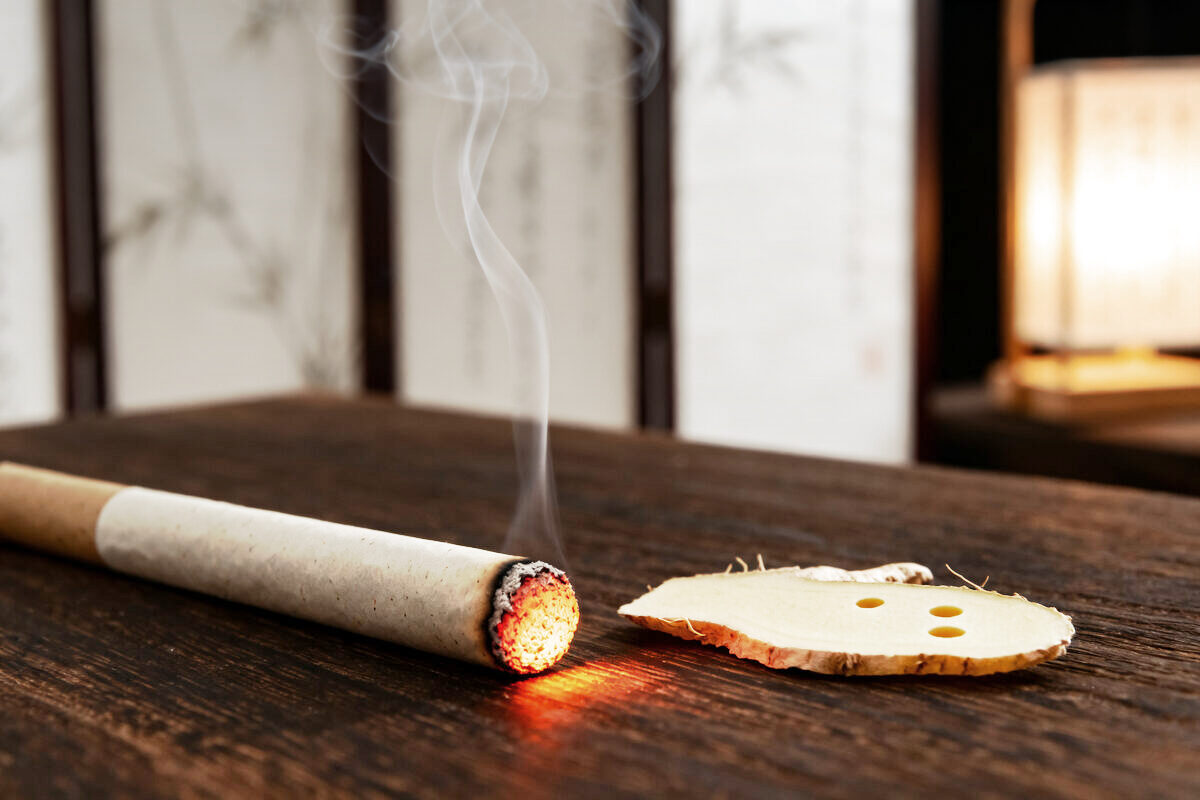
Sometimes mugwort — the dried ai cao left over from the Dragon Boat Festival. Mugwort is called the "king of herbs" in Chinese medicine. Warm in nature, good for warming the meridians and dispelling cold. I wrote about my first moxibustion experience before; after that, I started believing mugwort actually does something.
And something called hong hua — safflower — dried red petals that tint the water a faint crimson. My mom says it improves blood circulation, especially good for women.
I used to think these were just folk remedies. Then I looked them up —
Gingerol in ginger genuinely dilates blood vessels and promotes circulation. The essential oils in Sichuan peppercorn have antibacterial and mild anesthetic effects. Foot soaking with them does relieve fatigue. Mugwort volatile oils have warming and meridian-opening properties — documented all the way back in the Bencao Gangmu, the great pharmacopoeia of the Ming Dynasty. Safflower yellow pigment is a well-studied blood-activating compound in modern pharmacology.
These aren't mysterious forces. They're plant compounds doing real things, absorbed through warm water and skin.
But my mom doesn't know these terms. She just knows: cold, add ginger. Can't sleep, add peppercorns. For women, add safflower.
A thousand years of experience, compressed into one sentence.
A simple recipe
If you want to try, here's what I've been using. It's not a secret formula — just a combination that an ordinary person finds comfortable.
Basic version (nothing added): Hot water, around 40-42°C (104-108°F). Soak for 15-20 minutes, until your back feels slightly damp. Don't soak too long, and don't make the water too hot — some people think hotter is better, but scalding your feet red and swollen just damages the skin.
Sleep version (for when you can't sleep): A handful of Sichuan peppercorns (about 30g), or a small handful of dried mugwort. Toss into hot water and let it steep for 5 minutes before putting your feet in.
Cold-dispelling version (for when you're chilled or freezing): 3-5 slices of fresh ginger, smashed. If you're really cold, add a few cloves of garlic — though the smell isn't great.
Circulation version (good for women around that time of month): A pinch of safflower, or some slices of angelica root (dang gui).
My mom also has a "deluxe version" where she throws everything in. But for daily use, I think it's overkill — too many things and you can't tell what's actually working.
What I think about while soaking my feet
Honestly, at this point, foot soaking isn't about "wellness" for me anymore. It's more like a ritual.
Every night around nine, I boil water, pour it into the basin. Put my phone somewhere I can't reach. The moment my feet go in and the warm water rises over my instep, warmth floods up from the soles — like someone flipped a switch.
Then it's just quiet.
Sometimes I close my eyes. Sometimes I watch the steam curling off the water. Occasionally I think about the day, but most of the time, nothing.
Twenty minutes. Just right. Not too long, not too short.
Afterward, dry my feet, put on socks, get into bed. I fall asleep easily — not the kind where you're trying hard to fall asleep, but naturally, like water cooling down on its own.
I told a friend who'd been struggling with insomnia to try it. Three days later, he messaged me: "I'm not sure if it's a placebo effect, but for the first time in days I slept all the way to morning."
I replied: "Who cares if it's placebo. You slept."
Three questions for you
- When was the last time you actually noticed whether your feet were warm or cold?
- If you spent twenty minutes every night not looking at your phone, just soaking your feet — would the hard part be the habit, or putting the phone down?
- Of all the "old-fashioned" habits your parents told you about, was there one that was actually their way of caring for you?