“Drink More Hot Water”: The Laziest Words in Chinese, and the Medicine Behind Them
My American colleague asked why I drink hot water. My mom isn't a doctor — but behind her stands something a few thousand years old. Chinese medicine calls the stomach a stove, and ice water a block of ice dropped into the pot.
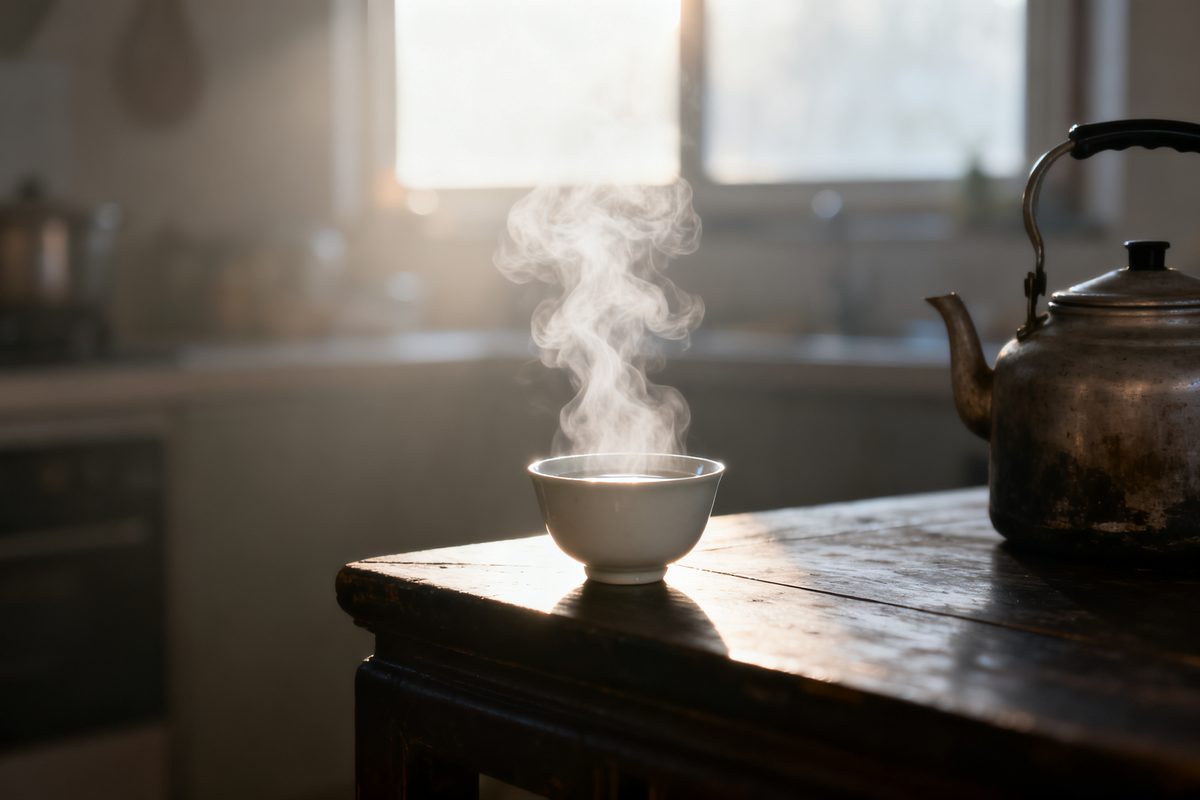
It was 3:30 in the afternoon, in the office pantry. My new American colleague watched me press the red button on the water dispenser and finally asked the question:
"Why hot water?"
He said he'd grown up on ice water. The ice maker in his family fridge never stopped. Sit down at any restaurant in America, and the first thing that lands on the table is a tall glass of water packed with ice. And there I was, holding a steaming cup, like some kind of riddle to him.
I told him honestly: I can't explain it. My mother taught me.
Three words, worn out
On the Chinese internet, "drink more hot water" is a joke. When a guy doesn't know what else to say to comfort his girlfriend, he falls back on those few words — and so they've become shorthand for not really caring, evidence that men are hopeless at this.
But in my family, those three words were not a joke. They were the family catechism.
Stomachache as a kid? My mom said it. Caught a cold? It. Soaked in the rain? It. Failed an exam? It. Crying? Don't talk yet — first, drink some hot water.
When I was little I thought it was the laziest answer in the world. Then I moved away, lived alone, and one winter my stomach acted up. I stood in the kitchen, and my first instinct was to boil water. The moment it boiled, I froze — those three words had already grown into me.
My mom isn't a doctor. But standing behind her is something a few thousand years old.
In Chinese medicine: the fire in the stove
In traditional Chinese medicine, the spleen and stomach are treated as the foundation of everything. There's a saying: they are "the root of acquired life" — meaning, after birth, everything you become is built from what you eat and drink, and all of it — water, rice, fruit — must be warmed and "cooked" by the fire in the spleen and stomach before it can turn into qi and blood.
Even water works this way.
When you drink a glass of ice water, your body can't use it directly. It has to heat that water up to body temperature first, and the fuel it burns to do that is what Chinese medicine calls yang energy. A simple image: you have a pot of soup simmering on the stove, and you drop a block of ice into it. The soup will still come to a boil — but only if you feed the fire more wood. The spleen and stomach are that stove.
The Huangdi Neijing, a medical classic over two thousand years old, puts it plainly: "When the body is cold and you drink cold, the lungs are injured." Anyone who starts coughing or sniffling right after drinking something iced — the ancients noticed them long ago.
In the Jin-Yuan period, a doctor named Li Dongyuan wrote an entire treatise on the spleen and stomach and placed them at the very center of medicine. He believed many illnesses began when this fire weakened. Later generations called his school the "Earth-replenishing school" — when the soil is rich, everything grows. And if you read through those doctors' instructions, they keep circling back to one sentence:
The stomach wants warmth.
When my mother's generation said "cold water hurts the stomach," it wasn't superstition. It was experience, passed down hand to hand through ordinary life. My mom never read Li Dongyuan. But she was saying the same sentence.
And the Western ice has a history too
Later I looked it up, and it turns out Americans drinking ice water isn't "natural" either.
In the early 1800s, a Boston merchant named Frederic Tudor had a business idea that sounded insane at the time: cut ice from frozen New England lakes and ship it to the Caribbean — even to India. The whole world laughed at him. Within decades, the ice trade was a serious industry, and once refrigeration arrived, ice became a fixture of the American home.
In that history, ice meant fresh, hygienic, modern, progressive. Ice water tasted like civilization.
And here's the thing: China's habit of drinking boiled water isn't ancient either. Hygiene campaigns in the 1930s, and later public-health movements, all pushed one message: drink boiled water. Boiling kills the germs — and in an era before treated tap water, that knowledge saved lives. "Drink boiled water" was written into school textbooks.
Which is what makes this so interesting —
Their ice meant clean. Our boiling meant clean. Two histories, two instincts. Neither was born this way, and neither is wrong.
Chinese medicine just added one more layer on top of that cup: not only boiled, but warm. The boiling was for the germs. The warm is for the stomach.
I'm not here to convert anyone
Honesty time.
I don't believe hot water cures everything, and I don't believe everyone who drinks ice water is wrecking their body. Western athletes take ice baths after games to reduce inflammation — that's their logic. Chinese medicine nurtures with warmth and doesn't startle the yang — that's its logic. Two languages describing the same body.
All I can speak to is my own experience: after all these years of warm water, I can't claim miracles, but my stomach genuinely complains less, and my hands and feet are less freezing in winter. Maybe half of it is placebo.
But comfort is the body's way of voting. It asks for warm, so I give it warm. That's probably my most practical attitude toward Chinese medicine: I don't ask it to explain the world. I only ask it to look after this one specific body of mine — the kind that gets cold, and gets tired.
The world is slowly finding its temperature
Here's the fun part: lately I keep seeing Westerners drifting toward warm water too.
On TikTok, people recommend a glass of warm lemon water first thing in the morning as a wellness secret. Thermos bottles sell better and better in the West — mostly for coffee, but still. Yoga teachers tell students to skip the ice water because it "puts out the digestive fire" — which sounds familiar, like it borrowed half from Ayurveda and half from Chinese medicine.
Last week I caught that American colleague of mine steeping goji berries.
He looked a little embarrassed and said: I'm doing it the Chinese way.
I smiled and didn't tell him that goji berries in a thermos is a meme back home too.
Coda
Eleven at night. My phone lit up. A message from my mom — the same three words.
It's getting cold. Drink more hot water.
That message used to annoy me. Now I get up and pour a cup first. The warmth in my hands, the steam rising, fogging my glasses — and in those few seconds when I can't see anything at all, a person is very quiet.
I imagine those three words will keep traveling. From my mother's grandmother, to my mother, to me. It isn't sophisticated. It isn't scientific. It's even a little clumsy. But it's the cheapest, realest care an ordinary person can offer.
A cup of hot water, while it's hot.
Three questions to leave with you
- When was the last time you drank a cup of hot water slowly — not to quench a thirst, just to drink?
- Does your family have its own three-word catechism? And who stands behind it?
- If your body could speak, what temperature do you think it's asking for today?