How to Choose a Five-Elements Crystal Bracelet: Don't Ask What You Lack — Ask What You Want
Crystals don't attract wealth or change your luck — I have to be honest first. So why do so many people feel they "work"? Forget "supplement what you lack." Five elements, five colors, one simple table: wear the reminder you actually want.
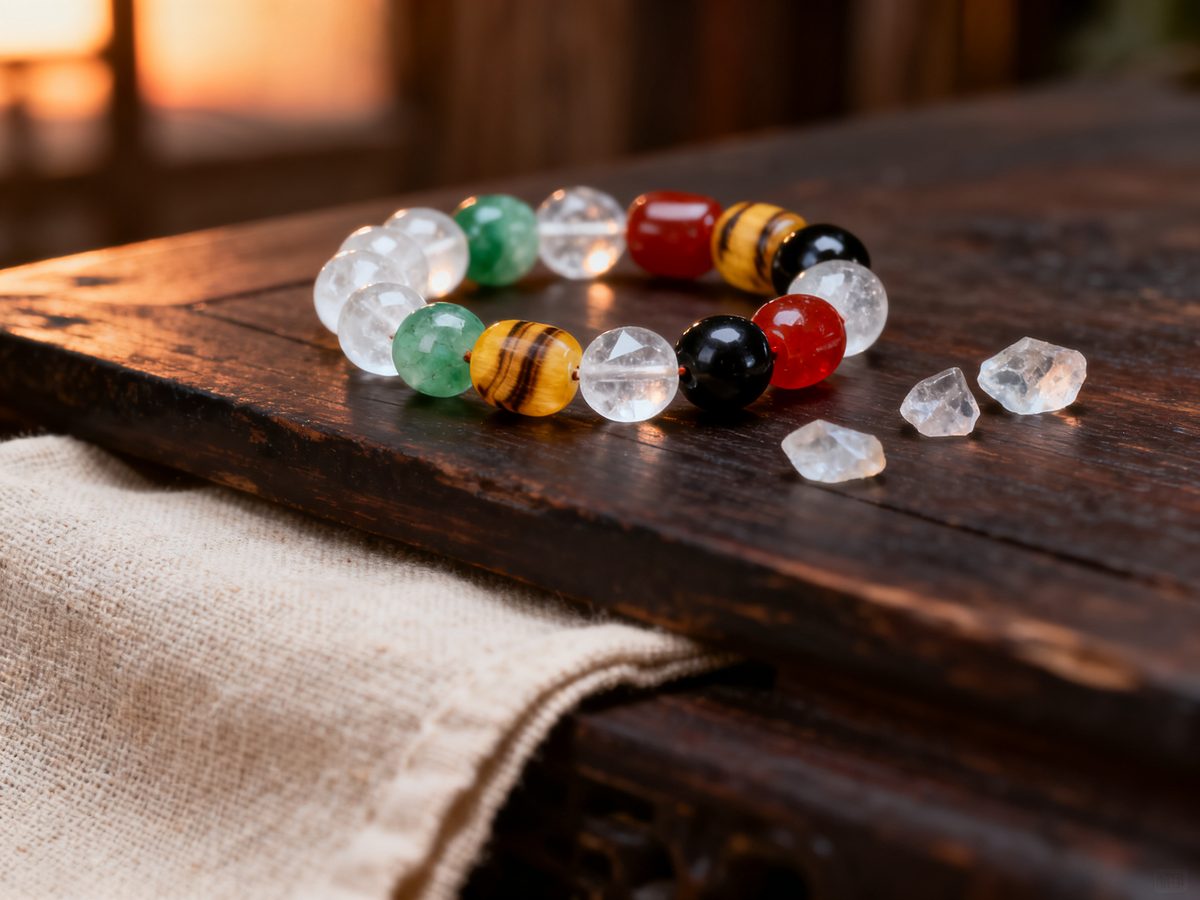
Today I'm wearing obsidian on my wrist.
I stood in the entryway for a while before leaving, and something occurred to me: I've worn many bracelets over the years, but I was never "matching an outfit" — I was "choosing a state of mind." When my thoughts are tangled, I reach for obsidian, something to help me sink. When things feel decent, white quartz, something to clear the air. There's no science behind it. I know that. But the small weight on my wrist does remind me of things.
A reader wrote to me a couple of days ago asking how to choose a five-elements crystal bracelet. She said she'd been reading online and only got more confused — one shop says a water deficiency needs black rutilated quartz, another says smoky quartz, and the comment section turned into an argument. She asked: could you write something that actually explains this?
I thought about it for two days. Instead of "how to choose," maybe I should start with "why."
(By the way, she was probably referring to the piece I wrote in June — "What's Your Element Missing?" That one was about understanding the idea. What she wanted this time was more concrete: okay, so how do I actually choose?)
First, let's be honest: this bead will not change your fate
I need to say this upfront, so you don't finish reading with one more thing to worry about.
Crystals don't attract wealth, don't turn your luck around, won't find you a partner, and won't make your boss like you. A crystal is a beautiful stone. That's all it is.
So why do so many people feel it "works"?
I once met an old woman at a temple who had been chanting for sixty years. The beads on her wrist had been polished bright by her thumb. I asked her: do you think the beads are magic? She laughed and said: the beads aren't magic. I chanted for sixty years, and the chanting produced a little quiet.
I've carried that answer with me for a long time.
The real function of a bracelet is the same as prayer beads — it's a reminder. The slight weight on your wrist nudges you when you're irritated, cools you when you're anxious. You raise your hand to check the time, you see it, you take one breath, and you remember: oh, I have other options.
So the "five elements" below isn't really about "fixing your luck." It's about picking yourself a reminder that fits.
What the five elements are: a very old personality typology
The five elements are Wood, Fire, Earth, Metal, Water.
It sounds mystical, but what the ancients were trying to say is quite plain: things in this world fall into five temperaments, which feed and check each other, turning in a circle to keep balance.
- Wood is growth. A spring tree, pushing upward, full of force and direction.
- Fire is radiance. The summer sun, bright, warm, impossible to hide.
- Earth is bearing. The ground — steady, generous, able to hold anything.
- Metal is refinement. Autumn — crisp, edged, about standards and order.
- Water is flow. Winter — clever, flexible, moving to low places, seeping into any crack.
They generate each other: Wood feeds Fire (wood catches flame), Fire creates Earth (ash becomes soil), Earth bears Metal (ore comes from the ground), Metal collects Water (condensation on cold metal — something the ancients observed), Water nourishes Wood (trees drink).
They also check each other: Wood breaks Earth (roots split soil), Earth dams Water, Water douses Fire, Fire melts Metal, Metal cuts Wood (the axe).
That's the whole system. Doesn't it feel like another version of a personality test? Some people are blazing Fire types, some are unhurried Earth types. Westerners use sixteen MBTI letters; the ancients used five characters. Both answer the same question: what kind of person am I, and who do I get along with?
The first time I saw this clearly, a friend was telling me about her MBTI type, and halfway through she stopped and said: wait — isn't this just the five elements? She's a Wood person: direct, quick to charge, allergic to anything sticky and slow — Wood controls Earth, and she can't stand Earth-type slowness. We both laughed.
It turns out the ancients finished the job of sorting people long ago, and along the way assigned each type a color and a stone.
Color is the language of the elements
Each element pairs with a color. This is the entire underlying logic of choosing crystals, and it couldn't be simpler:
- Wood → green, teal. Green aventurine, green phantom quartz, malachite, turquoise.
- Fire → red, purple. Red agate, garnet, amethyst, nanhong agate.
- Earth → yellow, brown. Tiger's eye, citrine, amber, smoky quartz.
- Metal → white, gold, clear. Clear quartz, moonstone, golden rutilated quartz, white agate.
- Water → black, blue. Obsidian, black rutilated quartz, aquamarine, lapis lazuli.
Memorize this table and no shop's marketing can spin you around again. When someone says a bracelet "attracts wealth," look at the color — yellow means Earth, gold means Metal. Earth stands for trust, Metal for principle; both have to do with "steadily building something." The spell breaks on its own.
But what about "which element am I missing"?
That's the real question everyone's asking.
The traditional answer starts with your birth chart: the year, month, day, and hour of your birth each carry a set of stems and branches. You count up the elements, see which is scarce or excessive, and then "supplement" accordingly.
But I have to be honest with you: I'd advise you not to rush into getting your chart read.
For one thing, very few people can actually read a chart well. A nine-dollar automated reading online is worth about nine dollars. For another, even if someone correctly tells you "you lack Water," lacking Water isn't necessarily bad — a birth chart is about balance and circulation, not fill-in-the-blank. For some people, the missing element is precisely the illness of their chart, and lacking it is a mercy.
So how should an ordinary person choose a five-elements bracelet? My own method is humbler, but I think more honest:
Choose by what you want, not by what you lack.
Look at the kind of days you're living, and wear that reminder:
- Restless, scattered, need to settle → wear Water: obsidian, lapis. That deep cool dark that looks quiet just to look at.
- Days feel gray, can't get moving → wear Wood: green aventurine, green phantom. The color of spring, reminding you things are still growing.
- Tired, easily rattled, want some backbone → wear Earth: tiger's eye, smoky quartz. An honest yellow, like four o'clock sunlight.
- Feel unheard, always pushed around → wear Metal: clear quartz, moonstone. Clean, crisp colors with boundaries.
- Too pent-up, holding too many words → wear Fire: red agate, garnet. A touch of vermilion, for when it's time to shine.
Seen this way, the crystal stops being "a fate assigned to you" and becomes "a suggestion you give yourself." The former breeds anxiety — if I lack this element and don't wear it, will bad things happen? The latter brings ease — I know what I want today.
What is a person with a bracelet actually wearing?
Back to the obsidian on my wrist.
A friend brought it back from a trip. It's nothing valuable, and one bead carries a natural grey-white streak, like a gap in the clouds. I don't wear it because someone told me I lack Water. I wear it because during that season, the voices in my head were too many, like a room full of people talking at once. Obsidian absorbs light into its black, and looking at it, the room seemed to quiet down a little.
Placebo? Maybe. But think of it this way: the human need for comfort is real. Gripping your wrist when anxious and taking a deep breath when anxious are the same act. Sliding prayer beads one by one, counting to a hundred, genuinely slows your heartbeat — what works isn't the bead, it's the small act of counting that pulls your attention out of the whirlpool.
So if you ask me how to choose a five-elements bracelet, my answer has three layers:
The first layer, the most honest one: choose the one that looks right to you. The color that feels comfortable at first glance is usually the color you need right now. Taste is more accurate than any algorithm.
The second layer: use the table above to match a color to the state you want. Wear what you want. It's an order you place for yourself.
The third layer, if you're genuinely curious about birth charts: find someone serious, and don't pull out your wallet in a livestream because a stranger said "you lack Water." With fortune-telling, better to not know at all than to half-know.
Beyond the bracelet
By the time I got here, it's dark outside.
I think of the reader who wrote in, probably frowning at a screen full of crystal names. I want to tell her: don't frown. The answer isn't in the shop, and it isn't in your birth chart — it's on your wrist. Whatever you want to see every time you raise your hand, that is the right choice.
The ancients sorted the world into five temperaments to understand themselves. We buy a stone and wear it on our wrist to understand ourselves. Thousands of years apart, doing the same thing.
The bead won't live your life for you. But the second it presses into your wrist — that second, you earned it yourself.
Three questions to leave with yourself:
- Without consulting any guide — what color of bracelet do you instinctively want to wear right now? What does that color say about the temperament you've been missing lately?
- Is there someone in your life who is unmistakably "one element" (an obvious Fire type, or a Water type)? When you're together, do you generate each other, or check each other?
- If you had to match one stone to your life as it is right now, which would it be? Why that one?