The Medicine Buddha Sutra: The Most "Practical" Buddhist Scripture — Health, Peace, and Fulfillment
The Medicine Buddha Sutra is the Buddhist scripture closest to everyday life. His twelve great vows cover health, prosperity, safety, and freedom from worry — nearly everything people wish for. It is not a promise about the afterlife, but a blessing for this life.
The Medicine Buddha Sutra: The Most "Practical" Buddhist Scripture — Health, Peace, and Fulfillment
Editor's Note
Most Buddhist sutras focus on liberation, awakening, and the afterlife — lofty and transcendent.
But one sutra is different.
It focuses on your life right now: physical health, material sufficiency, family harmony, freedom from disaster.
This is the Sutra of the Merit and Virtue of the Past Vows of Medicine Master Lapis Lazuli Light, commonly known as the Medicine Buddha Sutra.
Medicine Buddha — the teacher of the Eastern Pure Lapis Lazuli Realm — mirrors Amitabha Buddha of the Western Pure Land. One tends to the next life; the other tends to this one.
The Medicine Buddha Sutra is the most "down-to-earth" Buddhist text. It does not teach you to let go. It teaches you how to live well.
I. Who Is Medicine Buddha
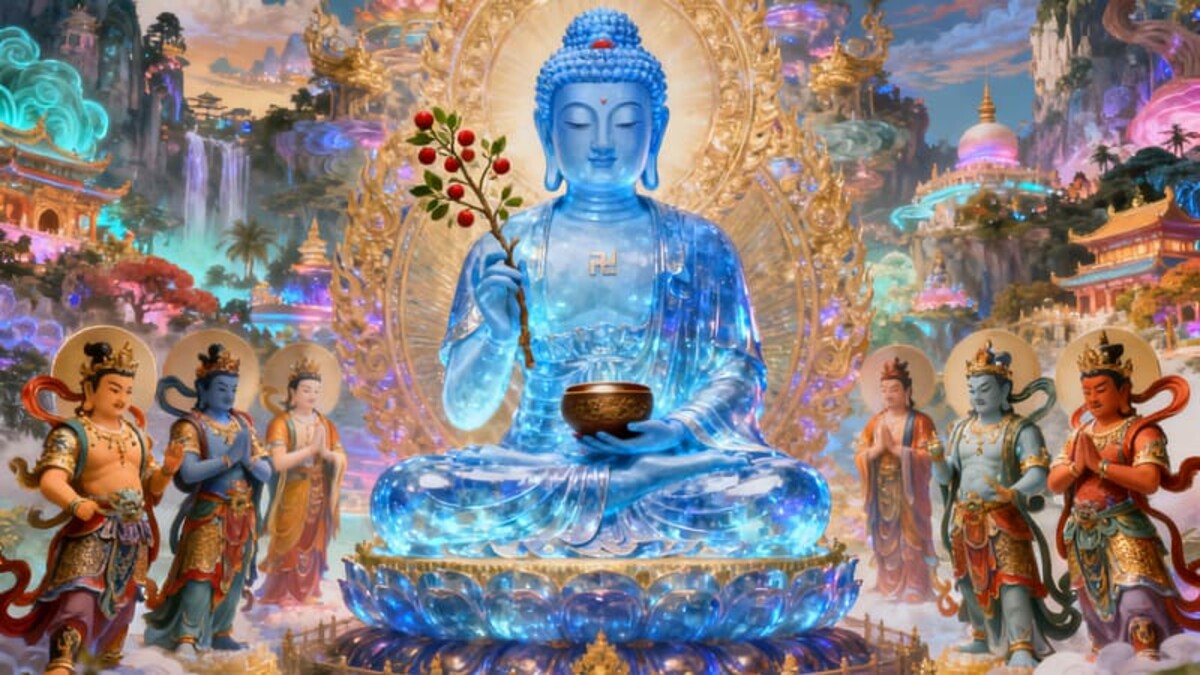
Medicine Buddha, fully named Bhaisajyaguru Vaidurya Prabhasa Tathagata, is the teacher of the Eastern Pure Lapis Lazuli Realm.
His image is a luminous blue (or lapis lazuli) color, symbolizing purity. He holds a medicine bowl in his left hand and a medicinal herb in his right — he is the "doctor" of Buddhism.
But Medicine Buddha heals more than physical illness. He treats three kinds of disease:
| Type | Meaning | Modern Equivalent |
|---|---|---|
| Physical illness | Diseases of the body | Physical health |
| Mental illness | Afflictions of greed, anger, and delusion | Mental health |
| Karmic illness | Consequences of past actions | Life circumstances |
Medicine Buddha's compassion: he cares not only about your soul, but about your body, your daily life, your every day.
II. The Twelve Great Vows of Medicine Buddha
Before attaining Buddhahood, Medicine Buddha made twelve great vows. Together, they encompass nearly everything people wish for in a good life:
| Vow | Content | Modern Need |
|---|---|---|
| 1st | Body radiant, inside and out clear | Physical and mental health |
| 2nd | Body like lapis lazuli, utterly pure | Purity and integrity |
| 3rd | Beings never lack necessities | Material sufficiency |
| 4th | Guide those on wrong paths | Life direction |
| 5th | Help beings maintain pure conduct | Self-discipline |
| 6th | Beings born with complete faculties | Physical wholeness |
| 7th | Beings free from illness and disaster | Health and safety |
| 8th | Women attain equal dignity | Equality and dignity |
| 9th | Beings freed from Mara's nets | Freedom from harmful influences |
| 10th | Prisoners and the condemned find release | Second chances |
| 11th | The hungry and thirsty find food and drink | Basic needs met |
| 12th | The poor find clothing | Living essentials |
Core spirit of the twelve vows: before you become a Buddha, let you live well first.
This differs from many people's impression of Buddhism. Buddhism is not only about "letting go" — it can also be about "receiving": health, safety, everything you need.
This is not greed. It is respect for life.
III. Why the Medicine Buddha Sutra Is "Practical"
1. It Acknowledges Human Needs
Many sutras emphasize "seeking nothing." The Medicine Buddha Sutra acknowledges: humans need food, clothing, and health. These needs are not shameful.
Medicine Buddha's vow-power fulfills these basic needs — then, when you are free from worry, you can pursue higher awakening.
Like the airplane safety instruction: put on your own oxygen mask first, then help others. Live well yourself first, then benefit others.
2. It Provides Concrete Methods
The sutra gives very specific practices:
- Recite Medicine Buddha's name — "Namo Bhaisajyaguru Vaidurya Prabhasa Tathagata"
- Make offerings — flowers, clean water, incense, lamps
- Observe the eight precepts — a short-term practice for one day and night
- Recite the sutra — 49 times
- Create an image of Medicine Buddha
- Light 49 lamps — symbolizing light dispelling darkness
Simple, concrete, accessible. Anyone can do them.
3. It Promises Benefits in This Life
Unlike sutras focused on the afterlife, the Medicine Buddha Sutra explicitly promises benefits in this life:
"One who recites this sutra, contemplates its meaning, and explains it to others — whatever they wish for, all will be fulfilled. Seeking long life, they obtain long life; seeking wealth, they obtain wealth; seeking position, they obtain position; seeking children, they obtain children."
Longevity, prosperity, status, children — these are humanity's most basic wishes across millennia.
The sutra does not call these wishes "attachments." It says: whatever you seek, practice well, act well, and you will receive it.
IV. Deeper Wisdom of the Sutra
1. Health Is the Foundation of All Practice
Buddhism teaches that a healthy human body is exceedingly precious.
Only with a healthy body and clear mind can you practice, help others, and realize life's value.
Taking care of your body is itself a form of practice.
A reminder for modern people: do not sacrifice health for other goals. Health is the foundation of everything.
2. Material and Spiritual Are Not Opposed
Some believe practice requires renouncing material comfort. The Medicine Buddha Sutra says: not necessary.
The third vow is "beings never lack necessities." Lack itself is suffering. Buddhism aims to end suffering, not create new suffering.
You can pursue material sufficiency while keeping a pure heart. What matters is that your mind is not controlled by material things — not that you have none.
3. The Ultimate Meaning of the Twelve Vows
On the surface, the twelve vows satisfy various human needs. At a deeper level:
Medicine Buddha wants every being to have the foundational conditions for practice.
- Health → energy to practice
- Material sufficiency → freedom from survival anxiety
- Safety → stable environment
- Mental clarity → possibility of awakening
Medicine Buddha's compassion: I will not ask you to be extraordinary from the start. I will first help you live well — and then you will naturally choose to become better.
V. Daily Practice
1. Morning Medicine Buddha Mantra
Each morning, recite the Medicine Buddha mantra seven times:
Om, bhaisajye, bhaisajye, bhaisajya, samudgate, svaha.
Then drink a glass of clean water, visualizing Medicine Buddha's lapis lazuli light purifying your body and mind.
2. Create a Small Shrine
Set up a small Medicine Buddha shrine at home — an image, a glass of water, a flower.
Change the water daily, light a lamp. This is not ritual — it is a reminder: I will take good care of my body and my life.
3. Vow + Action
The sutra emphasizes "making vows." You might vow:
"May I be healthy and energetic. May I use my health to do meaningful things."
Then act: regular sleep, healthy eating, appropriate exercise.
Medicine Buddha's blessing does not fall from the sky — it manifests through your own healthy actions.
A Final Thought
Among all Buddhist sutras, the Medicine Buddha Sutra is the most "gentle."
It does not demand you let go of everything, see through the mundane world, or achieve serenity.
It simply says: You want health, safety, prosperity, happiness? Good — I will help you. Live well first; the rest can come later.
This gentleness is the deepest compassion — because Medicine Buddha knows: a hungry person cannot understand emptiness. Someone in chronic pain cannot meditate.
Let you be well first. Then, you will find your own way.
Yi Yi Ru Shi · Eastern Aesthetics · Instruments for the Soul
Explore more Eastern wisdom through our mala bead collection — each bead a wish for your health and peace.