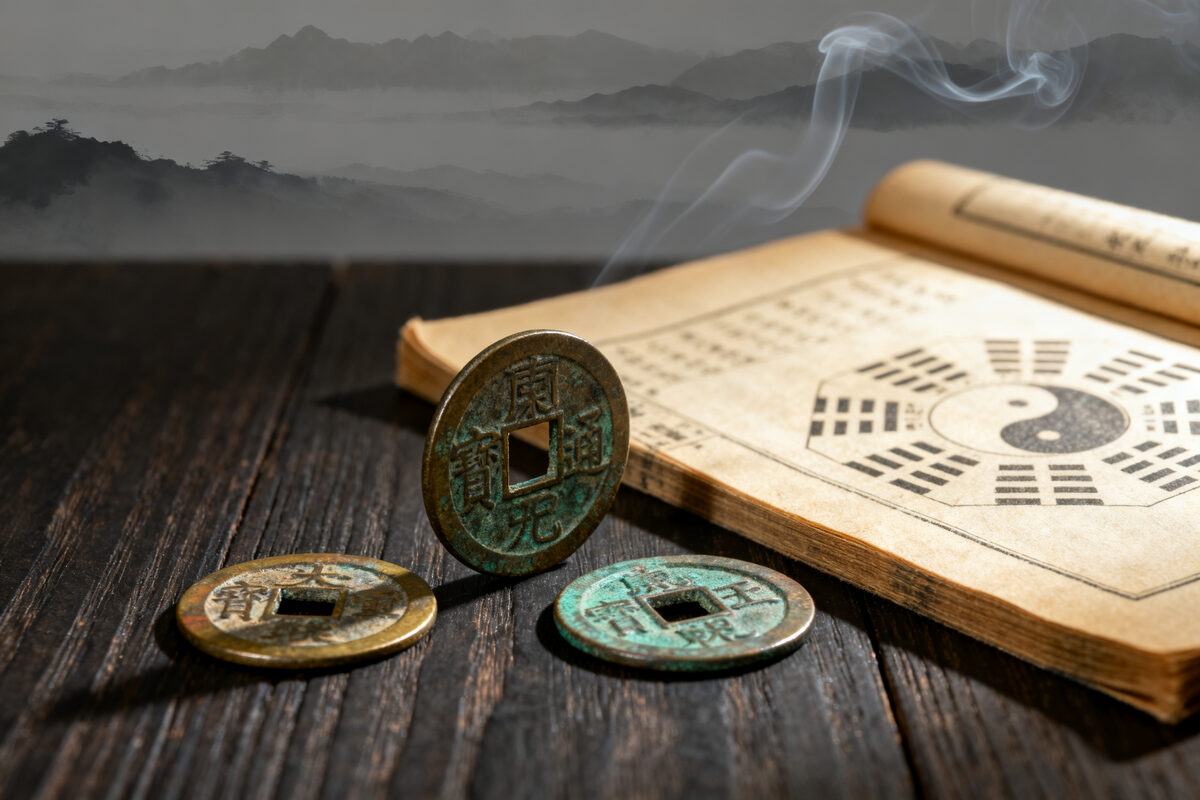
The Platform Sutra: How an Illiterate Woodcutter Wrote China's Most Important Zen Text
The Platform Sutra is the only Chinese Buddhist text classified as a "sutra" — a distinction reserved for the Buddha's own words. Its author, Huineng, could not read. His teaching comes down to a single question: what is your "original face"?
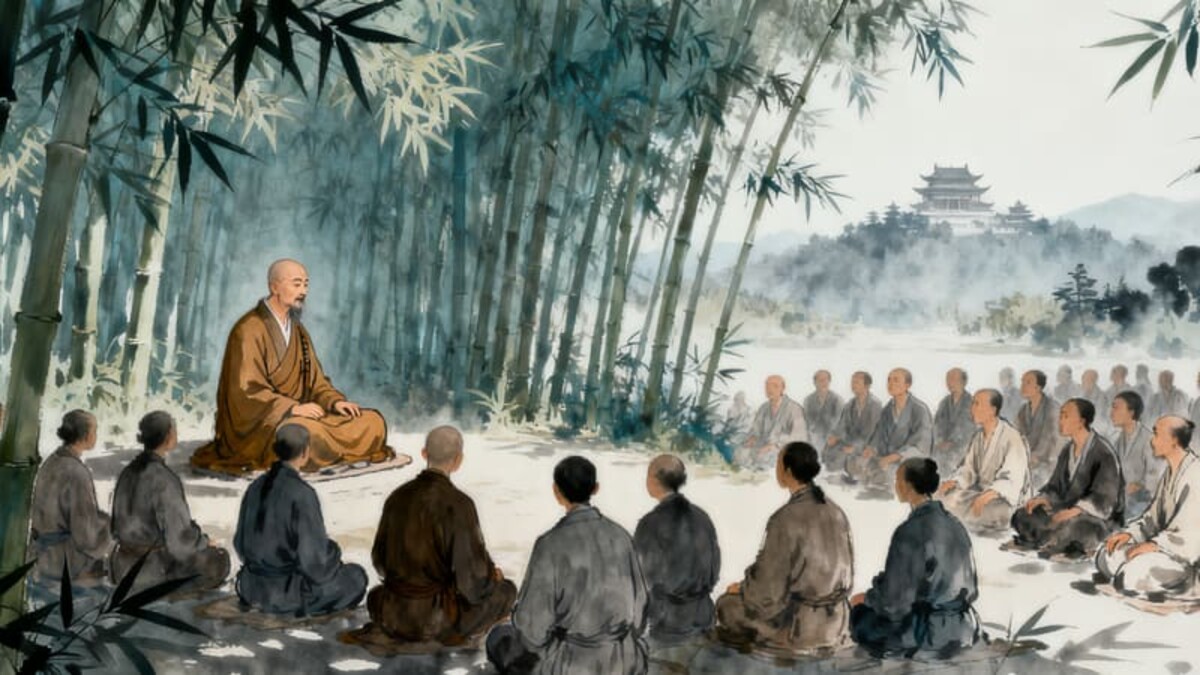
The Platform Sutra: How an Illiterate Woodcutter Wrote China's Most Important Zen Text
Editor's Note
In the entire history of Chinese Buddhism, every text classified as a "sutra" was spoken by the Buddha himself — with one exception: the Platform Sutra of the Sixth Patriarch.
Its author, Huineng, could not read. He was born into poverty, raised in a remote southern village, and made his living selling firewood. One day he heard someone reciting the Diamond Sutra, experienced sudden awakening, and traveled a thousand miles to study under the Fifth Patriarch Hongren. With a single four-line poem, he earned the transmission of the dharma and became the Sixth Patriarch of Zen.
An illiterate man produced a text later honored as a "sutra."
This alone tells you the core conviction of Zen: wisdom is not in books. It is in your own mind.
I. Who Was Huineng
From Woodcutter to Sixth Patriarch
In 638 CE, Huineng was born in Xinzhou (modern-day Xinxing, Guangdong) to a poor family. His father died when he was three. He and his mother survived by selling firewood.
One day, delivering firewood at a market, he heard someone reciting the Diamond Sutra: "A mind that abides nowhere."
In that instant, everything opened.
He arranged care for his mother and journeyed over a thousand miles to Huangmei (in modern Hubei) to meet the Fifth Patriarch, Hongren.
Hongren asked: "Where do you come from? What do you seek?"
Huineng replied: "I am a southerner. I have come far only to become a Buddha — nothing else."
Hongren tested him: "You are a southerner, a gelao [a derogatory term for southern tribal people]. How can you become a Buddha?"
Huineng's reply stunned everyone present:
"People may have north and south, but Buddha-nature has no north or south. My body may differ from yours, but what difference is there in our Buddha-nature?"
Hongren knew instantly this was extraordinary talent. To protect him from jealousy, he sent Huineng to the back compound to split wood and hull rice.
The Poem That Changed History
Eight months later, Hongren decided to pass on the robe of transmission. He asked his disciples to each write a poem demonstrating their understanding.
The head monk, Shenxiu, wrote:
The body is the Bodhi tree, The mind is like a bright mirror stand. Polish it diligently, Let no dust collect.
The body is a Bodhi tree, the mind a mirror. Polish it constantly — do not let dust settle.
The implied understanding: spiritual practice is a continuous process of self-purification.
Huineng heard this and asked someone to write his response:
Bodhi originally has no tree, The bright mirror has no stand. Originally there is not a single thing — Where could dust settle?
There was never a tree. There was never a mirror. There was never anything to begin with — so where would dust even land?
The implied understanding: there is no "self" that needs purifying. The belief that "I need to practice" is itself an attachment.
Hongren read this, summoned Huineng at midnight, expounded the Diamond Sutra, and passed him the robe.
Huineng was 24 years old.
II. Core Teachings of the Platform Sutra
1. Sudden Enlightenment — You Are Already a Buddha
Traditional Buddhism held that practice is gradual — slowly purifying defilements, slowly approaching awakening.
Huineng disagreed:
"A single moment of delusion makes you an ordinary person. A single moment of awakening makes you a Buddha."
One moment of confusion — ordinary. The next moment of clarity — awakened.
The teaching is not that you should "become" a Buddha. It is that you should "recognize" that you already are one.
It is like someone wearing glasses while searching everywhere for their glasses. They search the whole room, only to find them perched on their own nose. They did not need to "obtain" the glasses — only to notice them.
Huineng's Zen is about helping you take off the glasses of confusion and see they were on your face all along.
2. Original Face — Who Are You, Really?
Zen has a classic huatou (critical phrase): "Before your parents were born, what was your original face?"
Before you were given a name, an identity, a gender, a profession — who are you?
After every label has been stripped away — who are you?
This question is not about finding an answer. It is about seeing clearly: everything you identify with — name, career, achievements, failures — is not truly you. The real you is beneath all the labels.
3. No-Mind — Not Blank, But Unbound
"When the mind is undefiled by any circumstance, this is called no-mind."
"No-mind" (wu-nian) is often misunderstood as "empty brain." It is not.
Huineng is explicit: no-mind means facing every situation without being contaminated — not having no thoughts, but not being controlled by them.
It is like watching a movie — you can be fully immersed in the story, or you can remind yourself at any moment "this is just a movie." No-mind is the awareness that always remembers "this is just a movie."
III. Three Passages That Speak Directly to Modern Life
One: "It Is Not the Wind Moving, Not the Banner Moving — Your Mind Is Moving"
After emerging from hiding, Huineng arrived at Faxing Temple in Guangzhou. He saw two monks arguing.
One said: "The wind is moving." The other said: "The banner is moving."
Huineng stepped forward and said: "It is not the wind moving. It is not the banner moving. It is your minds that are moving."
Modern reading:
You feel the world is against you — work is unfair, relationships are difficult, luck is bad.
But work is just work. Relationships are just relationships. Luck is just luck. None of them are targeting you.
What makes you suffer is not these things themselves — it is your reaction to them. Your "mind moving."
Two: "The Way Is in Awakening — What Does Sitting Have to Do With It?"
Someone asked Huineng whether sitting meditation is the best practice.
Huineng replied:
"Alive, you sit but do not lie down. Dead, you lie down but do not sit. A bag of foul bones — why make it into a discipline?"
Huineng's Zen is not bound by form. You do not need to sit in a lotus position to practice. Walking, eating, washing dishes, working — all can be practice. What matters is your mind.
This is especially relevant today: You do not have time to meditate for two hours daily? That is fine. Mindfulness is not in the posture. It is in the awareness.
Three: "Who Would Have Thought My Original Nature Is..."
When Huineng attained awakening, he said five "who would have thought" statements:
Who would have thought my original nature is inherently pure. Who would have thought my original nature neither arises nor ceases. Who would have thought my original nature is inherently complete. Who would have thought my original nature is inherently unmoving. Who would have thought my original nature can produce all things.
In modern terms:
- My nature was already pure — I did not need to "purify" it
- My nature was never born and never dies — I did not need to make it "eternal"
- My nature lacks nothing — I did not need to "acquire" anything
- My nature cannot be shaken — I did not need to "stabilize" it
- My nature can create anything — I did not need to seek outside
Five statements, one message from different angles: what you have been searching for outside has been inside you all along.
IV. Modern Applications
1. You Do Not Need to "Become" a Better Person
Modern culture breeds a constant anxiety: I am not good enough. I need to change.
Courses, fitness, skills, habits — forever chasing a "better self."
Huineng would say: you do not need to become better. You need to see that "I am not good enough" is itself a delusion.
This does not mean you should not grow. It means the starting point for growth is not "I am deficient" but "I am already complete — I just temporarily forgot."
Like a flower — it does not "try" to bloom. It just needs sunlight and water, and it opens naturally.
2. Release "Methodology Anxiety"
Modern people are obsessed with methods — what meditation technique? What reading system? What time-management framework?
Huineng's teaching says precisely the opposite: do not attach to any method.
Methods are fingers pointing at the moon. The finger is not the moon.
You need to see the moon (awakening), not study the finger (methodology).
Start with whatever works for you. But do not be imprisoned by the method.
3. Practice in Daily Life
"The Dharma is in the world; awakening is not apart from the world. Seeking awakening outside the world is like looking for a rabbit's horn — rabbits do not have horns."
The Dharma is in everyday life. Seeking awakening outside of life is like searching for a rabbit's horn — an impossibility.
Know you are washing dishes when you wash them. Know you are walking when you walk. Truly listen when someone speaks. This is practice.
V. A Note for You, the Modern Reader
Huineng's story is, at its core, a story about trusting yourself.
He could not read, yet spoke wisdom classified as a "sutra." He was a southerner, looked down upon by northern monks, yet inherited the Zen transmission. He had no formal education, yet articulated truth that points directly to the heart.
Because he never looked outside for answers. He always looked at his own mind.
In our era, we need this wisdom more than ever.
We are drowning in information, tormented by comparison, chased by the anxiety of "not enough."
And Huineng told us 1,300 years ago:
You were never missing anything. You simply forgot.
Yi Yi Ru Shi · Eastern Aesthetics · Instruments for the Soul
Explore more Eastern wisdom through our mala bead collection — each bead a reminder to return to your original face.