The Finger Pointing at the Moon
Last night I couldn't sleep. Tossed and turned, then got up and flipped through the Shurangama Sutra. There's a passage that stopped me cold — the Buddha said when someone points at the moon, you should look at the moon, not stare at the finger. It felt like a mirror showing me a habit I repeat every single day.
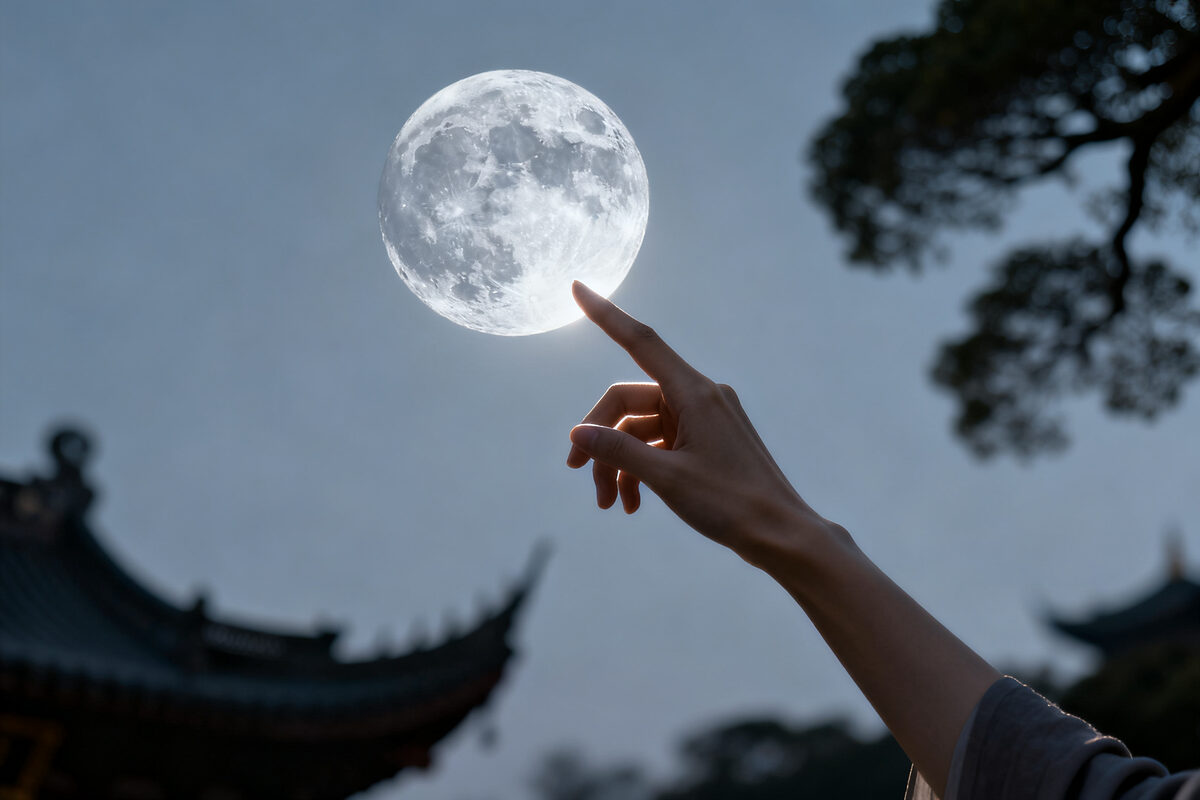
The Finger Pointing at the Moon: Are We Always Looking at the Finger and Forgetting the Moon?
Last night I couldn't sleep. Tossed and turned for a while, then just got up and flipped through the Shurangama Sutra.
Honestly, I've always found this sutra hard going. The language is so old, my mind wanders halfway through a passage. But there's one section I remembered the very first time I read it, and I've gone back to it again and again in my mind—
"Suppose someone points at the moon with his finger to show it to another. That person should look at the moon by following the finger. But if he stares at the finger and thinks the finger is the moon, then not only does he lose sight of the moon, he loses the meaning of the finger too."
The gist is: someone points at the moon for you, and you should follow the finger and look at the moon. But if you stare at that finger and decide the finger is the moon—then you don't just miss the moon. You've also misunderstood what the finger was for.
I sat there for a good while after reading that.
Not because the words were so profound. The opposite, really—it was because it hit too close to home. Like a mirror showing me a bad habit I repeat every single day.
One: Fingers Are Everywhere
If you think about it, "pointing at the moon" moments are everywhere in life.
There was a period when I was obsessed with buying different editions of Buddhist sutras. Just the Heart Sutra alone—I bought an annotated edition, a calligraphy edition, a Sanskrit bilingual edition, even a Japanese phonetic version. They lined up on my bookshelf. I flipped through each one a few pages.
My girlfriend saw them and said, "Do you actually want to read the sutras, or do you just want to collect books?"
I said of course I want to read them. But in my heart, I knew she was right. Those books were like so many fingers. I spent all my time studying the lines on the fingers, the shape of the nails, the color of the skin—and never once looked up at the moon.
Later I packed all those editions into a cabinet. Kept just the plainest one by my bed. Sometimes when I can't sleep at night, I open it and recite "form is not different from emptiness, emptiness is not different from form." I don't try to analyze it. I just recite. And somehow it feels more peaceful than all those hours I spent "studying."
Then there are the mala beads.
I have several sets—star-and-moon bodhi seeds, vajra bodhi seeds, phoenix-eye bodhi seeds, and a tiny string of agarwood beads. For a while I got deep into researching materials, origins, grades. I could hold forth on "full moon" vs. "crescent," density, oil content—the whole bit.
One day at a temple, an elderly lay practitioner saw me rubbing my beads and asked with a smile, "How many rounds have you recited?"
I couldn't answer.
Because I'd been polishing the beads, not counting with them. The beads were supposed to be a tool that points you toward focus. Instead, I'd gotten focused on the beads themselves.
The old man didn't say anything more. He just went back to his own reciting, head bowed. I noticed his mala was well-worn—the cord was fraying, the bead surfaces had gone pale from use. But he didn't seem to care about any of that.
That's someone who's really looking at the moon.
Two: Even the Teachings Are Just a Finger
I'm not saying studying sutras is bad, or that choosing a nice set of beads is wrong.
What I want to say is—the Buddha used this "pointing at the moon" metaphor, and it points to something bigger: all teachings, methods, rituals, and scriptures are just fingers.
Fingers are useful. Without a finger, you wouldn't know where the moon is. The Buddha taught for forty-nine years, and all those words were his outstretched finger, pointing us toward the truth of suffering and the direction of liberation.
But the finger is not the moon.
I have a friend who's been studying Buddhism for seven or eight years. He's read a lot of sutras and treatises. He can argue brilliantly. He can explain the difference between Madhyamaka and Yogacara over dinner. He can lay out the Three Marks of Existence crystal clear.
But one time he told me he hadn't meditated in three months.
"I understand all the principles. I just don't want to sit." There was a kind of helplessness in his voice.
I didn't say anything, because I'd been through a phase like that myself. Knowing a lot. Doing very little. Reading plenty of sutras. Not one fewer affliction to show for it.
During that period, all those sutras were just fingers for me—I examined every line on those fingers so closely I could've drawn the fingerprints from memory. But what the moon actually looked like? I'd long forgotten.
Sometimes I think the most remarkable thing about the Buddha isn't what he taught, but that he knew even what he taught would eventually need to be let go of. That famous line from the Diamond Sutra—"even the Dharma should be relinquished, let alone what is not Dharma"—probably means the same thing.
Once you've crossed the river, you don't need to carry the boat on your back.
Three: The Things That Aren't the Moon
If you flip the "pointing at the moon" idea around, it's actually a bit alarming—how often do we mistake things that aren't the moon for the moon itself?
Rankings, income, the size of your apartment, likes on your social media posts, what other people think of you...
Don't these things look like fingers? We stare at them and think they're everything. But maybe they're just fingers pointing somewhere else—pointing toward a need for security, a desire to be recognized, toward some corner of the heart that hasn't been properly tended to.
A while back there was a news story about a well-known entrepreneur who died suddenly. He was only in his forties. The comments section was full of people saying "What's the point of making all that money?" and "Should've taken better care of his health."
Those things are all true enough. But reading those comments, I kept feeling like something was missing.
What was missing, I think, is this—all that money, that position, those achievements, maybe they were just fingers for him too. Maybe he followed those fingers and found the moon he was looking for. Maybe he didn't. We don't know.
I just think—if someone, in the middle of a very busy life, could occasionally stop and ask, "Am I looking at the finger right now, or am I looking at the moon?"—maybe a lot of things would turn out differently.
I can't do it either. But I'm trying.
Four: Where Exactly Is the Moon?
Sometimes I wonder about a very simple question: where exactly is the moon? If all the scriptures, methods, and teachings are fingers, then what is the moon?
I thought about this for a long time. The answer is probably simpler than I imagined.
The moon isn't anything mysterious. It might be that moment when you drink a cup of tea and really pay attention. That little stir in your heart when you see the sunset. That instant when kindness rises in you toward someone. Those late-night moments when you sit quietly, thinking of nothing, and nothing is missing.
Those moments don't need sutras to validate them, don't need rituals to consecrate them. They're just there. You see it, and you've seen it.
The Buddha reaches out his hand and points in that direction. But the moon wasn't given to you by the Buddha. It was always there in the sky.
It's like how you don't need someone to tell you the sky is blue. You look up and you know. But if someone points the way, and you follow their finger and say "ah, so that's where it is"—the finger has done its job.
After that, the finger can be put down.
That's all for today.
It's almost dawn outside. I think again of that line: "Suppose someone points at the moon with his finger to show it to another. That person should look at the moon by following the finger."
The copy of the Shurangama Sutra is still open on my desk. I close the book and look out at the sky. Grey and dim. Can't see the moon. But I know it's still there, just hidden behind the clouds.
A lot of things are like that. Just because you can't see it doesn't mean it isn't there.
A few questions for myself, and for you:
-
When was the last time you "looked at the moon"? Not the literal moon—I mean a quiet moment when nothing was missing.
-
What are the "fingers" in your life—things you know are just tools, just means to an end, but you can't stop staring at?
-
If you could do just one thing today that would truly make you stop, what would it be?