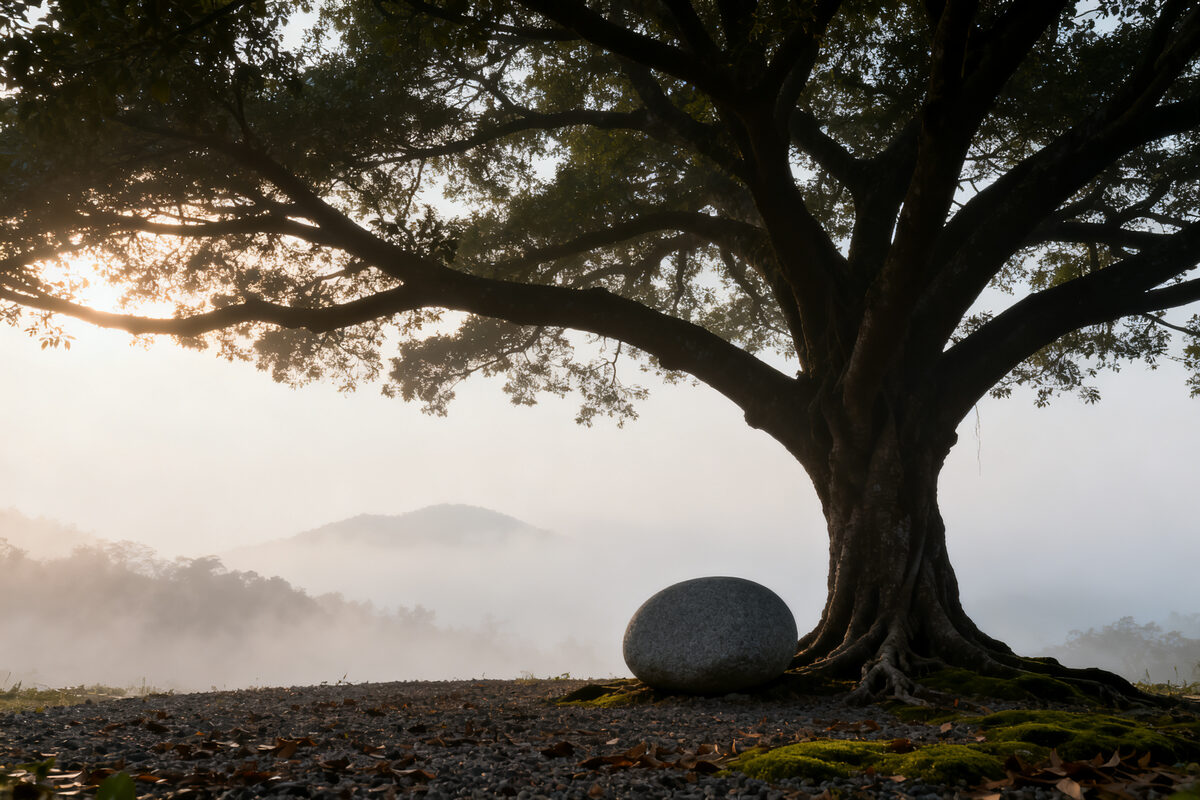
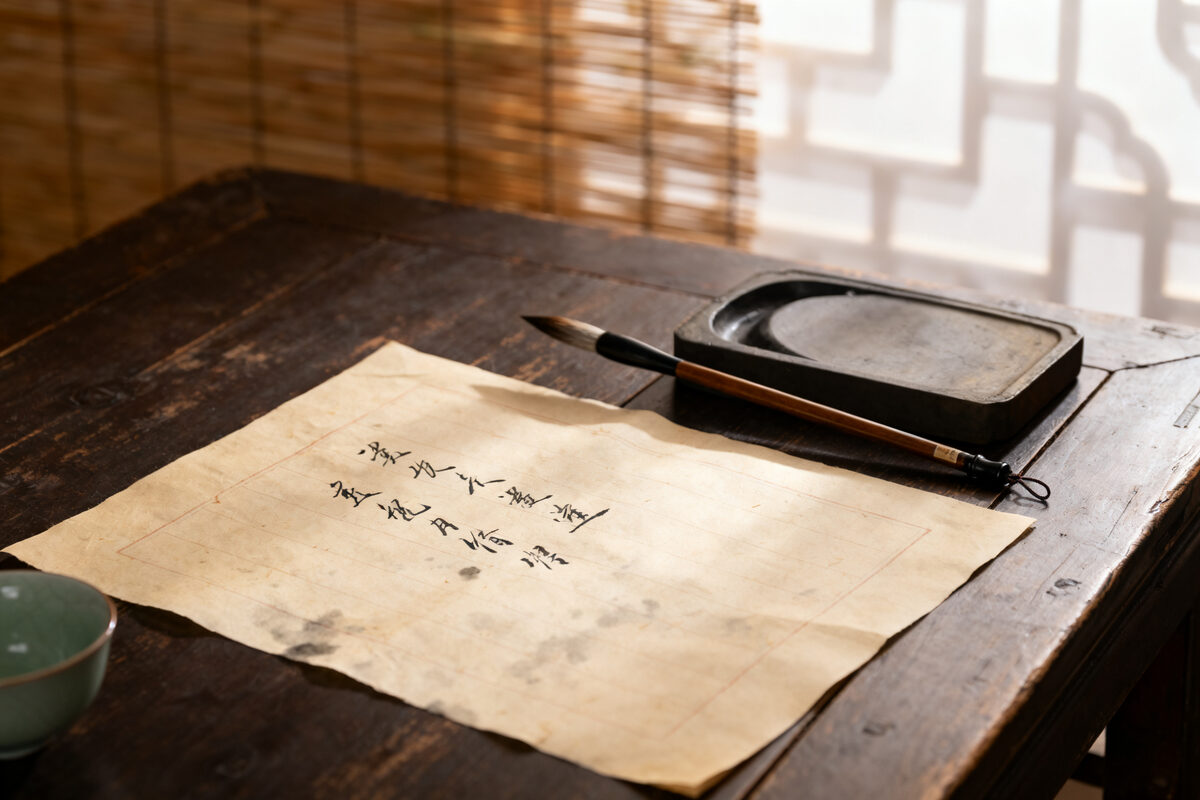
The Flower Sermon: One Flower, One Smile, and the Birth of Zen
On Vulture Peak, the Buddha held up a single flower. Thousands were bewildered. Only Mahākāśyapa smiled. Thus began the mind-to-mind transmission that would become Zen — a timeless teaching about direct awareness beyond words.
The Flower Sermon: One Flower, One Smile, and the Birth of Zen
On Vulture Peak, the World-Honored One held up a flower before the assembly. All were silent. Only Mahākāśyapa smiled. The Buddha said: "I have the treasury of the true dharma eye, the wondrous heart of nirvana, the reality beyond form. This subtle teaching does not rely on written words. Outside the scriptures, it is transmitted mind to mind. I entrust it to Mahākāśyapa."
These words, recorded in the Wudeng Huiyuan (Compendium of Five Lamps), are sparse—yet they contain the spiritual wellspring of the entire Zen tradition.
What happened that day on Vulture Peak, twenty-five hundred years ago? How did a single flower and a single smile give birth to a tradition that would reshape the civilizations of East Asia?
Today, let us enter this most spare, most profound of Buddhist stories.
The Assembly on Vulture Peak: A Silence of Ten Thousand
The story unfolds at Gridhrakūṭa, the Vulture Peak, in ancient India. The Buddha had called a dharma assembly. Monks, lay practitioners, and celestial beings gathered from every direction, awaiting the Buddha's supreme teaching.
According to the classical records, thousands were present. Among them were great arhats of profound realization, diligent practitioners of lesser attainment, and newcomers who had just entered the path. Each one waited with devotion for the Buddha's words.
Yet that day, the Buddha did not speak as he usually did.
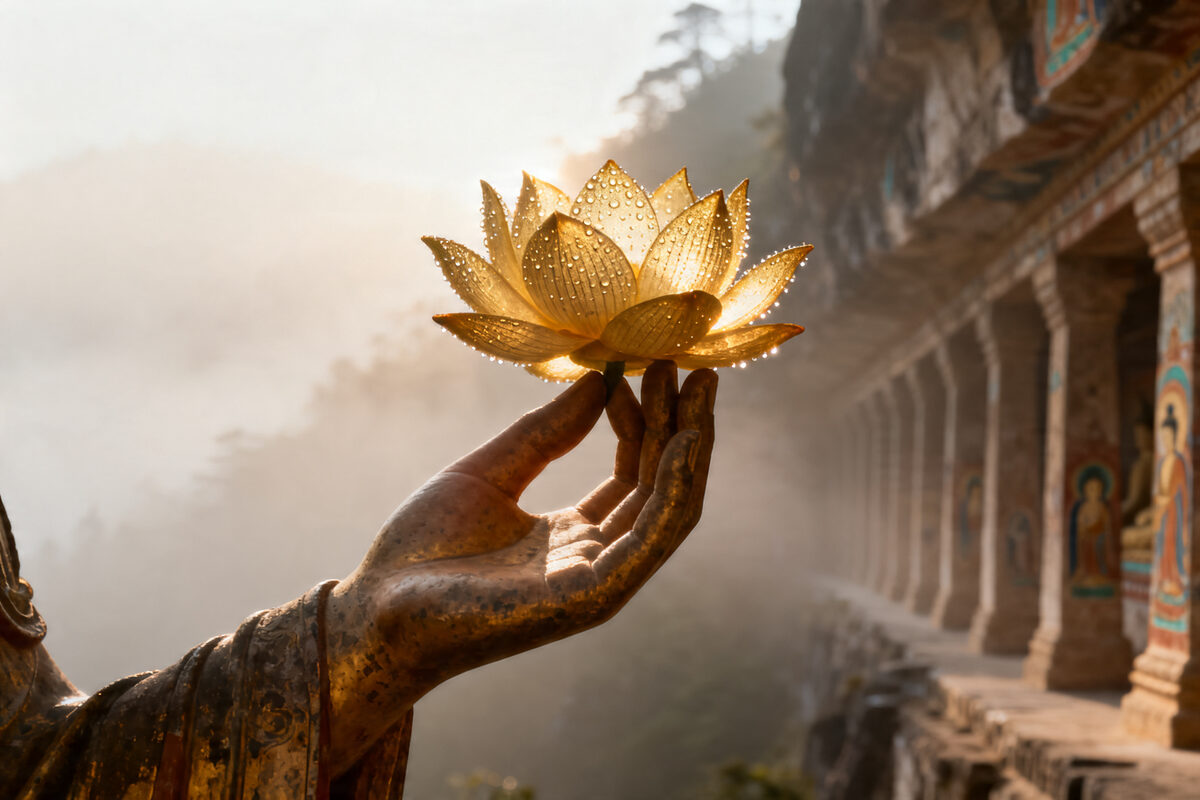
He simply sat in silence and picked up a flower.
It was a golden udumbara flower—a blossom of the utmost rarity and purity in Indian culture, symbolizing the most exalted qualities. The Buddha held it up slowly before the assembly and said nothing.
Silence fell.
In a gathering of thousands, there was only the sound of wind and the occasional cry of monkeys on the distant hillside. The disciples looked at one another, uncertain of the Buddha's intent. Some grew restless, some confused, some tried to reason their way to an explanation.
The Buddha remained silent, holding the flower, his gaze calm and far-reaching.
Time itself seemed to stop.
Kaśyapa's Smile: Heart Speaking to Heart
As the crowd sat bewildered, one elderly disciple at the edge of the assembly allowed the faintest smile to cross his lips.
This was Mahākāśyapa—one of the Buddha's most senior disciples, renowned as the foremost in ascetic practice. He was known for his rigorous austerities, often meditating in charnel grounds and under trees, desiring nothing of the world's comforts.
While everyone else tried to think their way toward the meaning of the flower, Kaśyapa simply smiled.
That smile was not the smile of comprehension, not the smile of "I understand."
It was a moment of resonance—a direct transmission from heart to heart. The message the Buddha conveyed through the flower, Kaśyapa received with his smile.
This was not the transfer of knowledge, not an exchange of concepts, but a resonance of mind that transcended language, transcended thought itself.
Seeing Kaśyapa's smile, the Buddha finally spoke. He uttered those famous words:
"I have the treasury of the true dharma eye, the wondrous mind of nirvana, the true form of no-form, the subtle gate of dharma. It does not rely on letters or words. It is a special transmission outside the scriptures. I now entrust it to Mahākāśyapa."
This is the "mind-to-mind transmission" that defines Zen—no reliance on words, a transmission outside the scriptures.
The Weight of a Flower: Why Not a Sutra?
What makes this story so compelling is the question: Why did the Buddha choose a flower rather than dictating a sutra?
Over his forty-nine years of teaching, the Buddha left behind a vast ocean of scriptures. From the Āgamas to the Perfection of Wisdom texts, from the Lotus Sutra to the Avataṃsaka, each one contains profound wisdom. If he were to transmit the most essential teaching, surely he would have left behind the most detailed text.
Yet he chose a flower.
The intention runs deep.
Words are a raft, not the far shore. The Buddha understood that all language is a finger pointing at the moon. The finger can guide your gaze, but it is not the moon. Cling to the finger, and you will never see the moonlight.
Truth cannot be contained by concepts. "The Tao that can be spoken is not the eternal Tao." The experience of nirvana, the realm of awakening, lies beyond all categories and definitions. The moment you try to describe it in words, it slips through your description.
Understanding is not realization. Knowing the word "emptiness" is not the same as realizing emptiness. Grasping the concept of impermanence is not the same as truly encountering it. The Buddha's forty-nine years of teaching were different approaches to guiding disciples toward direct experience. In the moment of the flower sermon, he demonstrated experience itself—a direct, unmediated knowing.
The flower was not a symbol. It was not a metaphor. It was simply this moment—complete, alive, unspeakable.
And Kaśyapa's smile was not a response or a confirmation. It was the natural bloom that occurs when two minds meet—like the spark that inevitably arises when two flints strike.
The Birth of Zen: From a Flower to a Wall
The flower sermon came to be regarded by later Zen tradition as the starting point of the "First Patriarch of the West." From Kaśyapa onward, this mind-to-mind teaching was passed down in India through twenty-eight generations.
The twenty-eighth patriarch, Bodhidharma, brought this teaching to China.
Bodhidharma's encounter with Emperor Wu of Liang is a classic case of mutual incomprehension. The emperor asked: "Since I ascended the throne, I have built temples, copied sutras, and ordained monks beyond count. What merit have I earned?" Bodhidharma replied: "No merit whatsoever." The emperor then asked: "What is the highest meaning of the holy truth?" Bodhidharma said: "Vast emptiness, nothing holy."
The emperor was utterly baffled. Bodhidharma crossed the Yangtze River northward and sat facing a wall in Shaolin Temple for nine years.
From a flower to a wall, the spirit of Zen remained constant: Truth is not found externally, not in scriptures, not in authority, but within your own heart. What you need is not to seek outward but to observe inward.
Later, Zen in China evolved into "Five Houses and Seven Schools," generating countless brilliant koans and Zen phrases. From the Sixth Patriarch Huineng's "Bodhi has no tree, the mirror has no stand," to Zhaozhou's "Have some tea," to Linji's "The True Person of No Rank"—all embody the spirit of direct pointing, of not seeking outside oneself, that began with the flower sermon.
The Flower Sermon Today: Finding Silence in a Flood of Information
Twenty-five hundred years later, we live in an age drowning in words and concepts.
Billions of pieces of information flood into our minds daily through phone screens. We consume "knowledge" through social media, short videos, and instant messaging, yet we find it harder than ever to experience true understanding. We use more and more words to describe the world, yet we see the world itself less and less clearly.
We are like those bewildered disciples on Vulture Peak—confronted with the flower, not knowing how to respond, so we analyze, deduce, judge, and discuss.
But perhaps what we truly need is simply Kaśyapa's smile.
Not more knowledge, but the courage to set knowledge aside.
Not more analysis, but the sincerity to face reality directly.
Not more words, but the stillness beyond words.
The Moment You Put Down Your Phone
Try a simple experiment.
Put down the screen you are reading, look up, and observe your surroundings.
What do you see?
Do not describe it in words. Do not label it in your mind—"this is a table," "that is a window," "this is a plant." Just see. See purely.
What do you see?
That seeing, unobscured by concepts, direct and alive—that is the flower the Buddha held on Vulture Peak.
And the faint smile that may be forming at the corners of your lips right now—that is Kaśyapa's smile.
Zen is not far away. It is not in the mountains. It is not in the scriptures.
Zen is in the moment you set down your concepts and face the present directly.
Reflections: Three Questions
First, if you had been at that assembly on Vulture Peak, how would you have responded? Would you have tried to understand the flower, or could you have let go of the urge to analyze and simply experienced the moment?
Second, have you ever had a moment in your life — an instant of wordless understanding? How did that experience differ from ordinary verbal communication?
Third, what does "not relying on words" mean today? In an age of information explosion, might learning the silence of "no words" be more valuable than acquiring more information?
The flower sermon is not history. It is this very moment. Not a story, but your experience right now.
As you finish reading this article and allow a faint smile—that is the continuation of the assembly on Vulture Peak.