Three Coins, One Question: I Tried I Ching Divination at Home
Insomnia at 3 AM. I opened the I Ching my teacher recommended. Three coins, six throws, one hexagram. Not superstition or fortune-telling — but a way to see the answer you already know but won't admit.
Three Coins, One Question: I Tried I Ching Divination at Home
Last night I couldn't sleep. Tossing and turning, mind full of clutter. A decision at work had been stuck for days — moving forward felt wrong, backing off felt wrong too.
At 3 AM, I gave up, made myself a cup of tea, and sat at my desk staring at nothing. My eyes drifted across the bookshelf and stopped on a worn copy of the I Ching. My teacher had recommended it years ago. "You don't need to understand it yet," he said. "Just keep it on the shelf. When the time comes, you'll open it."
I hadn't opened it much. But last night, something made me want to try.
Something My Teacher Once Said
My teacher is an old monk at a small mountain temple. Not a famous abbot from some grand monastery — just an ordinary old man. I visit him once or twice a year. He doesn't talk much, but every sentence lands like a stone thrown into still water. The ripples take a long time to fade.
One year I asked him: "Teacher, can the I Ching really predict the future?"
He didn't answer directly. He said: "The I Ching isn't fortune-telling. It helps you see the part of yourself you can't see."
I didn't quite understand then. I think I'm starting to.
He added: "People's problem isn't that they don't have answers. It's that they already know the answer — they just won't admit it. So they look for something outside to confirm what they already feel."
How to Throw Three Coins
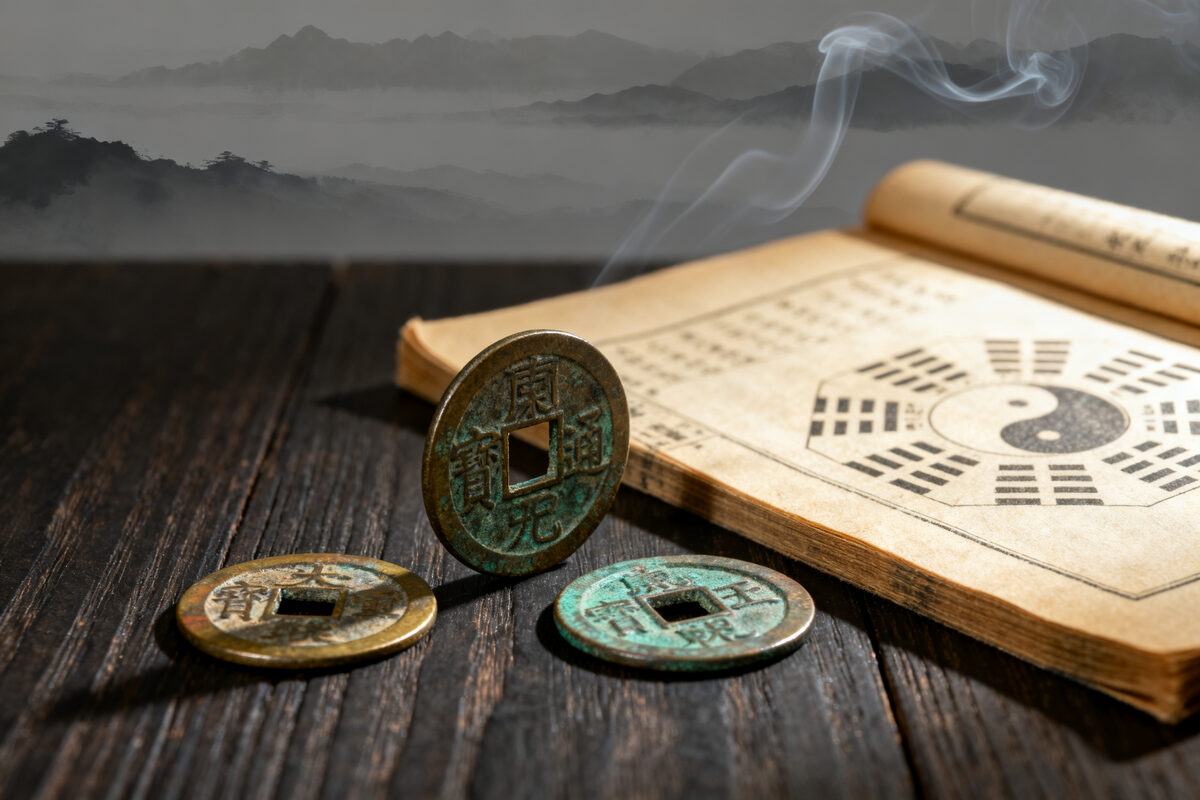
I flipped through the book, looked it up online, and found that the method isn't complicated. Simple, actually — three coins, thrown six times. Each throw, you record the combination of heads and tails. Stack the results from bottom to top, and you get a hexagram.
Here's how it works:
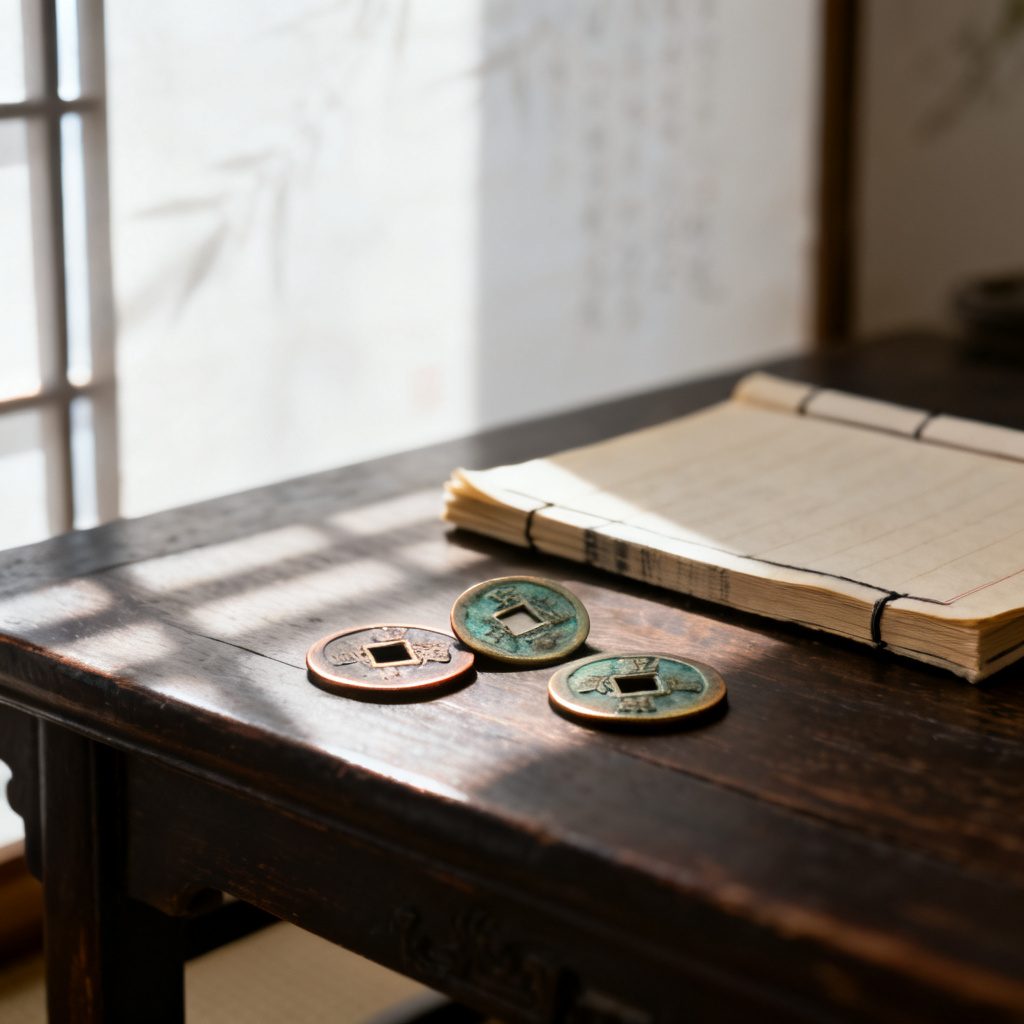
Get three identical coins. I found three one-yuan coins. The old tradition says to use ancient Chinese cash coins, but honestly — I think the sincerity matters more than the coin.
- Throw all three coins at once
- The side with "1元" (heads) = 3 points
- The other side (tails) = 2 points
- Add up all three:
- 6 points (three tails) = Old Yin, draw a broken line ⚋, but it will change
- 7 points (two tails, one head) = Young Yang, draw a solid line ⚊
- 8 points (two heads, one tail) = Young Yin, draw a broken line ⚋
- 9 points (three heads) = Old Yang, draw a solid line ⚊, but it will change
Throw six times, from the first throw to the sixth, stacking lines from bottom to top.
It sounds confusing written out, but in practice you're really just counting "how many heads came up." Three heads is the strongest yang energy. Three tails is the strongest yin. The two in between are ordinary yin and yang.
My hand shook a little on the first throw. Not from fear — more like, how do I say this — the whole thing suddenly felt real. Serious. Like I was actually doing something.
What Hexagram Did I Get?
I recorded my six throws from bottom to top:
Line 1: two heads, one tail → 8 → Young Yin → ⚋ Line 2: three heads → 9 → Old Yang → ⚊ (changing line) Line 3: one head, two tails → 7 → Young Yang → ⚊ Line 4: two heads, one tail → 8 → Young Yin → ⚋ Line 5: one head, two tails → 7 → Young Yang → ⚊ Line 6: two heads, one tail → 8 → Young Yin → ⚋
Stacked from bottom to top: the upper trigram is Zhen ☳ (Thunder), the lower trigram is Kun ☷ (Earth).
I looked it up — Hexagram 16, Yu (Enthusiasm/Preparation).
Yu means ease, joy, readiness, preparation.
I have to admit, when I saw that word, I froze for a second. Because the question I'd asked was: "Should I slow down and not rush this decision?"
And the Yu hexagram — according to the book — says exactly that: move in harmony with the right timing. Don't rush. The most important thing right now is to prepare, gather strength, and wait for conditions to ripen. When the time is right, things will fall into place naturally.
The fifth line was Old Yang — a changing line. Yu changing at line five becomes Hexagram 15, Qian (Modesty).
Modesty. Humility.
I stood up from my chair and paced around the room twice.
Is It Really "Accurate"?
I don't know.
If you ask me whether I "believe" — my answer is: I don't think it's superstition, but I also wouldn't hand my entire life over to three coins.
My teacher said something that stuck with me. He said: "A hexagram doesn't make decisions for you. A hexagram is a mirror. When you look into the mirror, the face you see is still your own."
I thought about that for a long time, and I think he's right.
Last night, before I threw the coins, I already had a feeling. A vague sense that I shouldn't rush, that I should wait a little longer. But I couldn't bring myself to trust that feeling, because "wait" sounds like avoidance. It sounds like weakness.
The Yu hexagram — or rather, what I read into it — gave me confirmation. It didn't decide for me. It took that faint voice inside me and translated it into a language I could hear.
Maybe that's what the I Ching has been doing for three thousand years. It doesn't predict the future. It helps you see the present clearly.
Then I Went Down a Rabbit Hole
Couldn't sleep, so I kept reading.
The I Ching is one of China's oldest texts — older than Confucius. Originally it was used for divination. During the Shang and Zhou dynasties, kings would consult it before going to war, relocating the capital, arranging marriages. Later, Confucius and his students wrote extensive commentaries — the so-called "Ten Wings" — transforming a divination manual into a book of philosophy.
Sixty-four hexagrams, each one a situation. Qian is forceful initiative. Kun is gentle receptivity. Tai is open communication between above and below. Pi is stagnation and blockage... It doesn't tell you "what will happen." It tells you "where you are right now, what the pattern of this situation is, what happens if you go with it, and what happens if you fight it."
My favorite insight: the core of the I Ching is change.
The only thing that never changes is that everything changes.
Sound familiar? It's the same thing Buddhism calls impermanence. All conditioned things arise and pass away. What you think is solid is exactly what's shifting the fastest.
So the I Ching doesn't teach you to cling to any position. It teaches you to do different things at different times. When things are going well, pull back and conserve. When things are hard, gather and build. When advancing, keep an exit in mind. When retreating, don't lose heart.
Profoundly simple. The kind of simple you keep forgetting as life piles up. I know I do.
4:30 AM Quiet
The tea had gone cold. Outside the window, the sky was turning gray.
I put the three coins back in the drawer and slid the book onto the shelf.
No lightning bolt of enlightenment. Nothing magical happened. But that thing that had been jammed inside me for days — it loosened. Not gone. Just loosened. Like a string wound too tight, finally releasing half a turn.
Maybe that's why people still crack open the I Ching in 2025. Not because it's magic, but because sometimes you need a ritual, a quiet moment, to gather yourself back together from all the scattered places.
The sound of three coins landing isn't so different from the sound of a wooden fish, a temple bell, rainfall. They all do the same thing — they help you stop.
And only when you stop can you finally hear yourself.
Three Questions for You
-
When was the last time you sat quietly with yourself — no phone, no distractions, just you?
-
If you could throw three coins and ask one question, what would it be? (Don't rush to throw them — just thinking of the question might be enough.)
-
Is there already an answer inside you that you've been afraid to admit?