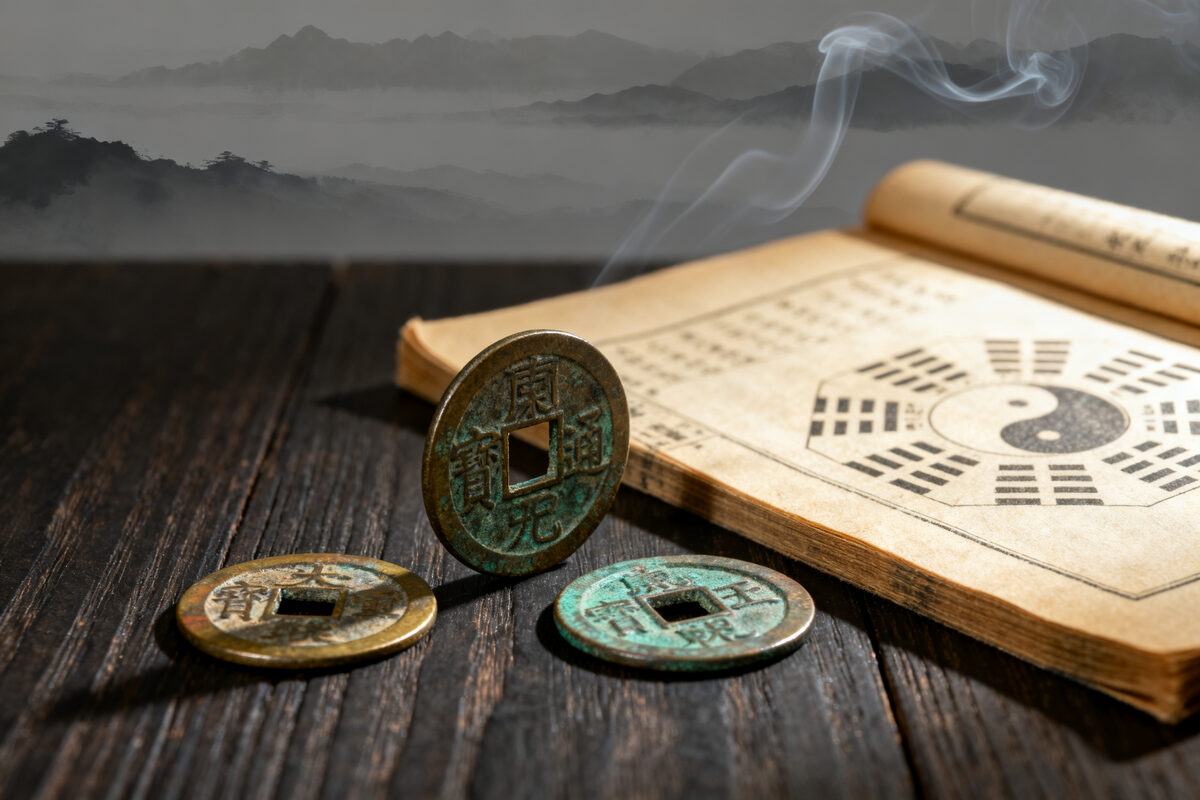
She Drew the Same Tarot Card Three Times. I Thought of Three Old Coins.
A friend asked the cards whether to quit her job — same card, three times. It reminded me of the other answer machine I grew up with: three copper coins and a three-thousand-year-old book. Jung called it synchronicity. The coins don't tell the future; they hand you a small piece of quiet.
A friend sent me a photo last night. A tarot card lying on dark velvet. On it, a man hanging upside down.
She asked: what does this mean? Should I quit my job?
She said she drew three times. Same card, all three.
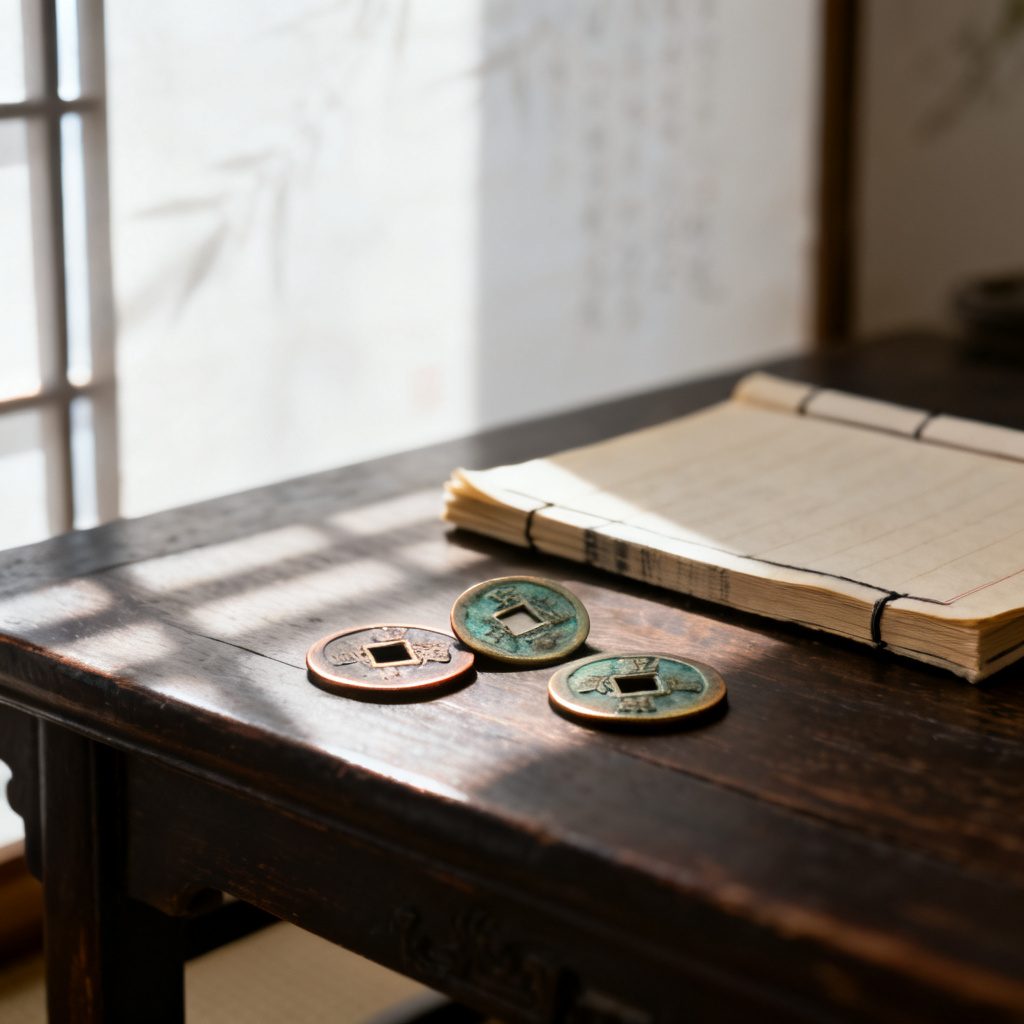
I stared at the photo for a while, and suddenly remembered another kind of "answer machine" I'd seen as a kid — three copper coins, shaken six times, an old man, a book with worn-out corners.
Two machines, one question
I don't really know tarot. But roughly: seventy-eight cards, upright or reversed, you draw one and read it. The person asking hands over the confusion inside, and the card hands back an image.
The I Ching, strictly speaking, isn't the fortune-telling book most people imagine either. It's something older. Sixty-four hexagrams, six lines each, broken and solid, arranged like code. Three thousand years ago, people counted through every situation a human can fall into, and got sixty-four: the beginning that says "the dragon lies hidden, do not act," the warning that says "tread on frost, and hard ice is coming," the top that says "the flying dragon who climbs too high will have regrets."
Seventy-eight painted cards on one side. Sixty-four three-thousand-year-old symbols on the other. Strangers, separated by a continent, both doing the same job:
Turning something in a person's heart that can't be said clearly, into a shape you can see.
Because the hard part was never the missing answer. The hard part is that the answer is a blur, and you can't even see it yourself.
The second the coins land
I watched someone cast hexagrams once, as a kid, back in my hometown.
Nothing like the mysterious scenes in movies. Just an ordinary afternoon, an old man sitting by the door, three coins rattling in his hand, then dropping onto the table. One glance at heads or tails, one mark on paper. Six casts, six marks, open the book.
The whole thing took less than ten minutes.
I didn't believe in it back then. What fascinated me was the person asking — every time the coins fell, his face moved. Three heads, his shoulders dropped in relief. Two tails one head, his brow tightened.
Much later I slowly understood: the coins themselves may have said nothing at all. But that little "thunk" in the asker's chest, the second the coins landed — that was real.
Psychology calls it intuition now. Whether you should quit — you already know. You've known for a while. It's just sitting somewhere deep, out of reach on ordinary days. You need something to fish it up — a card, a hexagram, or a coin thrown in the air. The instant it lands, the first thought that surfaces in you is usually the answer.
All the interpreting afterward is just finding words for that thought, so you finally dare to admit it.
A Swiss man writes a preface for a three-thousand-year-old book
There's one part of this story I've always found remarkable.
In the 1920s, a German named Richard Wilhelm translated the I Ching into German. After his death, the book passed into the hands of a Swiss psychologist — Carl Jung.
Jung, the one who stands next to Freud.
He studied this old Chinese book seriously, and wrote a long preface for the English edition. In it he said: Westerners ask "why," always hunting for causes. The I Ching doesn't explain causes. It just tells you: right now, you are in this hexagram. Like reading weather. It's raining, so take an umbrella.
Jung even coined a word for it — "synchronicity." Meaning: some things in this world are not cause and effect, but they happen together, echoing each other. You're carrying a question inside, and the coins happen to fall this way — maybe the coins don't "know" anything. Maybe it's just that in this one moment, the inner world and the outer world are saying the same sentence.
A psychologist who spoke the language of science, being solemn about an old book of divination — not because it was magic, but because in it he saw the thing he'd spent half his life looking for: how the human heart corresponds to the world.
The first time I read that, it stayed with me. The thing we threw away as superstition, someone else picked up and studied as scholarship.
What it really calculates isn't the future
But I don't want to make the I Ching sound too mystical either.
Shake the coins six times, get a hexagram, and then what? The I Ching almost never tells you "what will happen." It says: you are here now, this usually comes next, and here is how you'd best carry yourself.
The Qian hexagram, at its topmost line, says "the dragon who flies too high will have regrets." Not a prophecy. A reminder. The Qian hexagram of humility — six lines, all favorable — isn't saying humble people get rewarded. It's saying: a person who keeps themselves low cannot fall from a great height.
And there's a harder layer underneath: not one of the sixty-four hexagrams is always good, and not one is always bad. Peace at its extreme turns to stagnation. Stripping at its extreme turns to return. Good enough runs into bad, bad at the bottom circles back. It wrote "change" into the title as the only constant — Yi, which means change.
So strictly speaking, the I Ching doesn't predict the future. It is the notes of Chinese people, three thousand years ago, on one question: how should a person sit inside change?
And us, today, with tarot, with coins, with every method — the questions we bring are the same ones. Should I quit, should I leave, should I move. Look at the old hexagram records: should I worry about this illness, is this trade worth making, stay or go.
Different world. Same few questions.
What I replied to my friend
In the end I didn't explain what the Hanged Man means.
I only asked: does the man on the card look like he's suffering?
She said, strange — he actually looks quite calm. Upside down, and the light around him is rather bright.
I said, then maybe you've already decided, and you just wanted someone to agree with you.
A long pause. Then one word: yes.
I don't know what that card understands. But I know that when she drew the same card three times, she was already rehearsing the same answer over and over. The card is just a mirror.
So are three copper coins. So are sixty-four hexagrams. Their job isn't to tell you the future. Their job is to hand you a small piece of quiet when your heart is at its loudest — quiet enough that you can finally hear the thing that was already there.
As for whether quitting turns out well? In the I Ching, the hexagram after any hexagram can be a good one. Depends on how you walk it.
The coins settle, the page opens, and the road ahead is still yours to walk, one step at a time.
Three questions to leave with you:
- Have you ever had a moment when the answer was already inside you, and you just didn't dare admit it?
- Do you trust a card, a hexagram, or your own first instinct more?
- If you cast a "bad" hexagram — do you think it's describing you, or warning you?