Westerners Fear Seven Years of Bad Luck. My Mother Won't Let a Mirror Face the Bed
A friend woke at 3 a.m. to a figure standing at the foot of the bed — her own reflection. Half a world apart, cultures that never met are afraid of the same piece of glass. Unwrap the frightening language, and what's inside is the same simple thing: a good night's sleep.
A friend stayed with me last month. On her last night, she told me something.
She got up to use the bathroom in the middle of the night, still half asleep, and saw a figure standing at the foot of the bed. It moved. She was instantly awake, heart pounding, frozen for several seconds — before she realized it was her own reflection in the full-length mirror.
We both laughed when she finished. And after the laugh, I thought of my mother.
When we moved into a new house when I was little, my mother directed the workers as they placed the furniture. Everything was negotiable except one rule: the mirror must not face the bed. I asked why. She couldn't really say. It's just the old rule — "the spirit can't rest."
I didn't take it seriously back then. But later, in dorms, in rented rooms, in every new place I settled alone, I'd catch myself checking first thing: which way does the mirror face? Not because I believed. Because it had become a habit. Some rules are like that — you think you're keeping them, but really, they've moved into you.
A few days ago I watched a video of a foreigner explaining, in complete earnestness, their rules about mirrors: break one, and you get seven years of bad luck. The comments were lively. People were teaching each other how to undo the curse. One man said he broke a mirror as a kid, and honestly, those seven years hadn't been great.
I sat there laughing for a long time. My mother won't let a mirror face the bed. Westerners fear seven years of bad luck from a broken one. Half a world apart, never once consulted, people are afraid of the same piece of glass.
What feng shui says
So I finally looked it up. Feng shui has a lot to say about mirrors, and it says it with weight.
The idea is this: a mirror is a "reversing object." It receives, and it bounces back. Whatever it faces, it doubles and returns. The bed is where your energy is at its weakest and most inward at night — a mirror facing it is like setting another stone beside a pool of still water.
There's an even more direct version. The ancients believed that when you sleep, your soul steps out for a while — frightening to hear today, but they really dared to imagine things. Coming back in the night, it sees a "person" standing in the mirror. It gets confused. Frightened.
I know — by this point, many of you want to laugh. I wanted to laugh the first time I read it too.
But take the frightening language apart, and what's wrapped inside is plain: you wake in the night, groggy, there's a little light in the room, and you see a figure in the mirror — and it moves. Do you know that spike of heartbeat? My friend knows it now. One bad fright at 3 a.m., and your heart takes ages to settle. The rest of the night is gone.
Feng shui doesn't say "sleep environment optimization." It says the spirit can't rest. The ancients didn't know the word for the nervous system, didn't know why you can't fall back asleep after a midnight shock — but they knew the result: a mirror facing the bed, and you sleep badly. In the language of their era, they recorded it, generation after generation.
Where the seven years come from
The Western fear of mirrors is just as old.
The Romans believed the image in the mirror was the soul itself. Break a mirror, and you damage more than glass — you damage the you inside it. And the body, they believed, renews itself every seven years. So a broken mirror takes seven years to grow back. That belief traveled two thousand years and became the phrase everyone in the English-speaking world knows: seven years of bad luck.
And here's something stranger.
In many parts of China, when there is a death in the family, the mirrors are covered with red or white cloth. While reading up, I learned that Jewish families sitting shiva also cover every mirror in the house. The stated reasons are vague on both sides, but the meaning is the same: in those days, a person should not see themselves.
Two civilizations that never met made the same gesture: fear of the mirror facing the sleeper, and fear of the grieving person meeting their own reflection.
You can call it coincidence. Or you can take one more step, like I did: our wariness of "the thing in the mirror" may be far older than we think. Before glass existed, humanity first saw itself in still water, in polished bronze, in the eyes of another person. Perhaps that original astonishment never fully left our blood.
Afraid of mirrors, intimate with mirrors
Here's what I find interesting: for all the fear, the Chinese have always been close to their mirrors.
Han dynasty bronze mirrors dug from the earth often carry four characters cast into the back: 长毋相忘 — "never forget each other." A mirror, and a love letter in the same object. The Sui and Tang eras were more romantic still. There's a famous story, "the broken mirror made whole" — before a war tore them apart, a husband and wife snapped a bronze mirror in half, each keeping one piece as a token for reunion. And they truly found each other again through those two halves.
The same mirror: in daylight, a token of love. In the dark, a restless spirit. One object, two faces.
And a more everyday version. In the old residential blocks back home, have you ever noticed: two families facing each other, one hangs a small round mirror above their door, and a few months later the other family hangs one too, angled to bounce it back. As a kid walking past, I always felt those two mirrors were sparring silently in mid-air. Only later did I learn it's called a bagua mirror — the family hanging it feels the facing doors "clash," and wants to dissolve it. Whether it works, I don't know. But that wordless war of mirrors can go on for a decade.
What I did about mine
Back to me. When I moved last year, there was a large mirror fixed to a cabinet in the bedroom. It couldn't be removed. It faced the bed exactly.
My mother's rule turned over in my head.
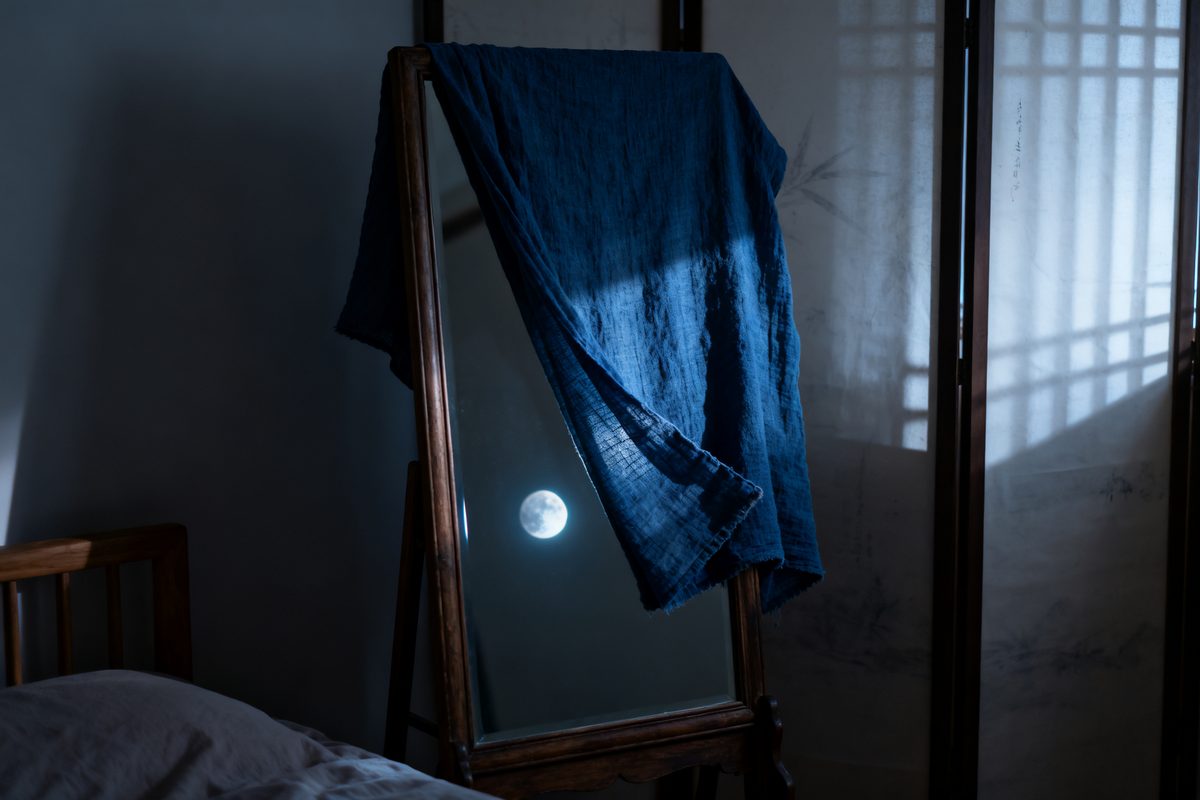
I found a piece of coarse indigo cotton cloth. At night before sleep, I cover the mirror; in the morning, I take it off. I won't pretend it changed nothing — those first nights, I did sleep more deeply. I woke fewer times in the dark.
Is it the cloth, or is it the mind?
Here's where I've landed: I can't separate them, and I've stopped wanting to. "It's just psychological" is sometimes only the name we give to things we haven't understood yet. A full night's sleep is real. That's enough.
If a mirror faces your bed, don't rush to debate whether you believe. Move it, or cover it. Try three nights. You won't need to ask anyone — sleep doesn't lie.
These days when I get up at night, I no longer see the person in the mirror.
The cloth is still there. She is still there. Only, in the hours I look at her, she doesn't look at me; in the hours she looks at me, I don't look at her. We've split the day in two, and each of us rests easy.
I don't know why, but thinking of it this way quiets something in me.
Three questions for you
-
Have you ever jolted awake at night? In that moment, what were you actually afraid of?
-
Is there a rule in your family that no one can explain, but everyone keeps?
-
When was the last time you truly looked at yourself in the mirror?