I Sat Facing Away From the Door for Three Years, Before I Understood the Chinese Word "Kào Shān"
For three years my desk faced away from the corridor, and I thought I was just tired. Then an elder asked: what's behind your seat? In Chinese, a sense of safety is measured by your back — a mountain to lean on. Not superstition, but observation the body already knew. A small story about moving a desk.
I Sat Facing Away From the Door for Three Years, Before I Understood the Chinese Word "Kào Shān"
For three years at my company, my desk faced away from the door.
You've probably had a seat like that. Air conditioner overhead, an open corridor behind you. Anyone heading to the pantry, the printer, or the boss's office passes behind your back. You hear footsteps. You sense someone stopping to glance at you — or maybe not. You can't be sure. When you turn around, it's a coworker. When you don't, something stays hanging in your chest.
For three years I thought it was just "a bad seat." Then last month, an elder relative visited, asked about my work, and casually inquired: what's behind your seat?
I said, a corridor.
He smiled and said four words: then behind you, there is no mountain to lean on.
The Word "Kào Shān" — a Mountain to Lean On
I looked it up later. "Kào shān" — literally "leaning mountain" — has been part of Chinese speech for over a thousand years. In English you might say "backing" or "connections." But the Chinese phrase keeps the image: a person's sense of safety is measured by their back.
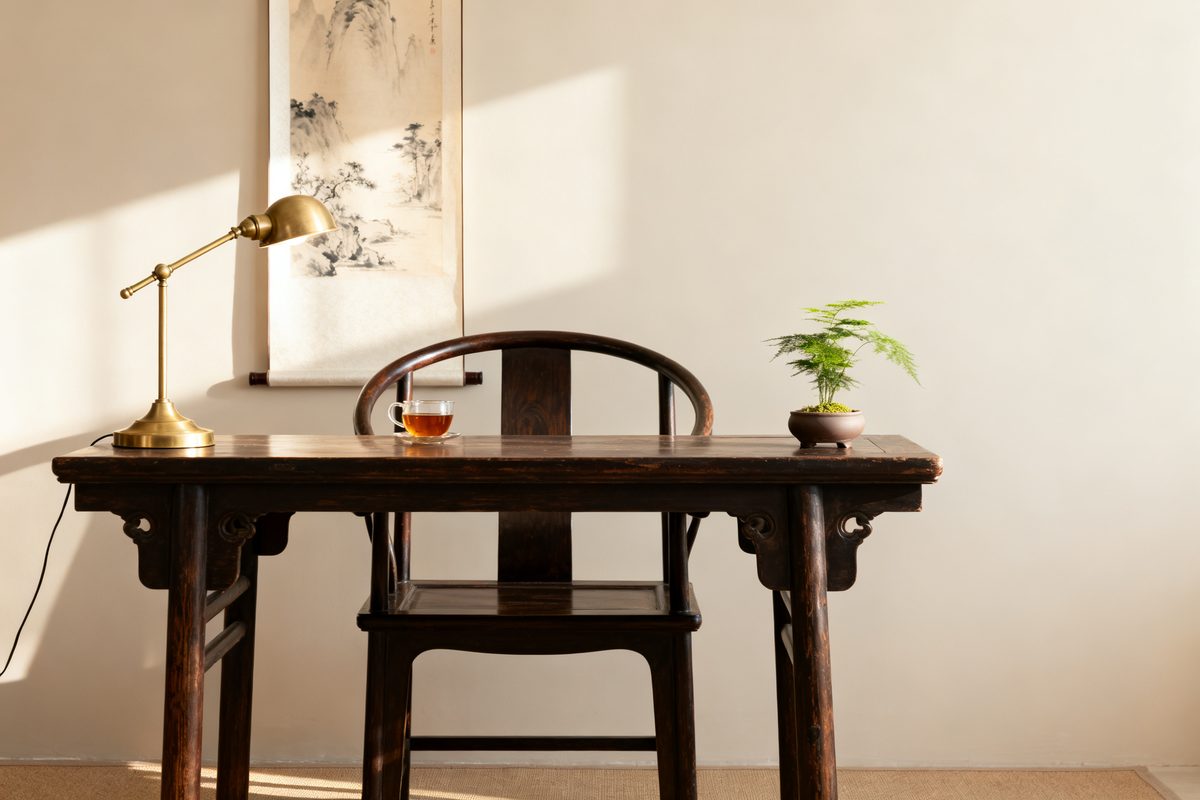
When job hunting, people look for a company with a mountain behind it. When trouble comes, the first thought is whether anyone stands behind you. Even the old armchairs in a traditional house always sit against a solid wall. The emperor's throne backed onto an entire carved golden wall. Visit any old residence, temple, or garden — the host's seat almost never faces away from the door.
At first I thought this was superstition. The more I thought about it, the more it seemed like observation, not superstition.
Your Back Is More Honest Than You Are
Our sensitivity to what's behind us is written into the body.
Animals sleep pressed against a cliff wall, or with the group's watchful eyes toward the open side. When a monkey troop rests, one sentry always faces outward. Humans came out of that kind of vigilance — we've just hidden it inside cubicles.
When your back faces a corridor, your eyes can't see it, but your ears and skin stay on duty. Every footstep is a small waking. You think you're focused on a proposal, but a background process keeps running, checking over and over: is it safe behind me?
Psychology has a term for it — attention residue that never fully releases. Every glance you didn't turn around to make still drains your battery. After three years, I assumed I was just getting older and tireder. Really, my back had been pulling shifts for me the whole time.
Feng shui masters don't talk about attention residue. They just say: no support behind, no peace in the seat.
Two languages, saying the same thing.
I Moved the Desk
After the elder left, I stared at my workstation for a long time.
I couldn't change cubicles — where the company puts teams isn't up to me. But the small things I could do turned out to be more than I expected.
One Friday afternoon, I turned the desk. It couldn't fully back onto a wall, so I angled it, turning the corridor behind me into a corridor beside me — whatever your peripheral vision can cover is the range where your back can relax. Then I put a tall plant at the corner of the desk, on the side behind me, like a gentle screen.
I also raised the back of my chair and added a cushion. It sounds clumsy. But the moment you sit down, you understand — when the lower back is held, the shoulders let go on their own.
When my mom heard about it, she said: isn't that just "a mountain behind your seat"? She never read a feng shui book. She heard it from my grandmother. My grandmother never read one either — she heard it from someone even older.
What gets passed down isn't a spell. It's the experience of "how a person sits comfortably." There just weren't words like "attention" or "open office" back then, so people used mountains as the metaphor.
Don't Turn a Desk Into a Lucky Charm
I don't want to tell this as a "moved the desk, got promoted" story. I didn't. The desk moved; the work stayed the same; the meetings stayed the same.
But one change was real: that nameless irritation at three in the afternoon faded.
Maybe because there was something shielding my back. Or maybe just because I made a decision about one thing — inside a big environment I can't choose, I settled the one small piece I can. Those ten minutes of moving the desk were the first time in three years I took my seat seriously. There's something of dignity in that. The way a person treats their seat quietly becomes the way they treat their life.
The old feng shui books say "mountains govern people, water governs wealth," and they make leaning on a mountain sound weighty. I think the first thing a mountain governs is simply whether you feel okay at three this afternoon. That's enough.
A few days ago I opened the ancient "Classic of the Dwelling" (Huangdi Zhaijing) and found a line: "The dwelling takes its form as the body, and its springs as the blood." The ancients looked at a home as a living thing — it has a body, it breathes. Your workstation is the same. It is your body for eight hours a day. How you arrange it is how you arrange yourself.
I didn't become a feng shui believer. I only admitted one thing: some old sayings, I laughed at first as superstition — then found out they were talking about me.
What's behind the seat you're sitting in right now?
If moving the desk isn't an option, is there one small thing that could make your back easier?
When was the last time you made a decision about where you sit?