Westerners Burn Sage to Cleanse. Chinese People Hang Peach Wood.
A friend lit a bundle of sage to purify her new apartment. Watching the smoke, I thought of the peach wood sword at home. Door gods, spring couplets, cinnabar, red string — behind the Chinese system of protection lies one ancient question: when you're afraid, what can your hand hold?
Emily's new apartment has a smell.
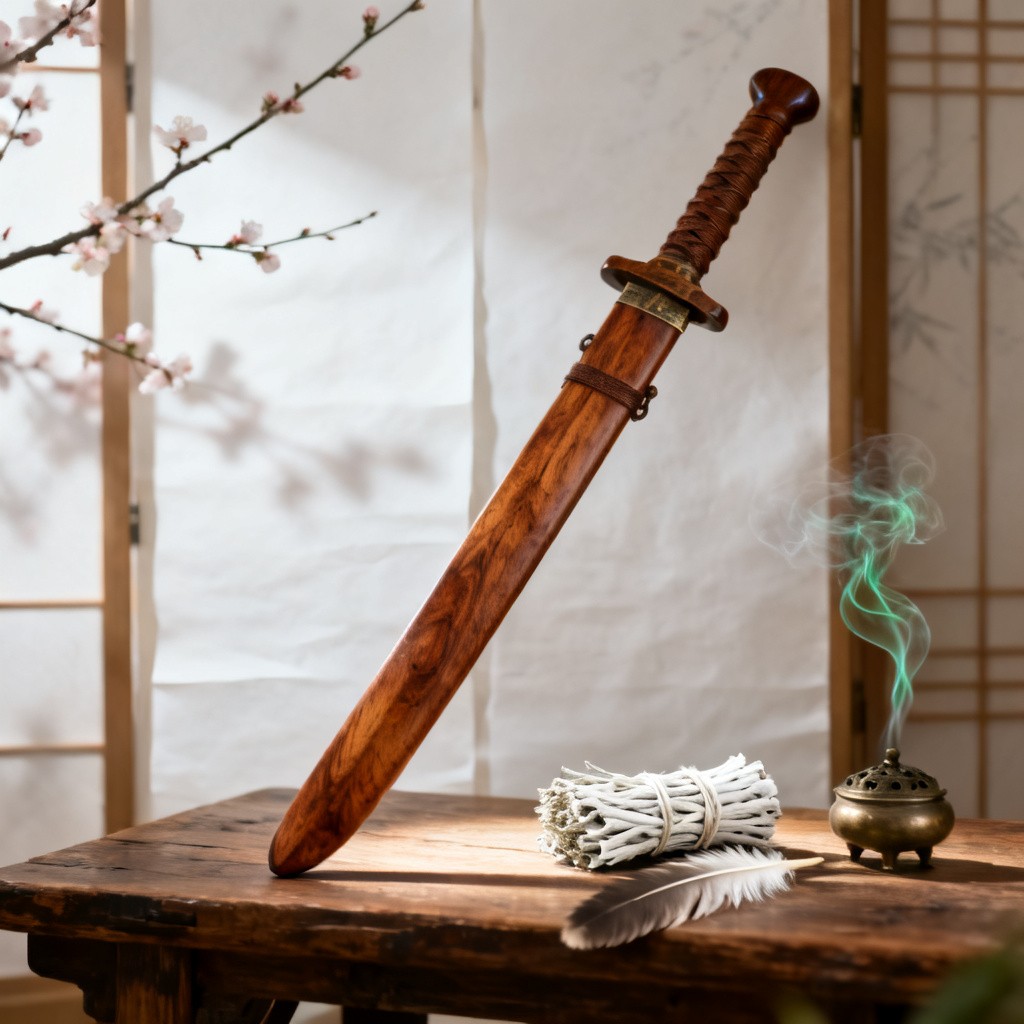
Not a bad one — the smell of herb smoke, faintly sweet, the kind that lingers like incense in a temple. I went over for dinner and found a bundle of white dried herb tied with red string on her coffee table, an abalone shell beside it, and a feather resting in the shell.
Sage, she said. You burn it when you move into a new place. Smudging. It comes from Native American tradition — you carry the smoke into every corner of the house, and the old energy leaves. She picked up the bundle as she talked, lit it again, and fanned the smoke toward her bedroom with the feather.
Watching that thin ribbon of smoke, I suddenly thought of the peach wood sword in my parents' home.
Two smokes, one thing
Emily was serious about her sage. Light it, blow out the flame, let the bundle smolder. Start at the front door, walk clockwise through every room, open the closets too.
I said: this is exactly what Chinese people do with mugwort, incense, and firecrackers after moving in.
She was surprised. Really?
Really. Moving into a new home in China is called "entering the house," and you pick a date for it — the old almanac tells you which day is auspicious. Before you walk in, some families fumigate the rooms with burning mugwort, some scatter salt and rice, some light a stick of incense in every corner. In Cantonese tradition you "worship the four corners." The purpose is always the same: see the old things out, and tell the space — new people have arrived.
Call it superstition if you like. But look closer, and human beings are astonishingly consistent. Catholics have holy water. The Japanese scatter salt at the entrance. Indians light ghee lamps. Americans burn sage. Chinese people burn mugwort and hang peach wood. Across oceans and thousands of years of separate languages, everyone is doing the same thing:
With a little smoke, a scent, a small ritual — renegotiating your relationship with a space.
Psychology calls it "the sense of control that ritual provides." When life changes violently — a move, a breakup, a job loss, an illness — people are frightened. And when you're frightened, performing an ordered sequence of small movements settles the heart. It doesn't matter which way the smoke drifts. What matters is that your hands are moving, and you know what you're doing.
Why the Chinese chose peach wood
Emily asked: so what do Chinese people use?
Peach wood, I said.
She didn't understand. Peach wood? Isn't a peach a fruit?
It is. But in China, peach wood is the essence of the five woods, capable of suppressing evil influence. The idea is at least two thousand years old.
The Shanhaijing tradition tells of a great peach tree on Duoso Mountain in the Eastern Sea, its branches coiling three thousand li. At the northeast corner of the tree is a gate — the Ghost Gate — through which all the ghosts of the world pass. Two deities stand guard at the gate, named Shentu and Yulei. They inspect every ghost. The evil ones are bound with reed ropes and fed to tigers.
When the Yellow Emperor learned of this, the story goes, he taught the people to carve great peach figures, paint images of Shentu and Yulei, and hang reed ropes at their doors to drive off ghosts. This account survives in Lunheng, written in the Han dynasty — where the philosopher Wang Chong recorded, with a certain dry skepticism, the customs of his own time.
And here is the part I love: the Spring Festival couplet grew out of that peach tree.
The earliest couplets were not written on paper. They were written on peach wood boards — "peach charms." When Wang Anshi wrote "always replacing old charms with new peach," that is what he meant. In the Five Dynasties period, Meng Chang of Later Shu inscribed the earliest known couplet on a peach board. Later, paper became cheap, peach boards became red paper, peach charms became spring couplets, and the door gods gradually changed from Shentu and Yulei to the Tang generals Qin Shubao and Yuchi Gong.
So every Lunar New Year, when you paste up your couplets, you are standing under a peach tree three thousand li wide, repeating a gesture two thousand years old.
The wood that fights ghosts
Emily asked a good question: why peach wood? Not oak, not pine — why peach?
I looked into it. There are several threads.
One is a pun: "peach" (tao) sounds like "flee" (tao). Ghosts see peach wood and flee. Very folk logic, and probably not the oldest layer.
One ties it to Houyi, the archer who shot down nine suns. Legend says he was killed by a peach wood staff — struck down by his own student. After death he became Zongbu, the deity who commands all ghosts. The staff that killed the king of ghosts carried its dread ever after; ghosts look at it the way criminals look at an executioner's tool.
And one — the one I find most persuasive — traces peach wood back to older shamanic memory. Peach blossoms open earliest in spring. To the ancients, the tree carried the first yang breath of the year, and yang suppresses yin — and ghosts are yin. Add that peach heartwood is red, and red has always been China's color of suppression: cinnabar is red, couplets are red, the clothes of your zodiac year are red. One piece of wood carrying both yang and red — two wards against evil in a single material.
I don't know which thread is the "true" one. Two thousand years of folk custom tangles its own roots. But here is what fascinates me: Chinese people don't agonize over "why." Chinese people ask "does it work."
Before burning her sage, Emily recites a few words, thanking the plant and her ancestors. Her practice is a relationship with spirits. When Chinese people hang a peach sword or wear a peach wood bracelet, hardly anyone recites anything — you hang it, you wear it, done. What Chinese people want is the feeling that "an object is standing guard for me." Once it hangs there, the heart is at ease. No need to think about it daily.
One culture lives in the ritual process; the other lives in the object itself. The same need — to be protected — grew two completely different shapes.
The many wards of China
Back to Emily. By the end of the story her eyes were bright. So your "cleansing object" is peach wood, she said — ours is a plant, and yours froze the protection inside the wood.
Exactly. And the Chinese took the idea to its full expression. Not just peach wood —
- Cinnabar (zhusha). Talismans are drawn in cinnabar. Daoists call it pure yang, immune to a hundred evils. Today people wear cinnabar bracelets for that same trace of yang.
- Mugwort (aicao). Hung at the door on Dragon Boat Festival. Its scent genuinely repels insects — one of the rare cases where folk custom and science agree completely.
- Copper coins. The "five emperor coins" hang behind doors — copper plus currency, warding off evil and inviting wealth at once.
- Red string. Tied around the wrist in your zodiac year. As simple as an object can be — and the act of tying it is itself the meaning.
Look at the system as a whole: peach wood blocks evil, cinnabar raises yang, mugwort clears foulness, red string binds fortune. None of it is "scientific." But every piece answers the same question:
When I am afraid, what can my hand hold?
When Emily burns sage, her hand holds the feather. When Chinese families paste couplets, their hands hold red paper. Different forms. Full hands, both.
What happened to the sword
Which brings me to the peach wood sword in my family.
Bought years ago at a city god temple, blessed, its hilt wound with brass wire, seven stars of the Big Dipper carved on the scabbard. It hung by my bed for years. Then one year, I took it down.
Not because it stopped working. Because one day I realized I no longer needed "a world kept outside the door." What comes will come; a sword cannot stop it. What I wanted to learn instead was: when things arrive, I am here.
The sword went into a cabinet. Now and then, cleaning, I take it out and hold it. The wood has developed a soft patina, the look of something touched by hands for many years. I still love it — but the way I love it has changed. I no longer expect it to block anything for me. It reminds me instead: when you are afraid, your hand may hold something — but the thing that truly must be steady is the hand that holds.
That is my final understanding of "warding off evil": the evil is not outside. The evil is panic.
Can peach wood suppress panic? For a while. Just as sage smoke can give Emily five quiet minutes. But after five minutes? Back into the days — sleep to sleep, meals to cook, tasks to finish one by one. The Chinese word for fate, "yunqi" — luck, the turning of fortune. Fortune can turn. But it never turns by the edge of a sword. It turns by living differently.
The old saying ranks it: first fate, second fortune, third feng shui, fourth hidden virtue, fifth study. Feng shui sits third — behind fate and fortune, ahead of virtue and study. The ancients themselves understood: objects assist; the person is the root.
Emily later asked if I could give her something Chinese for the new apartment.
I gave her a peach wood "peace tablet" and a small box of cinnabar powder. No chanting required, I said. Just let it sit. She was delighted and asked what it meant. Safe and sound, I said. It doesn't drive anything away. It only says one sentence, every day: may you be safe.
She set the tablet down beside the abalone shell. An American smoke and an Eastern wood, on the same coffee table, each minding its own business.
I think the protection a person needs was never "one culture's" protection. It is this: coming home late at night, pushing open the door, and finding a small order of your own inside — a thread of smoke, a piece of wood, a lamp. The world is vast and disorderly; a small sign at the door that says "I am here" is enough.
Three questions for you
- Is there an object in your home you can't justify but could never remove? What is it?
- What small ritual have you performed to steady yourself — when moving, at New Year, when starting a new job?
- Peach wood lasts; sage smoke disperses. One keeps, one clears. Which do you need more?