The Persimmon's Astringency Just Means Sweetness Isn't Due Yet: Frost's Descent, Autumn's Last Breath
A colleague bit into a persimmon and declared the fruit broken. He just didn't know — astringency is what sweetness looks like before its time. On Frost's Descent: a persimmon's calendar, why frost never actually falls, and the fifteen days Chinese medicine says matter more than all winter tonics.
This afternoon at 5:38, Frost's Descent arrived.
I looked up the exact time on purpose. A solar term isn't a whole day — it's a moment, precise to the minute. The sun reaches 210 degrees on its path, and in that single instant, autumn exhales its last breath.
It was already dark when I left work. The ginkgo trees downstairs aren't fully yellow yet, but as I walked, I caught that dry, burning-leaves smell in the air. Every year, when that smell shows up, I know: autumn has started to pack up.
My mom's call came two days ago, same as every year: Frost's Descent is coming. Wear more. No bare ankles. Eat something moist. I was nodding along when I remembered something —
Last year around this time, a foreign colleague at the office bought a bag of persimmons at the supermarket, took one bite, and announced to everyone with a frown: "This fruit is broken."
The Astringency Just Means It's Not Time Yet
Nothing was wrong with it. He just didn't know.
There are two kinds of persimmons: sweet and astringent. Sweet ones can be eaten right off the tree, but outside Asia, what's often sold is the astringent kind. One bite, and it feels like all the moisture has been pulled out of your mouth — your tongue goes numb and dry. English doesn't really have an everyday word for it. The closest is "astringent," which sounds like a legal term.
What he bought was an astringent persimmon that hadn't been ripened yet.
Later I taught him an old trick: put the persimmons and an apple in the same paper bag, fold the top shut, and wait a few days. He did it, half-doubting. A week later he came back holding a persimmon so soft it was almost translucent, and said it was one of the sweetest fruits he'd ever eaten in his life.
I said, yes — that's a persimmon. Don't touch it while it's bitter. Wait, and it becomes sweeter than almost anything.
Back home there's a saying: "Eat a persimmon at Frost's Descent, and you won't get a runny nose all winter." Half for luck, maybe. But a persimmon's schedule really is tied to this solar term: only around Frost's Descent do they turn truly sweet. Astringency is its youth. Frost is its coming of age.
Frost Never Actually Falls
While writing this, I checked some sources, and one detail stopped me for a long while.
Wang Chong, a scholar in the Eastern Han dynasty nearly two thousand years ago, wrote this in his book: dew, frost, rain, and snow do not fall from the sky — they rise "from the earth." Water vapor near the ground meets the cold night air and settles, leaf by leaf, tile by tile, into frost.
In other words, this solar term is named "Frost's Descent" — but frost never descends. It grows out of the ground on its own. What the name says, and what actually happens, are two different things.
I sat with that detail for a while. The more I turned it over, the more it felt like so many things: what we assume crashes into us from outside — bad luck, restlessness, that burning "shanghuo" feeling — so often grows out of our own ground. When the cold comes, whatever is in the soil is what frosts over.
The Huangdi Neijing, the classic of Chinese medicine, says that in autumn you should "let your mind settle and rest." I think it's saying the same thing: check what's planted in your own ground first, then decide what to water.
Better to Nourish Now Than to Nourish in Winter
There's an old saying: "A year of tonics is not as good as one Frost's Descent." My mother's generation takes it seriously. I used to think it was old-fashioned; now I think there's something to it.
Frost's Descent is the turning point between autumn and winter. In Chinese medicine, these two weeks are when yang energy sinks into the earth, and the human body follows it inward. These fifteen days are the doorway: get the doorway right, and winter has somewhere to store things. And it's not about heavy stews and meat — the tradition calls for gentle nourishing: settle the stomach first, so it can receive the winter that's coming.
None of the actual practices are expensive:
- Stop drinking iced things in the morning. Warm water, or a small bowl of congee.
- Rotate moistening foods — pear, lily bulb, Chinese yam, radish — because the dryness of deep autumn isn't done with us yet.
- The old rule for these two weeks: "keep cold out outside, keep heat down inside." Add the jacket, but hold off on hotpot and barbecue — don't freeze on one end and burn on the other.
- Soak your feet before bed. Water up to the calves, stop when you just begin to sweat.
No secrets there. The whole secret of seasonal living is probably "half a step early": start keeping warm before the cold arrives, start moistening before the dryness bottoms out. By the time your body complains, you're already half a step behind.
For me, tonight's foot soak was the practice. I put my phone aside and just watched the steam curl off the water. Ten minutes later the water had cooled, and I felt strangely clear and loose at the same time. Turns out ten minutes of doing nothing counts as nourishment too.
The Persimmons Left on the Tree, Kept for Winter
After Frost's Descent comes Winter's Beginning. Fifteen days left of autumn.
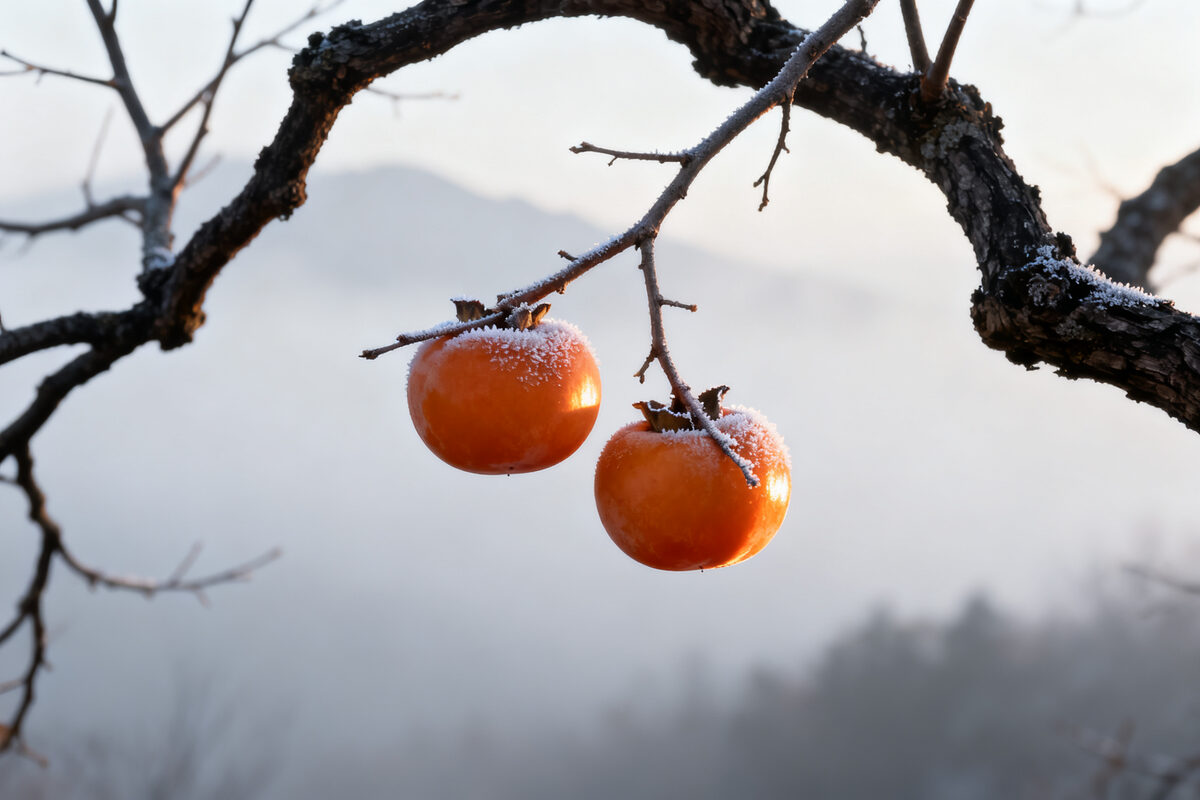
The persimmon tree in my neighborhood has almost lost all its leaves, but the fruit is still hanging — orange dots on bare branches, impossible to miss. I looked it up: persimmons can hang on well into early winter. All the leaves fall, and the fruit stays — kept for the birds, and for whoever passes by in winter.
The astringency passes. Sweetness is something you wait for, not something you rush.
Autumn is slowly breathing out its last breath. Take your time with it too.
Three Questions for You
- Have you ever bitten into an astringent persimmon? Did it ever turn sweet?
- Has your body been warning you about anything — half a step early?
- If frost grows from the ground, then where is your recent restlessness growing from?