Denmark Has Hygge. My Mom Has the Stove
A video about Danish hygge popped up — candles, chunky blankets, mulled wine. I laughed while watching, because my mom has been doing this for decades. She just doesn't know it's called hygge. She calls it sitting around the stove. One charcoal fire, one clay kettle, a few roasted tangerines. Hygge is letting go; the stove is tending. The little difference between them took me three hours by the coals to figure out.
Last Sunday the temperature dropped. I was curled up on the sofa scrolling my phone when a video about hygge came up. The Danish kind: candles, a chunky knit blanket, mulled wine, firewood crackling in the fireplace, a family sitting around it, nobody talking, just... being there. The top comment said: this is what life is about.
I laughed while watching. Not at them — I was thinking of my mom.
Because my mom has been doing this for decades. She just doesn't know it's called hygge. She calls it — sitting around the stove.
A pot of charcoal and a few roasted tangerines
Last winter, a friend dragged me out for tea. Not the formal kind, sitting upright at a tea table. Around a charcoal stove.
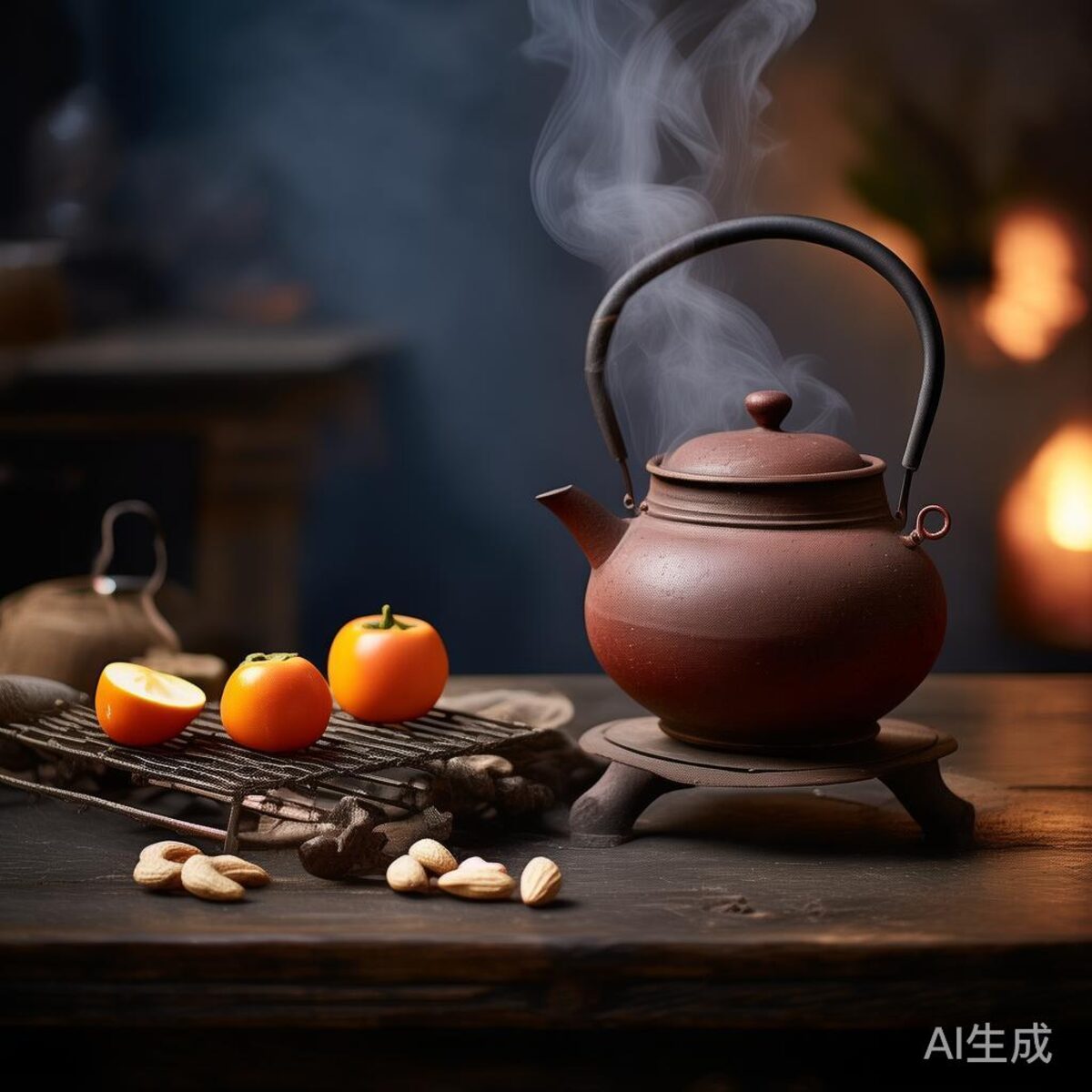
A cast-iron stove, machine-made charcoal, and on top a rough clay kettle. Next to the kettle a wire grill, and on the grill: persimmons, tangerines, peanuts, two pieces of rice cake. The water hadn't boiled yet, but the tangerines were already warm. My friend split one and handed it over: careful, it's hot. The segments had turned half transparent. One bite — hot, sweet, with a little char. That's when I learned you can roast a tangerine.
In the kettle, aged white tea. A Shoumei cake, pressed tight, a small chunk thrown in. The color came out slowly, a deep amber. Discard the first brew, start drinking from the second. Boiled tea and brewed tea are not the same thing — brewed tea has edges; boiled tea doesn't. Its flavor is round, folded inward.
The four of us sat like that for three hours. Charcoal added twice, six tangerines eaten, two rice cakes puffed up, one burst. Not much talking, but no awkward silence either. Someone would remember something, say a line, and we'd all go back to watching the coals.
On the way home I kept thinking: I've seen this somewhere before.
Then it came to me. Around my hometown's fire pit. In a friend's home in Yunnan, years ago. And earlier still, in old books.
Boiling tea is the oldest way — it just came back around
Go to a teahouse now and you'll see brewing. A lidded bowl, a fairness pitcher, tiny cups poured out one by one. Many people assume tea was always drunk this way.
It wasn't. Brewing only goes back to the Ming dynasty — six hundred years, at most. Before that, the Song whisked their tea: leaves ground to powder, paste mixed, a bamboo whisk whipping up a layer of foam. That whole practice crossed the sea to Japan and became the matcha ceremony. And before that, in the Tang dynasty, they boiled it.
Lu Yu, in The Classic of Tea, described boiling water in three stages: first boil, bubbles the size of fish eyes; second boil, strings of pearls welling up from the spring's eye; third boil, the whole surface tumbling like running waves. Past the third boil, the water is "old" — no good anymore.
People twelve hundred years ago could tell, by eye, how done the water was.
In the mountains of Yunnan, this habit never broke. Many villages keep a fire pit burning year-round. A clay pot is nestled in the hot ash, a handful of coarse tea tossed in, toasted and shaken till it's fragrant, then boiling water dashed in — a sizzle, and the whole room smells of it. The locals call it guan-guan tea. Trace today's trendy "stove-side tea" back up the line, and this fire pit is where it lands.
That's why the charcoal stove felt familiar. It's not a new thing. It's an old thing. A thousand-some years of detour — from the Tang pot, to the Song bowl, to the Ming teapot — and back to a clay kettle beside the coals. One big circle. Home again.
Hygge and the stove: the little bit between them
I'm not here to rank them. Hygge is lovely. Every winter in the world needs candles.
But I kept turning it over, and the two things differ by a little bit.
The picture of hygge is getting yourself settled. Blanket on, candle lit, cup in hand, fully at ease. Its keyword is: nothing to do.
The stove is different. The keyword of the stove is: tending.
The charcoal needs adding — not too hot, or the water boils over; not too weak, or it never boils. The tangerines need turning, or one side chars while the other stays cold. When the rice cakes start to puff, you'd better be watching — one beat late and they burn. Persimmons need the skin to wrinkle before the sweetness is coaxed out. By the third boil the tea starts thinning; time to swap it.
You sit at the stove and your hands never quite stop. But it's the lazy, drifting kind of busy — not work, just tending. Eyes on the coals, hands flipping tangerines, mind holding nothing.
I once mentioned this to an elderly lay Buddhist. He said: when your hands are busy with small things, your heart can't hold the big ones. I didn't really get it then. After a few afternoons by the stove, I got it a little. When a person is fully idle, the mind gets loudest. Give the hands something small — something light, something it doesn't matter if you ruin — and the heart settles down, bit by bit, like the charcoal.
Hygge is letting go. The stove is tending. Letting go steps outside life for a while. Tending stays inside life, but takes it slow.
Maybe Chinese people never quite trusted "complete relaxation." What we trust is that a day needs someone keeping watch. Watching over a fire, watching over a kettle, watching over a few tangerines. Keep watch long enough, and the afternoon passes — and whatever was weighing on you passes with it.
Go drink tea
Writing this, I remembered an old story.
The Tang master Zhaozhou. Two monks came a long way to see him. He asked the first: been here before? Yes, said the monk. Zhaozhou said: go drink tea. He asked the second. No, never, said that one. Zhaozhou said: go drink tea.
The monastery steward couldn't take it: why does the one who's been here get tea, and the one who hasn't also get tea? Zhaozhou looked at him and said: go drink tea.
A thousand years, and people are still telling it, peeling layers off it. My understanding is shallow, so I'll take the shallowest layer: however big the question, at the very bottom it's just one bowl of tea. You've arrived — the tea is hot. You're confused — the tea is still hot. Drink it first.
Stove-side tea, in the end, is something like that. It solves nothing. It just sits you down beside the coals and gets one hot bowl of tea into you.
Coda
Another cold night coming. I'm going to haul out the stove, dig up last year's leftover charcoal, and try boiling a pot myself.
I used to think "ritual" was a pretentious word. Now I think it depends. Some rituals are performed for others. Some are a step you build for yourself — and up that step you walk, out of the phone, over to the charcoal, and sit down.
The coals will glow. The water will boil. The tangerines will be sweet. That's enough for now.
Three questions, for you and for me:
- When was the last time you sat quietly for two full hours, no phone?
- Does your family have its own kind of "stove" for winter — not necessarily charcoal. A pot of soup counts. A pot of congee counts.
- If you had to tend one thing all afternoon, what would you choose?