The Tai Sui You're Told to Fear Is a Star That Doesn't Exist
In 2026, four zodiac signs "offend Tai Sui." A friend warned me to be careful — and I got stuck on one question: what IS Tai Sui? One night of digging later: the star we've feared for two thousand years was invented. Jupiter circles in 11.86 years, so the ancients imagined a perfect star that never runs fast or slow. Tai Sui isn't superstition. It's a written acknowledgment of a mistake.
A few days ago, a friend suddenly messaged me: be careful next year
She said 2026 is the Year of the Fire Horse. She was born in the year of the Rat, and the Rat clashes head-on with the Horse. "You're offending Tai Sui," she said. Then she added, helpfully: "Check your own zodiac. Maybe you offend too."
I was born in the year of the Ox. I checked. Ox and Horse form a "harm" relationship. I offend too.
Great — both of us, then. She sent me a hug emoji and forwarded a post: offending by position, by clash, by punishment, by harm, by break — in a Horse year, the offending signs are Horse, Rat, Ox, and Rabbit. I counted. Twelve zodiac animals, four of them flagged.
Honestly, my first reaction wasn't fear. It was amusement — this list has better coverage than the "nodules" section of a health report. But halfway through laughing, I got stuck on one question:
What exactly IS Tai Sui?
I've "known" this word since childhood. My mom said, never disturb the ground over Tai Sui's head. But if you asked me what Tai Sui actually is, I couldn't give you a single word.
So I decided to look it up. One lookup turned into a whole night. And at the end of it, I laughed out loud, alone, at my screen.
The first answer: the Tai Sui in the dirt
Let's start with the strangest one.
There's a thing called the "Tai Sui flesh." Old materia medica books called it a "flesh lingzhi" — something that grows underground, looks like meat, and grows back after you cut it. Folk belief says if you dig it up while laying a foundation, it's terribly unlucky. That's the oldest meaning of "disturbing the ground over Tai Sui's head" — not above a star, but literally in the soil, disturbing the Tai Sui itself.
Every few years there's a news story about it. A construction site digs up a big pale soft blob, a reporter goes to ask an expert, and the expert says it's a slime mold colony, a rare composite organism. Some get sent to labs. Some, reportedly, got stewed.
But that "flesh Tai Sui" is not the Tai Sui of the zodiac. Like "the North Pole" and "the North Star" — they sound like relatives, but one is on the earth and one is in the sky.
The zodiac's Tai Sui is in the sky.
The second answer: a star that can't keep time
The second answer came from a book on ancient astronomy. This one made me sit up straight.
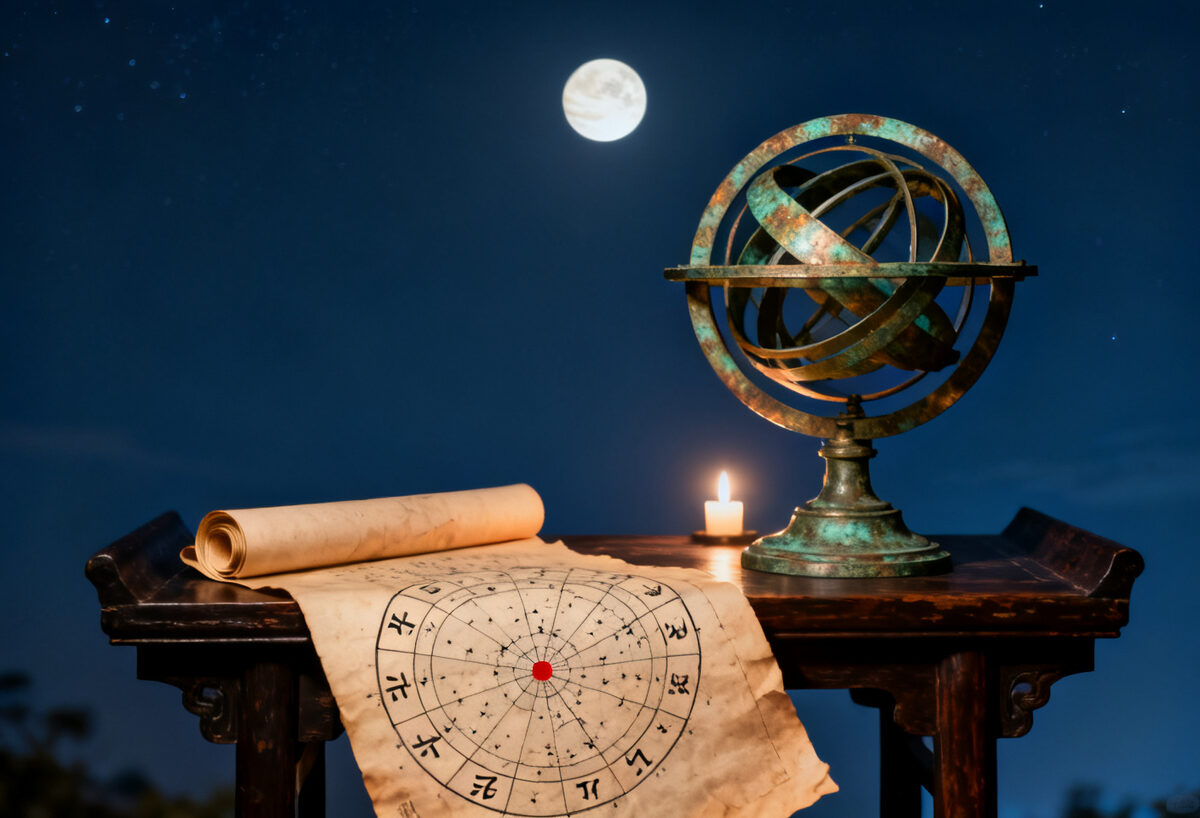
The ancients looked up and noticed one star that behaved strangely. Unlike the others, it didn't sit still. Every year it drifted a little eastward — slowly, steadily, like the hand of a clock. One full circuit took about twelve years.
That star is Jupiter.
Twelve years per lap — sound familiar? The twelve zodiac animals were walked out by this star. The ancients divided the sky into twelve sections, and Jupiter paused in one section each year. This great celestial clock: one notch per year. That's why Jupiter's ancient Chinese name was the "Year Star." Sui — as in sui sui, year after year.
Using a star as the calendar. I sat with that for a long time. Two thousand years ago, no clocks, no calendar alerts — and yet the question "what year is it" had an answer: look up, see which section Jupiter is in.
But here the story hits a stubborn little problem.
Jupiter's circuit isn't exactly twelve years. It's 11.86.
Close enough, right? But with a clock, "close enough" is fatal. After eighty-four years, this celestial clock runs a full section behind. Give it a few more centuries and it points to the wrong years entirely.
So how did the ancients fix it?
I assumed they'd build correction tables. Instead, they did something I never saw coming: they fired Jupiter.
They supposed there was another star in the sky — a perfect star, circling in exactly twelve years, never fast, never slow. For convenience, they had it run opposite to Jupiter. Then they gave this star its name: Tai Sui.
In other words, Tai Sui is a manufactured star. It doesn't exist. No one has ever seen it; no one ever will. It was computed — a perfect, imaginary hand drawn onto the sky to correct a clock that couldn't keep time.
The night I learned this, I genuinely laughed. The thing we've feared for two thousand years is a star that doesn't exist. Like having a watch that runs slow — and instead of fixing it, you draw a watch that's always right, and live by that.
But the laugh didn't quite finish. Because I realized this nonexistent star might be the most honest thing the ancients ever made. They knew their clock was off. They didn't fool themselves. They measured the error, wrote it down, and gave it a place of honor in the sky.
Tai Sui isn't superstition. Tai Sui is a written acknowledgment of a mistake.
So what does "offending Tai Sui" actually mean
Once you know what Tai Sui is, "offending" it becomes easy to picture.
This imaginary hand sweeps one notch per year — twelve years per full sweep — and each year it points at one zodiac position. Next year it points at the Horse.
If you were born in a Horse year, the hand is pointing straight at you — that's your zodiac year, benmingnian. If you're a Rat, you sit directly opposite — the hand crashes into you head-on, traditionally considered even more turbulent than a benmingnian. Add in the punishment, harm, and break relationships, and the full list is Horse, Rat, Ox, Rabbit.
In plain language: the great twelve-year clock is sweeping past you next year.
Is that good or bad? The traditional view is refreshingly neutral: it means movement. Big movement — which can carry bad things, or good. That's why a Tai Sui year calls for steadiness. Fewer wild swings. In the first lunar month, go to a temple and pay respects to Tai Sui — in Cantonese areas they call it "securing Tai Sui." Wear a little red. At year's end, go back and say thank you. Like greeting the person on duty: this is your shift, and I'll behave.
What does the West call the same star
Curious, I searched for how the West sees this star.
Turns out Western astrology fell for Jupiter too. They have a concept called the "Jupiter Return" — Jupiter coming back to the position it held when you were born, once every twelve years. And here's the thing: your Jupiter Return years and your Chinese zodiac years are, give or take, the same years.
One planet, swinging back around every twelve years. The East says: Tai Sui sits overhead — lie low, wear red, stay steady. The West says: Jupiter Return is your year of expansion, opportunity, renewed faith — go push, go ask, go begin.
One tells you to hold. One tells you to charge. Which is right?
My own feeling: they're describing the two halves of the same year. The year the hand sweeps over you, one twelve-year cycle is ending and another is beginning. It's a time to close things out, and a time to start things up. Those who cling to the ending see "hold." Those who rush the beginning see "charge." The star just walks its path. The rest is what people say to themselves.
The Fire Horse that comes once every sixty years
One more thing. This Fire Horse year comes once in sixty.
2026 is a bingwu year — fire in the heavenly stem, fire in the earthly branch, a horse burning double. The last bingwu year was 1966. Japan used the same calendar, and a folk belief said girls born in Fire Horse years were too fierce — so that year, births dropped by more than twenty percent. Tens of thousands of children who might have arrived that year didn't — because of a star that doesn't exist.
Decades later, the Fire Horses of 1966 grew up and grew old, indistinguishable from people born in any other year. The star decided nothing. What decided it was fear of the star, living in human hearts.
So if someone tells you a Fire Horse year runs too hot and needs taming — you can listen, or not. Honoring Tai Sui can be a solemn way to begin a year. It should never be a sentence handed down to frighten you.
That night, I went out and looked at it
The night I wrote this, I stepped outside and looked for Jupiter. On an autumn evening it hangs in the southeastern sky — bright, and it doesn't twinkle much. Planets rarely do; that's the trick for telling them from stars. Clouds drifted past. It just stayed there.
It doesn't know it's called the Year Star. It doesn't know it's called Jupiter. It doesn't know that down below, two civilizations have spent millennia — one inventing a fake star out of it and fearing that star for two thousand years, the other plotting its returns and making wishes on schedule. It just finishes its circle, every 11.86 years.
An error of 0.14 years. For two thousand years, our clocks have come and gone, and we're still working around that little gap.
I stood downstairs and watched it for a while, thinking: next year the hand sweeps over me. Ox and Horse — harm. Fine, let it harm. I'll pay my respects, wear my red, and live my year well.
If a star that doesn't exist can be in charge of a year, why can't a star that does?
Three questions for you:
- Does your zodiac sign offend Tai Sui next year? Position, clash, punishment, harm, or break — look it up and tell me which one you are.
- Same event, two civilizations: one says "stay steady," the other says "go big." In the year your own hand swept past you — which sentence did you hear?
- If you had to give "error" a place of honor — the way the ancients reserved a star position for Tai Sui — what's the nonexistent star in your own life?