Your Body Isn't Broken, It's Clogged: Understanding Dampness in Chinese Medicine
A friend visited from the States and felt inexplicably heavy. I brewed adzuki bean tea and talked about dampness in Chinese medicine - not mysticism, just the body speaking.
A friend visited me from the States recently. She drinks ice water with every meal, eats salad for dinner, and scrolls her phone until midnight. On the third day she said, "I don't know what it is, but I feel so heavy here. It's not jet lag. It's like the tiredness is coming from inside my bones."
I was brewing adzuki bean tea at the time. I smiled and told her two words: dampness.
She looked at me like I'd said something mystical.
But honestly, dampness is probably one of the most underestimated concepts in Chinese medicine, and one of the things that affects daily life the most. It's not a disease — you won't find anything wrong in a blood test. You just feel off. Your head feels wrapped in a wet towel. Your limbs feel like they're filled with lead. You wake up with a thick white coating on your tongue. Your face gets oily. That little belly just won't go away.
I used to not believe in any of this either.
First Time I Heard About "Dampness"
It was many years ago, when my grandmother was still around.
I had just started working, pulling late nights every day, living on takeout. In summer I craved cold things — iced beer, chilled watermelon, air conditioning on full blast. One time I went home to visit, my grandmother looked at my face and said, "You have a lot of dampness."
I didn't understand. I thought she meant I was sweating too much.
She didn't explain much. She just got up the next morning and made a pot of adzuki bean and barley tea. That was the first time I tasted it — mild, not really good or bad, but after drinking it, my body seemed to let out a small sigh of relief.
Later I started learning a bit of Chinese medicine on my own, and I finally understood what dampness meant.
So What Is Dampness?
I'm not a doctor, so I can't explain it in professional terms. But the way I understand it, dampness is basically excess water in the body — water that should have been drained but wasn't, water that should have been flowing but got stuck.
Imagine a potted plant on your balcony. You overwatered it, and the pot has no drainage hole. Water sits there. The soil turns sticky and foul. The roots start to rot. From the outside the plant still looks okay, but inside, things are already going wrong.
The human body isn't so different.
Chinese medicine says "dampness is a yin pathogen, its nature is heavy, turbid, and sticky." In plain English: dampness is heavy, sticky, and once it gets into your body, it's incredibly hard to get rid of. It's not like a cold — you can't just sweat it out. Dampness is that guest who overstays their welcome.
And the most annoying part is that dampness can affect almost every part of your body:
- Head: dizziness, brain fog, like wearing a tight hat
- Limbs: heavy and weak, no desire to move
- Digestion: bloating, poor appetite, sticky stool that's hard to flush (I know it's awkward, but it's one of the most direct signs)
- Skin: oiliness, acne, eczema
- Mood: drowsiness, low energy, feeling like you're growing mold
Where Does Dampness Come From?
I thought about this for a long time. Because I was the kind of person who knew dampness was bad but kept creating it anyway.
Here's what I figured out:
First, from what you eat.
Too much cold and raw food. Ice water, ice cream, cold salads, eating fruit like it's a meal. These cold things damage the spleen and stomach, which are the body's "drainage system" for fluids. Break the drainage, and water starts to accumulate.
Sweets too. Chinese medicine says "sweetness promotes dampness" — too much sugar and you're asking for it. Milk tea, cake, all those desserts taste great going down, but leave your body feeling sluggish.
Greasy food as well. Fried chicken, BBQ, heavy takeout — these are hard to digest. When your digestive system can't process them, they turn into dampness.
Second, from where you live.
Living in a damp environment — wet floors, clothes that won't dry, moldy walls — the external dampness gets into your body too. Especially in the south during plum rain season, the entire air is saturated with moisture. Even if you don't "eat" dampness, you'll "breathe" it.
Third, from not moving enough.
Modern people's biggest problem isn't doing too much, but moving too little. Sitting for hours, blood and qi circulation slows down, and the body's fluid metabolism slows with it. Water sits there, accumulates day after day, and becomes dampness.
I had a period like that. Ten hours a day in front of a computer, my only exercise being the walk from chair to fridge. I felt terrible — yellowish complexion, thick tongue coating, loose stool. I went to see a Chinese medicine doctor, who took my pulse and said: "Spleen deficiency with damp encumbrance."
I asked how to treat it. He said something I've never forgotten: "Your body isn't broken. You've just clogged it up yourself."
How to Tell If You Have Dampness
I learned a simple self-check method. Doesn't cost a cent.
Wake up in the morning, look in the mirror, and stick out your tongue.
A normal tongue is light pink with a thin white coating, neither too dry nor too wet.
If you have heavy dampness, you'll see:
- A thick, greasy coating — white or yellowish
- Teeth marks along the edges, like a wavy pattern pressed by your teeth (this happens because the tongue swells from moisture and gets pressed against the teeth)
- A tongue that looks puffy and watery
Other signs:
- Waking up exhausted no matter how long you slept
- Going to sleep with wet hair
- Cloudy urine
- For women, increased discharge
- Frequent mouth ulcers
- Wanting to lie down right after eating
If you check three or more of these, dampness has probably found you.
My Simple, Dumb Methods for Clearing Dampness
I'm no wellness guru. These are just things I've tried that worked for me. They might not work for everyone, but maybe they'll help someone.
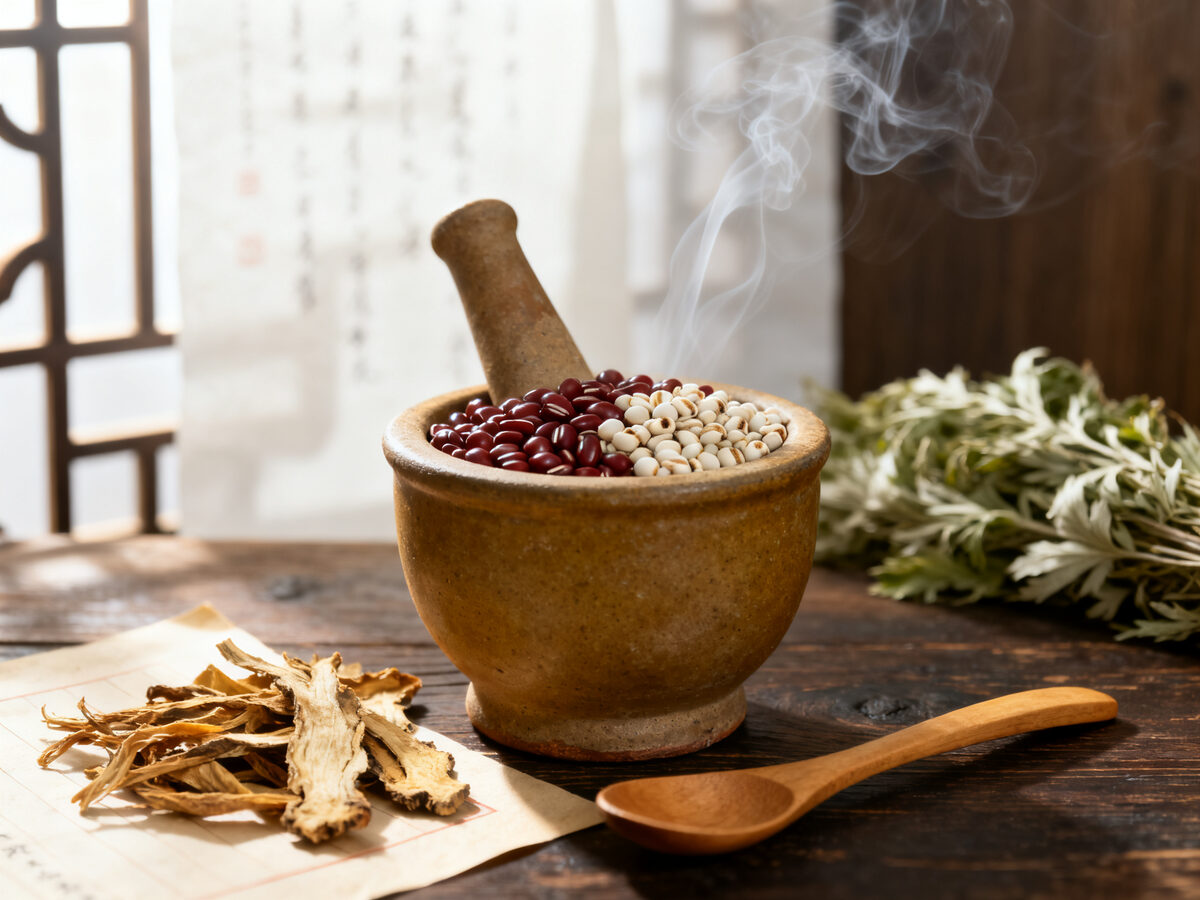
1. Adzuki Bean and Barley Tea
My grandmother taught me this, and it's what I've stuck with longest.
Note: the "red bean" in Chinese medicine is actually adzuki bean (chi xiao dou), not the large red beans used for sweet bean paste. Adzuki beans are thin and elongated, and much better for dampness. The barley (yi mi) is best roasted — raw barley is cooling, but roasted is gentler.
Simple method: one handful each of adzuki beans and roasted barley, soak for two hours, boil for forty minutes. Drink it as water. No sugar needed.
Since coming back from the States, I've been brewing a pot every morning as my water for the day. After about two weeks, the biggest change was that waking up wasn't so hard anymore. My tongue coating went from thick white to a thin layer.
2. Foot Soaking
I've mentioned this many times. Every night, soak your feet in hot water — not too hot, around 40°C — for fifteen to twenty minutes, until you break a light sweat.
To boost the dampness-clearing effect, add a few slices of fresh ginger or a handful of mugwort (ai cao).
My experience: after soaking, I feel lighter. Not a weight-change kind of light, but something inside — like something is slowly dispersing.
3. Moxibustion
Last winter I started trying moxibustion. I usually apply it to Zusanli (four finger-widths below the knee, outside) and Zhongwan (four finger-widths above the navel).
Honestly, the first time the smoke almost choked me. But afterward, my stomach felt warm and cozy, and I slept incredibly well that night.
The principle, as I understand it, is using the warmth of mugwort to drive out cold and damp. Like lighting a fire in a damp, dark room — not to burn the room down, but to get the air moving.
4. Movement
The most effective but also the hardest to maintain.
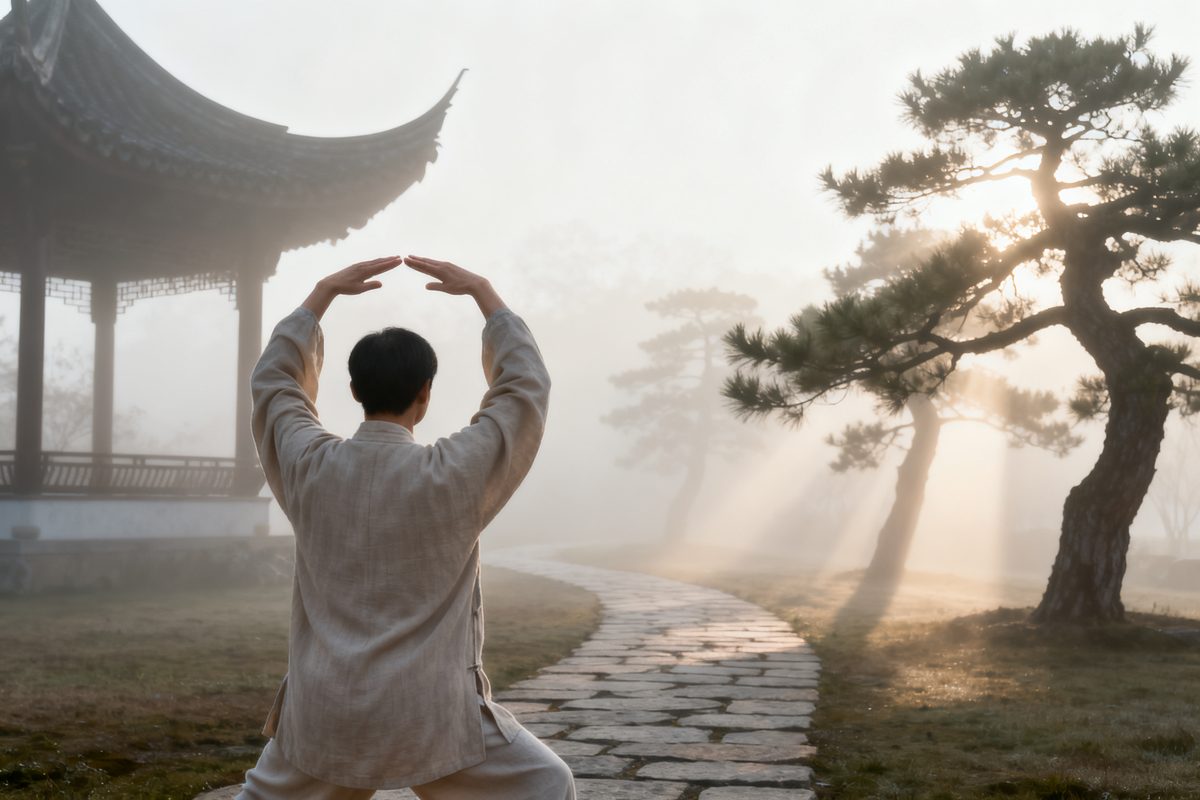
No need for intense exercise. Brisk walking, Baduanjin, tai chi — anything that gets you to a light sweat. Chinese medicine says "a light sweat and dampness leaves on its own." But note: don't drench yourself. Heavy sweating actually damages your qi.
I practice Baduanjin every morning now, about twenty minutes. Afterward my body is slightly warm with a fine layer of sweat. It feels like the inside of my body opened a window and let the breeze in.
5. Less Cold Food
Simple to say, hardest to do.
Especially in summer, not drinking ice water is almost a spiritual practice in modern society. But I did notice that when I switched from ice water to warm water, my digestion improved significantly.
A friend put it more directly: "Your spleen and stomach are like a stove. Pour ice water on them and the fire goes out."
One More Thing About Dampness
I hesitated writing this far.
Because dampness is real and useful in Chinese medicine, but it's also easily exploited. The internet is full of "miracle dampness cures" — expensive tea bags, patches, gadgets. As if dampness is a terrifying enemy that requires spending money to defeat.
I don't think that's right.
Dampness isn't an enemy. It's more like a signal from your body — telling you that your recent lifestyle might have a problem. Too much cold food, too little movement, too late to bed, too much stress.
Clearing dampness doesn't require buying anything expensive. A bowl of adzuki bean tea, a basin of hot water for your feet, a daily walk. These methods have existed for thousands of years. They don't need to be invented or packaged.
Sometimes I think the wisest thing about Chinese medicine isn't the complex formulas or theories, but the most basic premise: your body and nature are connected. How you treat it is how it responds. Give it ice water and it tells you it's uncomfortable through heaviness. Give it warmth and movement, and slowly, bit by bit, it clears out what doesn't belong.
Before my American friend left, I packed her a small bag of adzuki beans and roasted barley. I told her to try brewing it when she got home, and to stop drinking ice water every day.
She took it with a smile and said, "This is very Chinese."
I said, maybe. But for thousands of years, this bowl of water has helped a lot of people. Not because it's magical, but because it respects a simple fact: people need warmth.
A few questions for myself, and for you:
- Have you ever felt that vague heaviness — "nothing's specifically wrong, but I just feel weighed down"?
- When was the last time you soaked your feet properly?
- If dampness is a letter from your body, what do you think it's trying to say?