Azure Dragon on the Left, White Tiger on the Right: An Old Movie Line That's Actually a 2,000-Year-Old Map
"Azure Dragon on the left, White Tiger on the right" sounds like movie swagger. It's actually a feng shui formula — a 2,000-year-old map of star mansions, city gates, roof tiles, and the dragon that raises its head each spring.
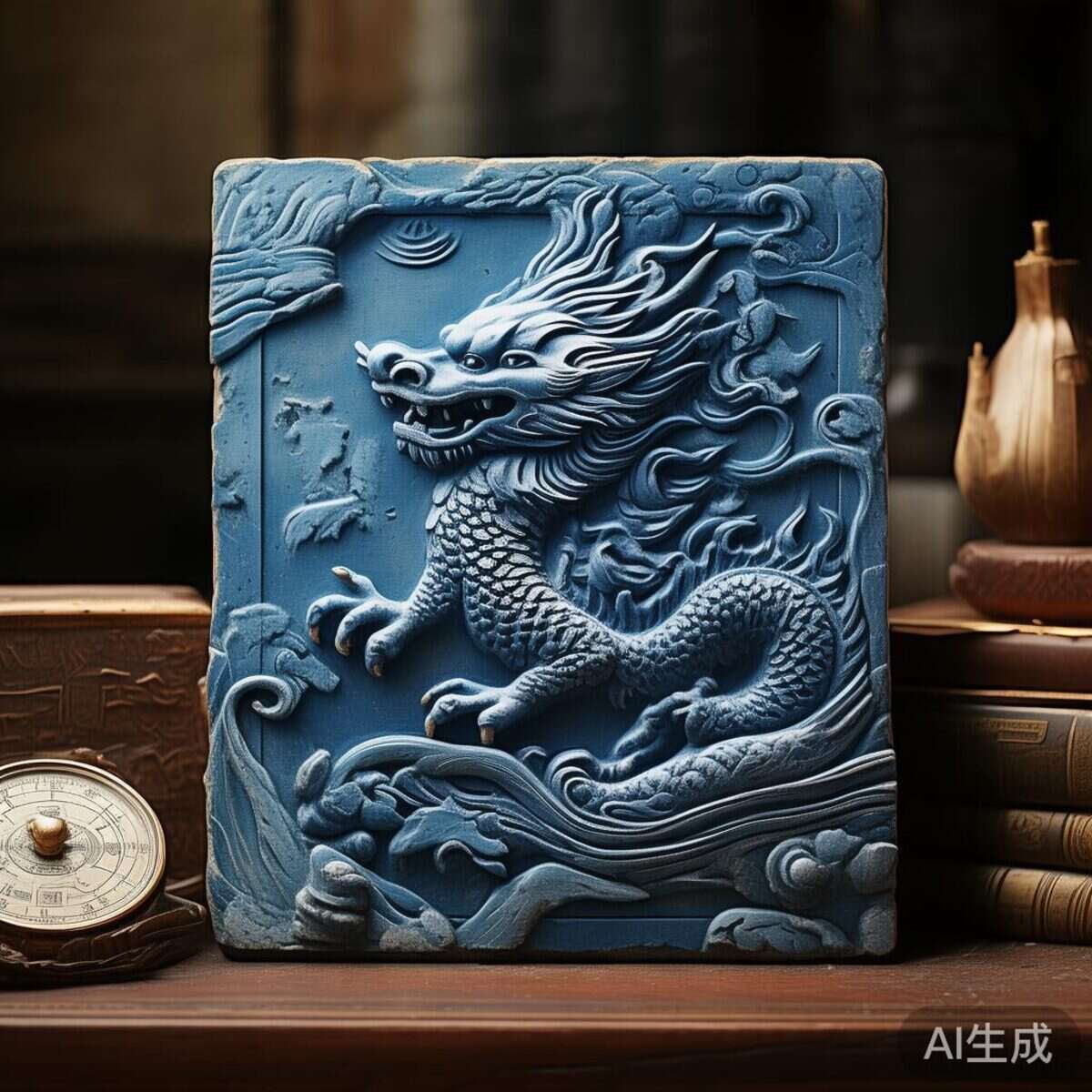
I rewatched an old Hong Kong movie over the weekend. I don't remember much of the plot, but one shot stayed with me: the boss lifts his shirt, shows his tattoos, and says, "Azure Dragon on the left, White Tiger on the right."
When I was a kid, it just sounded tough. Eight words, with their own drumbeat.
That night, I paused. Because I remembered something: those eight words weren't invented by a screenwriter. They're much older than the movies. They're a feng shui formula. And behind that formula is a map of directions the Chinese have been drawing for more than two thousand years.
It Started in the Sky
To understand "Azure Dragon on the left," you first have to look up.
The ancients had no phones, no calendar apps. They had the sky. At night, with nothing else to do, they watched the stars. Over time, they sorted the stars near the sun's path into twenty-eight groups — the Twenty-Eight Mansions.
These groups were divided into four teams by direction, seven groups each. Connected together, each team looked like an animal:
- The seven eastern mansions looked like a dragon. East belongs to wood, to spring, and its color is azure. Hence the Azure Dragon.
- The seven southern mansions looked like a bird. South belongs to fire, to summer, its color is vermilion. Hence the Vermilion Bird.
- The seven western mansions looked like a tiger. West belongs to metal, to autumn, its color is white. Hence the White Tiger.
- The seven northern mansions looked like a turtle wrapped by a snake. North belongs to water, to winter, its color is black (xuan means dark). Hence the Black Tortoise.
Notice: these are not four animals. They are a coordinate system. Direction, color, season, element — all welded together. When an ancient Chinese person heard "east," they heard spring, azure, wood, growth. One word, four layers.
This system has a name: the Four Symbols.
Which Dragon Raises Its Head
Every year on the second day of the second lunar month, "the dragon raises its head," and barbershops in China have lines out the door. My mother told me from childhood: a haircut on this day means a smooth year. But which dragon raises its head?
The one in the sky.
Specifically, the first of the seven eastern mansions, called Jiao — the horn. In early February's dusk, Jiao emerges above the eastern horizon. First the horn, then slowly the whole dragon climbs into the night sky. The ancients looked up and said: the dragon is raising its head.
On the ground, grass was sprouting around the same time. The dragon lifts its head in the sky; spring starts work on the earth. That's why this day is also called the Spring Plowing Festival.
A barbershop queue, traced upward two thousand years, ends at the stars. The line was never cut.
A City Is a Star Map
What fascinates me even more is how the four symbols came down to the ground.
A friend visited Xi'an last year and told me about a street called Zhuque Street — Vermilion Bird Street.
That's not a random name.
In Tang dynasty Chang'an, the great southern gate was called the Vermilion Bird Gate, and the central axis outside it, Vermilion Bird Street. Why name the southern gate after a bird? Because south belongs to fire, its color is vermilion, its creature the great bird. The person naming it wasn't looking for a pretty word. They were carving the sky's coordinates into the city.
Beijing is the same. The north gate of the Forbidden City was called Xuanwu Gate in the Ming dynasty — north belongs to water, its creature Xuanwu. Then came the Kangxi Emperor, whose personal name was Xuanye. To avoid his name, the character xuan could no longer be used. The gate became today's Shenwu Gate.
A city gate's name holds a direction, an element, a divine beast, and an emperor's name. Walking down Vermilion Bird Street is walking through the sky.
A Universe on the Roof
The four symbols can get even smaller — as small as a roof.
In the Han dynasty, people fixed round tiles called wadang on the eaves. Among excavated Han wadang there is a set called the Four Guardians: one carved with the dragon, one with the tiger, one with the bird, one with the turtle-snake — one for each direction.
A roof, four directions, four beasts. However small the house, the person inside lived at the exact center of the universe.
I once saw Han wadang behind museum glass. Honestly, at first glance they aren't stunning — just grey clay discs. But stand there a while, and you get goosebumps. Two thousand years ago, a common craftsman pressed the directions of the stars into the eaves of an ordinary family's home, with his hands in the mud.
Back to That Movie Line
Now we can return to the movie.
"Azure Dragon on the left, White Tiger on the right" is a feng shui formula. It assumes a house facing south: standing inside looking out, your left hand is east, your right hand is west. The left is the dragon's side, the right the tiger's. Feng shui prefers the dragon side a little higher than the tiger side.
So that movie boss, with a dragon on his left shoulder and a tiger on his right, probably didn't know: he had a two-thousand-year-old map tattooed on his body. With the directions correct, even.
I've seen people abroad on TikTok with the four guardians tattooed down one arm — dragon, tiger, bird, turtle-snake. Someone asked what it meant. The person with the tattoo couldn't really say: "Chinese mythology, looks sick."
It does look sick. He just doesn't know that what's wrapped around his arm is a complete coordinate system: four animals, four directions, four elements, four seasons.
Why Directions Calm Us
Finally, why this fascinates me.
When people get lost, the first instinct isn't fear — it's to look for direction. Look for the sun, for the North Star, for anything that tells you where you are. A sense of direction is almost the same thing as a sense of safety.
Two thousand years ago, people could look up and see that dragon. In spring it lifted its head in the east; in summer it stretched overhead; in autumn it sank west; in winter it slipped below the horizon. The dragon's position was the season; the season was time; time told you whether to sow or to harvest.
No app reminders. The night sky was one huge system that never crashed.
We have GPS now, precise to six decimal places. But that settled feeling of knowing where you stand hasn't grown with it. Instead, when I occasionally look up and recognize Orion's belt, something in me goes quiet — ah, winter is coming.
When the ancients recognized that first horn of the dragon, I think it was the same quiet.
The dragon in the sky lifted its head twice, and two thousand years passed.
Three Questions for You
- Does your city have streets or gates named after directions, colors, or mythical beasts? Next time you pass one, look up where its name came from.
- Do you know which side of your desk or your home is the "Azure Dragon" side? You don't have to believe in feng shui. Knowing is interesting enough.
- When was the last time you really looked at the stars?