The Night Before Mercury Retrograde, I Thought of Twenty-Nine Comets in a Tomb
On October 24 the third Mercury retrograde of the year begins, and the internet is rescheduling contracts again. 2,100 years ago in Changsha, someone drew twenty-nine comets onto silk — the earliest comet drawings humanity has. Fear is instinct. Drawing what you fear is civilization.
Last night I was scrolling on my phone and saw several bloggers overseas counting down. Not to a holiday — to a planet. Mercury. On October 24, the third Mercury retrograde of the year begins, and it runs until November 13.
The comment sections were full of groans. Someone said they'd pushed their moving date to December. Someone rescheduled a contract signing until after the retrograde. Someone backed up their computer three times. And someone earnestly warned everyone: these weeks, ignore any ex who suddenly texts you. They probably will come back.
The first time I learned the words "Mercury retrograde," an American friend taught me. She said it very seriously: Mercury retrograde. Communication goes wrong. Electronics break. Contracts fall apart. She showed me the astrology app on her phone, with precautions detailed down to "don't send important emails this week."
Honestly, my first reaction was to laugh. But after laughing, something felt familiar.
The familiarity came from my mom. She doesn't know Mercury. But she knows the broom star.
We were afraid too
When a comet swept across the night sky trailing its long tail, people in ancient China called it a "beixing," a "long star," or more plainly — the broom star. A bad omen. War. Famine. Old people forbade children from pointing at it.
The Spring and Autumn Annals records one line: "In autumn, the seventh month, a broom star entered the Dipper." That was the fourteenth year of Duke Wen of Lu — 613 BCE by our calendar. Ten characters, one comet brushing past the Big Dipper. Many scholars believe this is the earliest written record of Halley's Comet in human history. Whether it was really Halley, no one can be one hundred percent sure. The people who looked up that night didn't know. The person who wrote those ten characters didn't know either.
But they wrote it down.
That's the part I most want to talk about. Keep reading.
1973, Changsha, a Han dynasty tomb
In 1973, archaeologists opened Han Tomb No. 3 at Mawangdui in Changsha. The occupant was a young lord of the Dai household, buried around 168 BCE — more than 2,100 years ago. The tomb held many things: lacquerware, silk paintings, bamboo slips, and a whole cache of books written on silk.
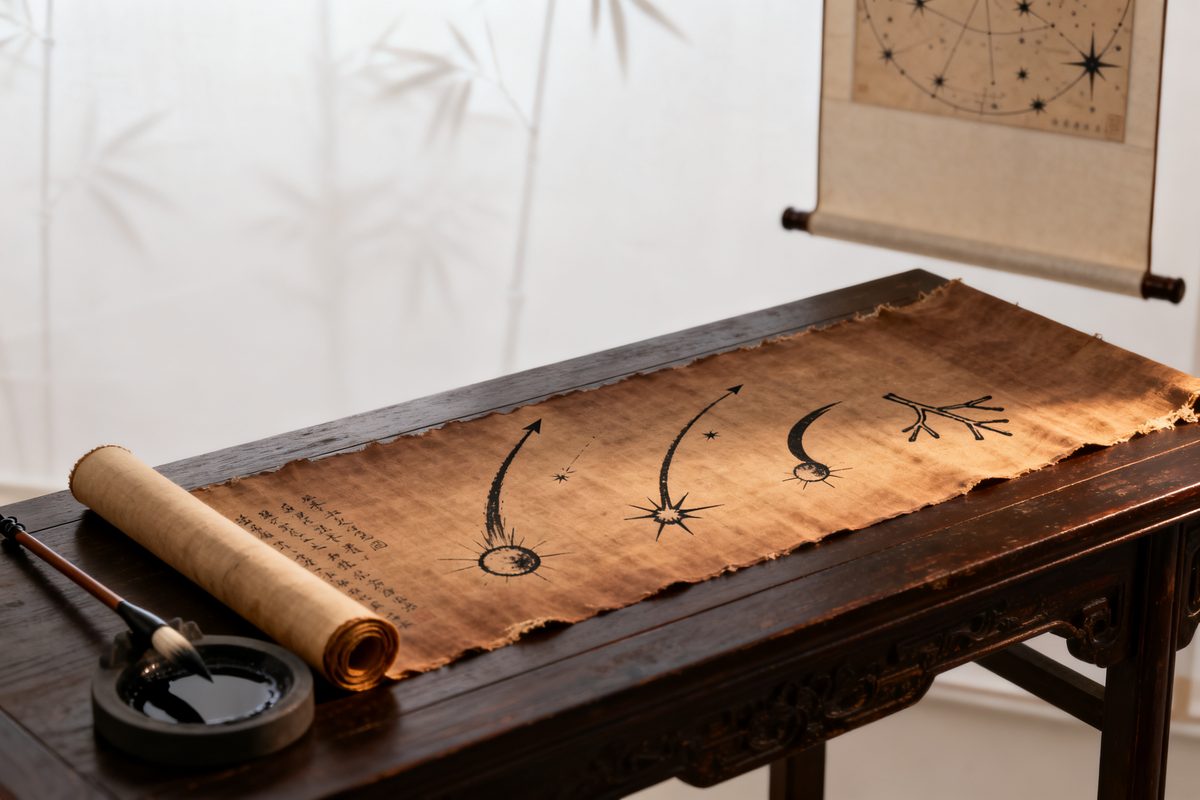
One scroll was later titled "Miscellaneous Prognostications of Astronomy and Meteorology." As the conservators unrolled it inch by inch, they saw something — a set of comet drawings.
Twenty-nine of them.
Not one. Twenty-nine. Lined up, one by one. Every comet has a head and a tail, but no two are alike: some tails are thin and straight, like arrows; some curve and droop like loose hair; some branch like tree limbs; and one is drawn exactly like a broom — the "broom star," alive on the silk.
Each drawing has a name and a divination text below it. The names are ancient: "Red Pourer," "White Pourer," "Heaven's Flute"... The texts mostly predict misfortune — "there will be war," "great famine." You see, they were afraid too. Just like the people counting down to the retrograde on Twitter, they had their fears.
The science historian Xi Zezong studied these drawings. What struck me most was his observation: the classification of comet tail shapes in these twenty-nine images aligns with modern astronomy's understanding of comets. Modern science divides comet tails into dust tails and ion tails — dust tails bend and scatter, ion tails are straight and thin. 2,100 years ago, without telescopes, people watched with their naked eyes, night after night, and honestly drew what they saw.
Europeans wouldn't produce a comparable comet drawing until 1531, when Apianus observed Halley's Comet. The Mawangdui silk predates it by nearly 1,700 years.
Astrology and astronomy, one step apart
Same strange thing in the sky —
One response: it's going to affect me, I need to hide. Don't sign contracts. Don't buy electronics. Don't send emails. Don't answer the ex.
Another response: what is it, actually? What did it look like last time? How is it different this time? Let me draw it.
Here's the interesting part: in the Mawangdui silk, these were the same project. The drawings clearly say "war" and "famine" beside them — the person who drew them believed in omens. But they didn't stop at believing. After the fear, they looked one more time, and drew one more line. The divination is written below; the observation is drawn above. Fear and curiosity, on the same piece of silk.
Later generations of Chinese kept this habit going for a very long time. Halley's Comet returns roughly every 76 years, and from its 240 BCE apparition onward, every single return was recorded in Chinese histories. Not one missed. It is the only unbroken record of one comet spanning more than two thousand years anywhere in the world. When modern astronomers calculated Halley's orbit, these Chinese records were essential evidence.
Fear is human instinct. But turning the thing you fear into drawing after drawing, record after record — that is a civilization's real skill.
Written before the third retrograde
On October 24, Mercury goes "retrograde" again. Strictly speaking, it doesn't. Mercury orbits inside Earth's track, and every few months it catches up and passes us — like the moment you overtake a car on the highway, and for an instant the other car seems to slide backward. It never moved backward. Our eyes are playing tricks on us.
My American friend probably knows it's an illusion. She still double-checks her emails during retrograde, and when a flight gets delayed she posts a #MercuryRetrograde tag, laughs, and lets it go.
I don't think that's a bad thing. People need small rituals to settle their nerves about uncertainty — like my mom not cutting hair in the first lunar month, like me pressing my palms together when I enter a temple. These little fears are actually quite gentle.
But this year, when the retrograde comes, I might think of that silk scroll in Changsha, and those twenty-nine comets. I might think of the person who drew them — who had far more reason to be afraid than any of us, because in their world, that star truly announced war and famine. But what they did was not move their contract to December. They ground the ink, laid out the silk, and drew that ominous star, line by line.
The stars in the sky don't manage your contracts down here. But how you look at them decides whether you hide indoors — or become the first person to draw one.
If something does go wrong during the retrograde — an email sent to the wrong person, a crashed laptop, a message from the past — maybe try that ancient method: don't rush to hide. First, look clearly at what it looks like.
Even if you never draw it, one clear look counts.
Three questions, for you who read this far:
- Is there something you've feared for years but never really looked at?
- If you had to draw your most recent bout of "bad luck" as a picture, what shape would it be?
- What records will we leave behind for people two thousand years from now?