On Halloween, Black Cats Get Locked Up in America. In China, We Call Them Xuanmao
Because of the color of their fur, black cats sit an extra week in American shelters before Halloween. Meanwhile, a Qing dynasty book calls the same cat "the creature that wards off evil". Two ledgers for one cat — and in the end, it is always humans who paint the color on.
This morning I was scrolling on my phone and saw a post I couldn't laugh at.
Some animal shelters in America put out a notice: during the week before Halloween, black cat adoptions are paused. The reason you can probably guess — every year, people take a black cat home as a party prop, take their photos, then dump it. And further back, people truly believed that on Halloween night, witches rode out on black cats.
In other words: today, in the richest country on this planet, there are cats that have to stay locked up an extra week in a shelter, simply because of the color of their fur.
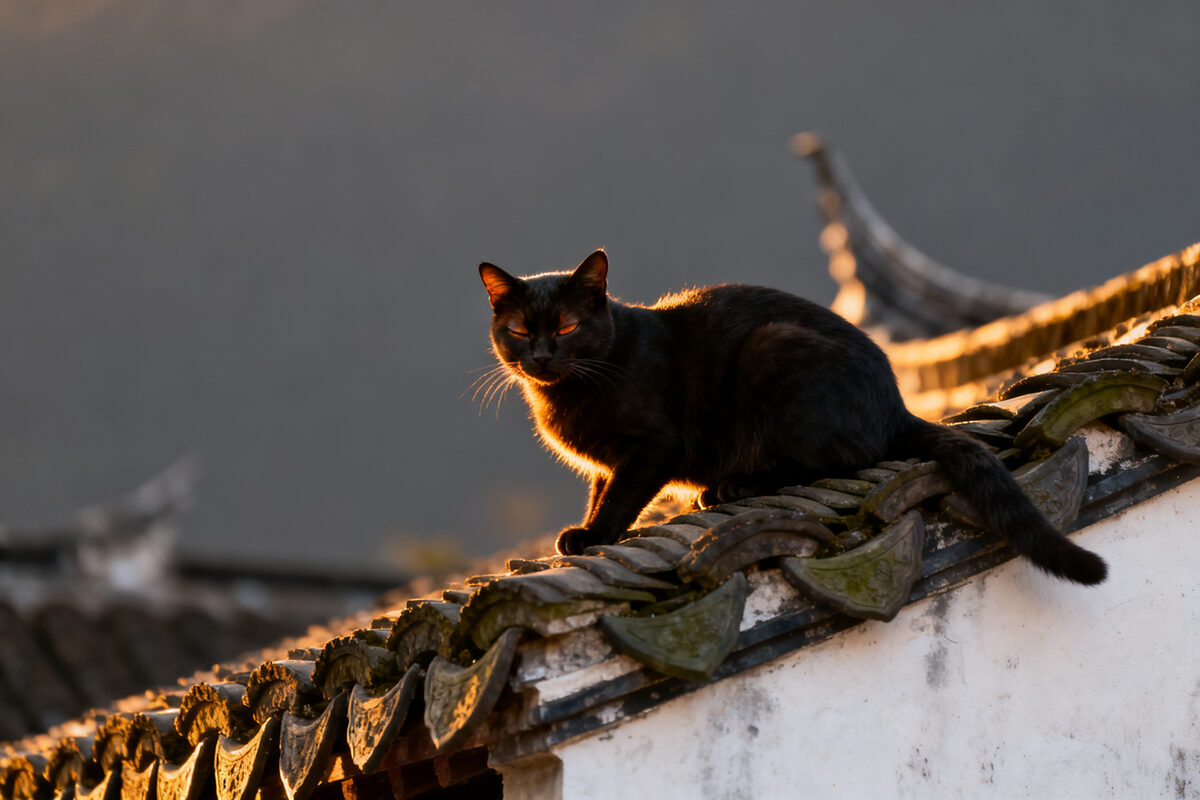
I put down my phone and looked out the window. The black cat in our neighborhood was sitting on a car roof, sunbathing, tail hanging down, looking like it owed nobody anything.
The same cat, born on the other side of the Atlantic, and born under my building, lives two completely different lives.
A Ledger Going Back a Thousand Years
Westerners have feared black cats for about a thousand years.
In medieval Europe, sermons said witches turned into cats — or that the witch's cat was a gift from the devil. In the thirteenth century, a papal decree put black cats on the list of heresy trials. Then came the witch-hunt era, and women and cats suffered together. For hundreds of years, the black cat's standing in Europe, to borrow a modern phrase, was "systemic discrimination."
Those old superstitions crossed the Atlantic and finally landed on Hollywood's Halloween decorations: witch, broomstick, jack-o'-lantern, black cat — the full ensemble, on tour once a year.
The funny thing is, Europeans themselves never agreed. British sailors believed a black cat aboard meant a safe voyage; in parts of Scotland, a black cat sitting at your door meant money was coming. Same continent, attitudes toward one cat could differ by a whole sea.
Clearly, whether a cat is lucky or unlucky was never the cat's decision. It was always ours.
In China, the Ledger Is Written Differently
In the Qing dynasty, during the Xianfeng years, a man named Huang Han compiled a book called Maoyuan ("The Cat Garden"), collecting cat records and anecdotes from across the centuries. One line in it reads:
"The xuánmāo — the black cat — is a creature that wards off evil. Best placed in the south of the home. Beneficial for generations."
Xuán means black — the deep, glossy kind of black. Translated plainly: the black cat repels evil; it is well suited to the south side of a house, and it brings good to your descendants.
Notice: not "brings misfortune," but "wards off evil." Not something to avoid, but something you deliberately invite in to guard the place. One is taboo, the other is protection. Same animal, same black fur, one continent apart — two completely opposite verdicts.
The Chinese, in fact, took cat-keeping seriously. In the Song dynasty, bringing a cat home required a "betrothal gift." The poet Lu You wrote: "With a pouch of salt I welcomed the little fur child, who now guards the ten thousand volumes in my mountain study." Salt as a bride-price — you didn't buy a cat, you married one in. And what for? To guard books. Mice chewed his collection, so the cat was his library security, and in winter, his foot-warmer. He wrote several poems for his cats; in one he says the cat is asleep on his blanket and he can't bring himself to move — "The fire is soft, the felt is warm; my fur child and I are not going out." Storm raging outside, him and his cat, neither one leaving.
A culture that pays a bride-price for a cat and hides from the rain with one can hardly bring itself to believe that same cat is the devil's mount.
But I Have to Be Honest
Chinese folk sayings were never unified either.
While researching, I found places that say "pigs bring poverty, dogs bring wealth, a cat brings a pawnshop" — a cat arriving at your door is a sign of fortune. Yet other places taboo the "night cat entering the house," saying a cat yowling on the roof is coming to take something away. In Northeast China, the black cat became "Black Cat Detective," a hero for generations of children; among my grandmother's generation, kids weren't allowed to stare into a cat's eyes, because cats can see what we can't.
See — we never settled it among ourselves either.
But here's the difference: in China, whichever way the saying goes, the cat is treated as a creature with spirit — whether it wards off evil or sees the unseen, it simply perceives more than you. Medieval Europe treated the cat as an evil creature — the cat itself was the calamity.
One is "having spirit." The other is "being guilty."
And that difference, for one specific cat, is the difference between a livable life and an unlivable one.
The Color Is Painted by Us
Go one layer deeper, and Buddhism said this plainly a long time ago.
A cat is just a cat. Black fur, white fur, yellow fur — the sorting is done by human eyes, the choosing by human hearts. The person who fears the black cat fears no cat; they fear the shadow of "misfortune" in their own mind. The person who honors the xuánmāo isn't really honoring a cat either; they're honoring their own wish for safety. The cat did nothing. It sits on the wall, licks its paw, suns itself — and, as a side effect, holds up a clear mirror to the hearts of two hemispheres.
The Diamond Sutra says: "Abide nowhere, and give rise to the mind." Let the mind cling to no thing. It fits this cat exactly: the black cat does not abide in "unlucky," nor in "lucky" — it abides only in itself. It is always humans who abide in "lucky" and "unlucky."
If this black cat were in a California shelter tonight, it would be kept under watch. In a Suzhou alley, it's the xuánmāo that "guards the house." In a Japanese shop, it's the black maneki-neko with its raised paw, warding off illness. And the cat itself? The same everywhere: find somewhere warm, and take a nap.
A thousand cultures have arranged a thousand fates for it. It has accepted none of them.
Coda
Tonight is Halloween. On the far side of the earth, kids with painted faces go door to door for candy, with paper witches and black cats on the doors. On this side, the black cat downstairs should be at its usual spot — the ledge on the power box that still holds the day's last warmth.
My mother greets it when she passes. She calls it "Little Black." It never answers. But it never leaves, either.
A thousand years, and it hasn't changed at all. What changes is us, looking at it.
Three questions to leave with you:
-
Have you ever lived with a cat? Was there a moment when you felt its eyes saw you more clearly than yours saw it?
-
Are there sayings about cats where you're from — lucky ones or unlucky ones? When you first heard them, did you believe?
-
If "the color is painted by us" — beyond cats, where else have you painted color onto someone else, or onto yourself?