The Night Before Halloween, a Foreigner Asked Me: What Are Your Ghosts Afraid Of
He asked me how China deals with ghosts. We have Zhong Kui, mugwort, river lanterns at the Ghost Festival. Western ghosts fear the cross — ours fear different things. This is my answer.
The Night Before Halloween, a Foreigner Asked Me: What Are Your Ghosts Afraid Of
Yesterday I got a message. A reader in America — his Chinese is shaky, but his question was careful and sincere.
He said his city is decking itself out for Halloween — pumpkins, cobwebs, skeletons, a whole wall of candy at the supermarket. A Chinese colleague told him Chinese people also have a "ghost festival," but it doesn't seem to work like this. He thought about it, couldn't figure it out, and came to ask me: what are Chinese ghosts afraid of?
I stared at that question for a long time.
Honestly, my first reaction was to laugh. But after the laugh, I found I had no answer. I know Zhong Kui. I know mugwort, peachwood, the phrase "respect and keep your distance." But to string them into one sentence for a foreigner — "here is what our ghosts fear" — I was stuck.
Today I want to catch this question properly. Before Halloween arrives, before the plastic skeletons go up, let me talk about the Chinese way of dealing with ghosts.
First, a Failed Exam Candidate Who Loved Wine
You can't talk about Chinese ghost-management without one man: Zhong Kui.
The story goes that in the Tang dynasty there was a man named Zhong Kui — fierce-looking, but brilliant. He traveled to Chang'an to sit the imperial exam. His essays were beautiful; the examiners nodded as they read. But at the final palace interview, the emperor looked at his face — too ugly. The emperor judged him by his looks and struck his name off the list.
Zhong Kui killed himself on the palace steps.
Every time I read this part, I pause. A man studies for years, walks to the closest point to honor and rank — and then, because of a face, everything goes to zero. A ghost didn't scare him to death. People's eyes did.
But the story continues. Later the emperor fell ill, and no medicine helped. In his dream a little ghost stole the imperial consort's perfume pouch and the emperor's jade flute, running circles around the hall. Just as the emperor fumed, a great ghost burst in — wild hair, grimy face — seized the little ghost, gouged out its eyes, and tore it apart and ate it.
The emperor asked: who are you? The great ghost said: I am Zhong Kui, the scholar rejected for my ugliness. Death could not make me rest. I have vowed to rid the world of evil spirits on your behalf.
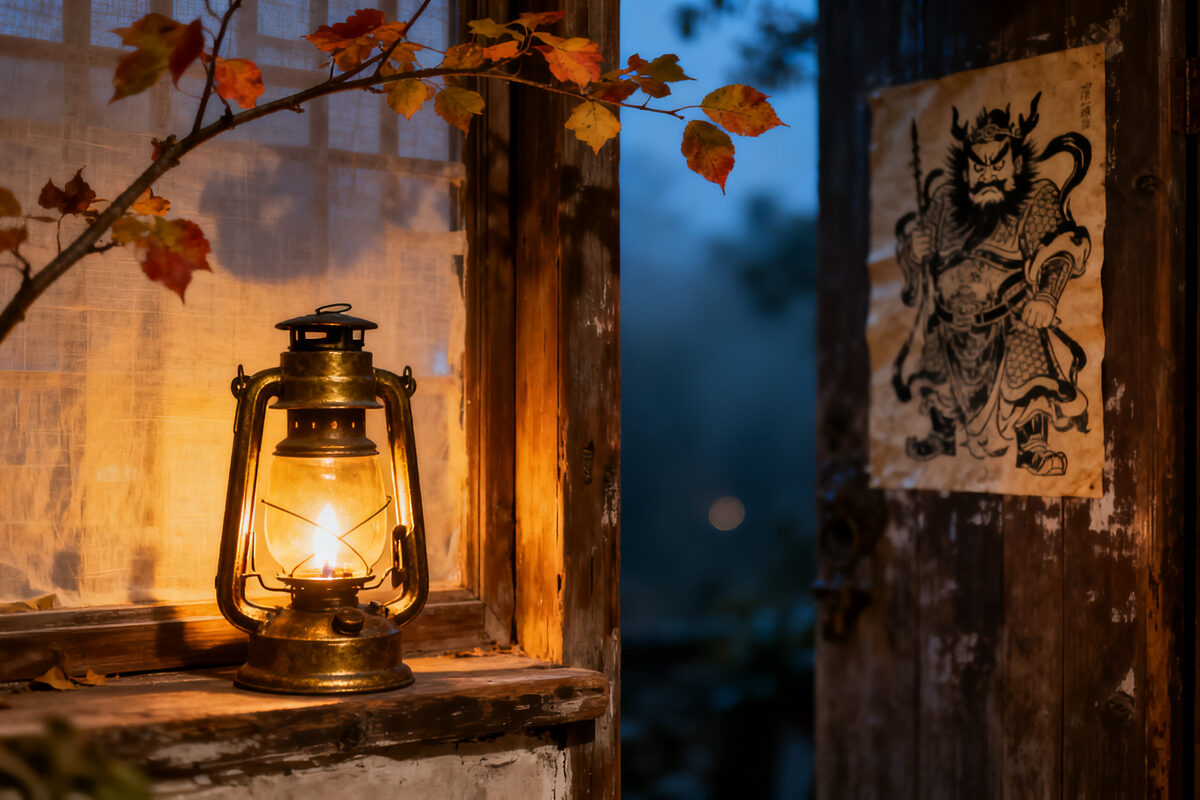
The emperor woke — and the illness was gone. His first act was to have the master painter Wu Daozi paint the figure from his dream, "Zhong Kui Catching Ghosts," and hang it in the palace. From then on Zhong Kui became China's ghost-catcher — pasted on doors, hung at Duanwu, called on to exorcise evil.
As a child I heard this story and felt only satisfaction: evil punished, the ugly man vindicated. Reading it now, I taste another layer —
A man destroyed by human prejudice chose, after death, to hunt ghosts.
He didn't come back for revenge on the emperor. He didn't come back to claim his rank. He went after the things that hide in the dark, that cannot stand the light. Perhaps this is the deepest way Chinese people settle a grievance: when your injustice has nowhere to be heard, let it become strength — and protect others.
Afraid on One Hand, Feeding Them on the Other
The Western Halloween logic is "dress as a ghost, blend in among them." Children wear masks and go door to door for candy — the folklore says it's to fool wandering spirits. Ghosts are "them," we are "us": a clear line, each side minding its own fun.
The Chinese logic is very different.
The Chinese way with ghosts is, first of all, to feed them. At the Ghost Festival we burn paper money, lay out offerings, float river lanterns — not to drive them away, but to invite them to a meal. The logic: you suffered in life, you drift and suffer in death — come, eat something warm, take the money, and go in peace. We send you off not because we hate you, but because we hope your suffering ends.
Of course, there are fierce tools too. Zhong Kui is fierce. Mugwort and calamus are fierce. The peachwood sword, cinnabar — all fierce. But look at where these fierce things live: on doors, on windows, on the body. Defense, not crusade.
Chinese people rarely go out hunting ghosts. We hang mugwort at the door, paste Zhong Kui on the gate, tie sachets and five-color threads on children. Every one of these gestures says the same thing: don't come in. Inside is off-limits. Out there, do as you please.
This sense of proportion feels deeply Chinese to me. Not afraid of you, but not provoking you either. Not merging with you, not warring against you. Inside the line is the human world. Outside it — may all beings be at peace.
Where Ghosts Come From
Here I stopped writing for a long while.
Because I remembered something more fundamental: what is this "ghost" that Chinese people have spoken of for thousands of years?
The ancient dictionary says: "A ghost is what a person returns to." To die is to become a ghost; ghost means "to return." A ghost is not some thing that arrives from outside. It is what a person becomes after going back.
That definition softened something in me.
In Western horror, ghosts are usually aliens: they come from the basement, from the well, from the possessed object. They stand against the living; you call a priest, you perform an exorcism, someone must win.
Chinese ghosts are mostly "people we knew." The husband who never made it home. The woman wronged to death. The father who starved. The one who died waiting for an apology. So the Chinese cure for ghosts was never only to fight — it is to release, to burn paper, to fulfill a vow, to settle that breath. Chinese people believe most ghosts don't want your life. They want a reckoning.
Du Liniang returns to life because her love is unfinished. Nie Xiaoqian reincarnates because her ashes must go home. In Liaozhai, so many ghost girls only want to be treated as a person, once.
Writing this far, I begin to understand: Chinese ghost stories are, in the end, human stories. A ghost's grievance is the shadow cast by a person's injustice.
That Night, This Is What I Told Him
I answered the message a day later. Not because I was busy — because I didn't know how to say it.
In the end I wrote this, translated it into my clumsy English, and sent it:
"Your ghosts fear the cross, holy water, the name of God. Our ghosts fear different things — mugwort, peachwood, an ugly scholar named Zhong Kui. But what they fear most, maybe, are two things: being forgotten, and never receiving a reckoning.
So in China our way of dealing with ghosts is often not to drive them out, but to make offerings. Light a lamp, burn some paper, and say to them: I know you suffered. Eat something warm. Go in peace.
You ask whether I believe in all this. What I believe isn't ghosts — it's that breath. When someone leaves holding down a grievance, that breath doesn't scatter on its own. Lighting lamps and burning paper is how the living finally say the words stuck inside: 'I'm sorry.' 'I miss you.' 'You suffered.'
Those words, held down inside a heart — that is the real haunting."
After sending it, I added: enjoy your Halloween. Carve the pumpkins, take the candy — play, but don't use "ghosts" to frighten yourself. If something is weighing on you, the Chinese remedy is: say it out loud, cry it out, and say your proper goodbyes.
Silence from his side for half a day. Then at night: "My grandfather passed this spring. Maybe I'll light a lamp for him too."
I sat with that message for a long time.
You see — this is where the Chinese "superstition" truly travels. It doesn't check your passport. An American who lost his grandfather and a Chinese woman burning paper at a crossroads have the same empty place inside. Light one lamp, and the empty place is lit, just for a moment.
A Quiet Ending
Outside the window it is deep autumn. In a week comes Halloween; soon after, the Winter Clothing Festival — the first day of the tenth lunar month, when Chinese people send warm clothes to those who have gone. The two holidays sit close together: one plays at ghosts, the other remembers people.
I think of my grandmother, on Ghost Festival nights when I was small, squatting at the mouth of the alley, drawing a circle on the ground and burning paper money inside it. The fire flickered, and she murmured — "send me a dream when you get it," "is it cold over there." I hid behind the door, afraid. Now I think: where in that fire was there any horror? It was the humblest longing in the world.
Our ghosts — what are they afraid of?
Perhaps nothing. Perhaps they are only waiting. For a lamp. For a reckoning. For someone who remembers.
Three questions to leave with you:
- Is there something unresolved in your life — a sentence never spoken, a person never properly farewelled? Inside you, does it sit like a "ghost" that refuses to leave?
- Does your hometown have an old custom of "sending off" or "remembering"? As a child you may have called it superstition — how do you see it now?
- If on Halloween you lit one lamp — not to drive anything away, only to miss someone — who would come to mind?