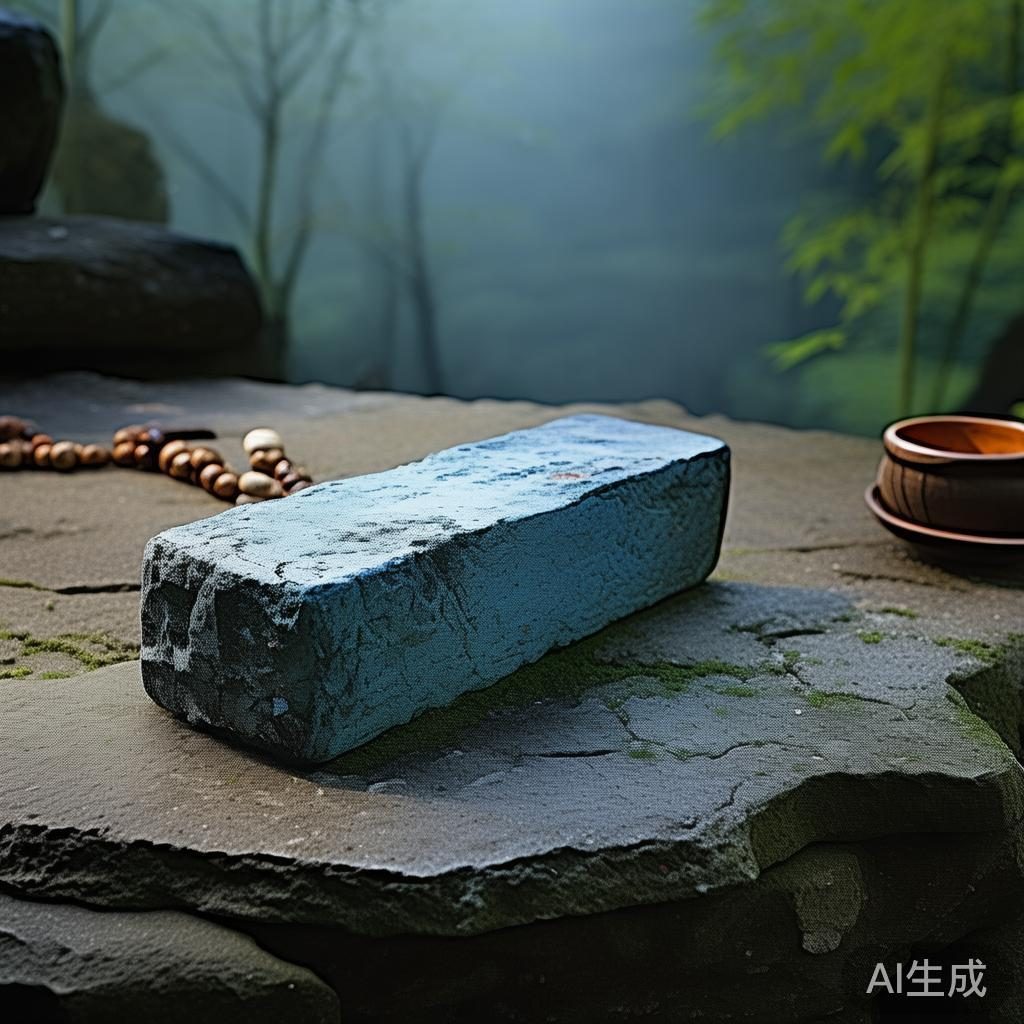
Nan-in's Cup of Tea: In Emptiness, the Universe Unfolds

Nan-in's Cup of Tea: Emptiness Holds the Universe
Prologue: A Cup That Overflows
Have you ever found yourself standing before an entirely new landscape, yet unable to see it clearly because your mind was clouded by old prejudices?
A university professor, learned and self-assured, carrying the weight of ten thousand books he had read and a thousand arguments he had constructed, came to visit the Zen master Nan-in. He believed he stood at the very threshold of truth, needing only one final push to enter the gates of Zen.
Yet Nan-in said nothing. He simply, silently, poured a cup of tea.
The cup filled. The tea overflowed, spilling across the table, dripping onto the floor. Nan-in kept pouring.
At last, the professor could bear it no longer. "Master! The cup is full! It can hold no more!"
Nan-in set down the teapot and looked at him calmly. Then he spoke the words that would echo through centuries:
"You are like this cup — full of your own views and opinions. How can I show you Zen unless you first empty your cup?"
In that moment, the professor was stunned into silence.
And that single overflowing cup of tea became one of the most celebrated koans in the history of Zen.
The Original Koan
This koan originates from Japan's Meiji era (1868–1912) and is recorded in the writings of several Zen scholars. The story is brief, yet its depth is boundless:
During the Meiji era in Japan, there lived a renowned Zen master named Nan-in in Tokyo. One day, a university professor came to visit him, asking about the nature of Zen.
Nan-in invited the professor to sit and proceeded to prepare tea. He poured tea into the visitor's cup, and even when the cup was full, he continued pouring.
The professor watched the tea spill over the brim and flood the table. "Master, the cup is already full! Stop pouring!" he exclaimed.
Nan-in paused and said, "You are exactly like this cup. You are full of your own ideas and preconceptions. If you do not first empty your cup, how can I show you what Zen is?"
The story ends here. No explanation. No conclusion. In the Zen tradition, a koan is a teaching transmitted "from mind to mind" — not something to be analyzed through reason, but something that triggers a sudden flash of insight, a moment where consciousness itself shifts.
Historical Context: Who Was Nan-in?
Zen in the Meiji Era
Nan-in (南隐) was a real Zen priest who lived during Japan's Meiji era. The Meiji period (1868–1912) was a time of radical transformation — Western civilization poured into Japan, traditional Buddhism and Shinto were challenged, and the entire society oscillated between modernization and preservation of ancient ways.
In this context, Zen faced unprecedented pressures. On one hand, academic intellectuals increasingly tried to analyze Zen through the lens of Western philosophy, treating it as an object of rational study. On the other hand, the living tradition of Zen practice was gradually eroding under the tide of industrialization.
Nan-in's story captures the tension of this era perfectly. The university professor represents the mindset of Meiji-era intellectuals — brimming with Western philosophical concepts and logical frameworks, attempting to "understand" Zen the way one might understand a scientific theory. Nan-in, with a single cup of tea, shattered that entire approach.
The Zen Tradition of "No Written Words"
To truly appreciate this koan, one must understand a foundational principle of Zen: "A special transmission outside the scriptures; no dependence upon words and letters; direct pointing to the human mind; seeing into one's own nature and attaining Buddhahood."
These sixteen characters trace their origin to the story of the Buddha holding up a flower on Vulture Peak. As the assembled monks waited for a sermon, the Buddha simply held up a single golden flower. Mahākāśyapa smiled, and in that silent exchange, the dharma was transmitted. No sutras. No arguments. Just one moment of mind-to-mind connection.
Nan-in's teacup koan is a direct continuation of this tradition. He offered no Zen theory, quoted no scripture, constructed no argument. Instead, he used an everyday, concrete action — pouring tea — to convey a profound metaphor.
This embodies a unique aspect of Zen pedagogy: truth cannot be poured into a mind that is already overflowing.
The Cultural Roots of the "Empty Cup"
The imagery of emptiness has deep roots across East Asian philosophy.
In Daoist thought, Chapter 11 of Laozi's Dao De Jing states:
Thirty spokes converge upon a single hub; it is the emptiness at the center that makes the wheel useful. Shape clay into a vessel; it is the space inside that makes it useful. Cut doors and windows for a room; it is the empty space that makes the room livable. Therefore, profit comes from what is there; usefulness comes from what is not there.
The essence of this passage: a vessel's value lies not in its solid walls but in its hollow interior. A cup is useful not because of its material, but because of the empty space it creates.
In Buddhism, the concept of śūnyatā (emptiness) is even more central. Nāgārjuna wrote in his Mūlamadhyamakakārikā: "Whatever arises in dependence, that I call emptiness." Emptiness here does not mean nothingness — it means that all phenomena lack fixed, independent essence. And precisely because everything is "empty," everything is possible.
Nan-in's teacup elegantly fuses the Daoist insight of "usefulness of emptiness" with the Buddhist teaching of śūnyatā.
Modern Interpretation: How Full Is Your Cup?
Cognitive Overload in the Information Age
We who live in the twenty-first century face an even more severe "full cup" problem than the Meiji-era professor.
Each day, we are bombarded by information — news alerts, social media feeds, short videos, podcasts, books, online courses. Our phones are filled with "read later" bookmarks; our shopping carts overflow with courses we intend to take; our calendars are packed with self-improvement plans.
But here is the question: When we keep pouring things into the cup without stopping, when do we ever pause to empty it?
We are so busy "learning" that we forget to digest. So busy absorbing that we forget to reflect. So busy filling that we forget to leave space.
What psychologists call "cognitive overload" is essentially the same problem Nan-in identified over a century ago — the cup is full, and nothing new can enter.
The Trap of "I Already Know"
The professor's greatest problem was not ignorance. Quite the opposite — it was the conviction that he already knew.
This is the greatest enemy of learning. The philosopher Bertrand Russell once observed: "The trouble with the world is that the stupid are cocksure and the intelligent are full of doubt." In Zen terms: the moment you become certain you understand, you have closed the door to deeper understanding.
Zhuangzi, the great Daoist philosopher, wrote in the "Autumn Floods" chapter:
You cannot speak of the ocean to a frog in a well — it is confined by its space. You cannot speak of ice to a summer insect — it is limited by its season. You cannot speak of the Dao to a narrow-minded scholar — he is bound by his doctrines.
The professor before Nan-in was precisely such a "narrow-minded scholar" — not because he lacked intelligence, but because he was imprisoned by his own intelligence.
Echo Chambers and the Modern Mind
In the age of algorithms, our preconceptions are more entrenched than ever. Recommendation engines serve us content that confirms what we already believe. Social circles become increasingly homogeneous. We live inside "filter bubbles" — each of our cups overflowing with reinforced biases.
If Nan-in were alive today, he might say to each of us: "Put down your phone. Empty out all those opinions you think you know. Then, and only then, let us talk about what is real."
Practical Methods: How to Maintain a Beginner's Mind
1. The Daily "Reset" Practice
Each morning, spend five minutes in a "reset" meditation. Do not think about your plans. Instead, inhabit the feeling of "right now, I know nothing." Release yesterday's experiences, today's agenda, tomorrow's anxieties. Simply return to the state of a beginner.
Shunryū Suzuki Roshi wrote in Zen Mind, Beginner's Mind:
"In the beginner's mind there are many possibilities, but in the expert's mind there are few."
This is the finest expression of the empty-cup mindset. Beginner's mind (shoshin) is not ignorance — it is a state of perpetual openness, a refusal to settle into fixed conclusions.
2. The Three-Second Pause
When you encounter a viewpoint that contradicts your own, do not immediately argue. Pause for three seconds and say to yourself: "Perhaps they see something I cannot."
Those three seconds of silence are the act of emptying your cup. They create a space where new possibilities can enter.
This seems simple but is profoundly difficult in practice, because the brain's default mode is confirmation bias — we instinctively seek evidence that supports our views and reject what contradicts them. Breaking this pattern requires conscious, deliberate effort.
3. Periodic "Knowledge Decluttering"
From time to time, examine your belief system. Ask yourself:
- Which of my opinions were formed ten years ago and never reconsidered?
- Which biases did I inherit from parents, teachers, or social media?
- If new evidence tomorrow disproved one of my core beliefs, could I accept it?
This periodic "knowledge decluttering" is the process of actively emptying the cup. It does not mean abandoning all knowledge and experience — it means maintaining the awareness that your cup may be full and needs regular cleaning.
4. Learn from Outsiders
Sometimes, the most profound insights come from the most unexpected sources. A child's question may penetrate to the heart of a matter more effectively than a professor's treatise. A child's cup, after all, has not yet been filled with preconceptions.
Practice listening to people whose backgrounds are entirely different from yours. Not to judge who is right or wrong, but to sense whether their perspective holds a landscape you have never glimpsed.
5. The Courage of "I Don't Know"
In modern society, admitting ignorance seems to have become a form of shame. People compete to display their knowledge, experience, and insight. But Zen teaches us that true wisdom begins with the acknowledgment: "I don't know."
Socrates declared: "I know that I know nothing."
This is the same principle as Nan-in's empty cup. Admitting ignorance is not weakness — it is courage. Only when you dare to say "I don't know" can new knowledge enter your life.
Questions for Reflection
Before concluding, I offer three questions for you to contemplate on a quiet evening. There are no standard answers — just as Nan-in's teacup has no fixed interpretation. The answers dwell in the space that opens after you empty your cup.
Question One
What fills your "cup" right now? If Nan-in were pouring tea for you at this moment, would your cup overflow? What would spill over — pride, prejudice, anxiety, or fear?
Question Two
When was the last time you genuinely changed a deeply held opinion? If you cannot remember, perhaps your cup has been full for so long that you have forgotten what emptiness feels like.
Question Three
If you were to empty your cup right now, what would you be most reluctant to let go of? That very thing you cling to most tightly may be what you most need to release.
Epilogue
Nan-in's tea has long since gone cold, yet its aftertaste has traveled across more than a century to arrive before each of us.
In an age of information explosion and clashing opinions, perhaps we need the art of "emptying the cup" more than ever. Not because knowledge is worthless, but because only an empty vessel can hold what truly matters.
The next time you lift a cup of tea, think of Nan-in — and remember:
Only when the cup is empty can the heart be full.
Text / Yiyirushi yiyirushi.com