Guanyin's Thirty-Three Forms: The Face That Listens
A Westerner stood before a white porcelain Guanyin and said: "Her face — it's not sad, it's not happy. It's listening." Why do church statues look down while Guanyin looks straight at you? I opened my old copy of the Universal Gate chapter. Compassion is not one face; it is a thousand. (And yes — Guanyin used to have a mustache.)
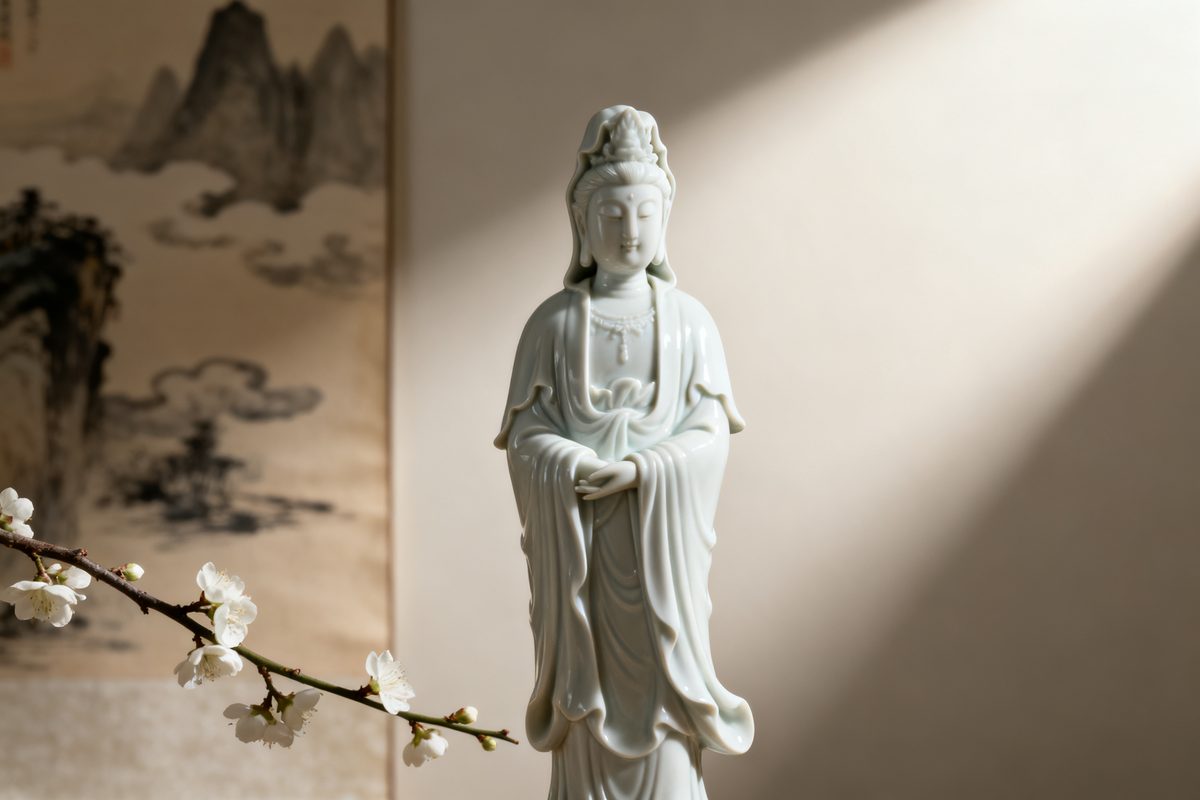
I was scrolling on my phone last night and came across a video by a Western guy. He stood in front of a white porcelain Guanyin statue and said, quietly: "Her face. It's not sad, it's not happy. It's... listening."
The top comment under the video: "The statues in our churches all look down at you. Why does this one look straight at you?"
I sat with those two comments for a while. Then I went to my bookshelf and dug out the notebook where I once copied out the "Universal Gate" chapter of the Lotus Sutra.
A Being Without a Fixed Form
In the Lotus Sutra, the Buddha tells the bodhisattva Inexhaustible Intent: whenever a living being needs to be reached, Guanyin takes on whatever form that being needs to see. Whatever form can meet them where they are — that is the form she appears in.
The sutra lists thirty-three of them: a buddha, a monk, a brahma king, a god, a dragon spirit... all the way down to a nun, an elder's wife, a laywoman, a boy or a girl.
The first time I read that passage, honestly, I didn't get it. I thought a bodhisattva should look like the paintings: white robes, a vase of pure water, a willow branch, standing on a lotus. A fixed image is comforting — you know who you're bowing to, you know who you're asking.
But the sutra says no. The bodhisattva has no fixed form. Meet a fisherman, appear as a fisherman. Meet someone who is sick, appear as a doctor. Meet a child, appear as a child. Whatever form is needed, that form appears.
"Whatever form can reach them — that is the form she takes."
Over the years, that line slowly turned into another sentence in my mind: compassion is not one face. It is a thousand faces.
Why This Idea Hits People So Hard
In the comments under that video, the liveliest debate wasn't "who is Guanyin" but "why does she have so many forms."
One comment read: "This feels like the opposite of idol worship."
I turned that sentence over for a long time. In many traditions, the image of the divine is solemn, fixed, unchangeable — something you must look up to. But the thirty-three forms say the opposite: the image doesn't matter. The image is empty. It arises according to need.
A fixed image offers certainty: this is what the divine looks like. The thirty-three forms offer something softer: whatever you need, that is what I will be.
This is not a god on a high throne. This is a being who crouches down to speak at your height.
Someone asked: "So Guanyin is basically a shapeshifter?"
The reply was wonderful: "Not a shapeshifter. A mirror."
A Piece of Trivia: Guanyin Used to Be a Man
This is my favorite piece of history to tell foreign friends.
In India, Avalokiteśvara — the bodhisattva we now call Guanyin — was originally depicted as male: a sturdy prince with a neat mustache, seated among the Buddha's attendants. Look at early statues from India, Sri Lanka or Southeast Asia, and you'll see Guanyin with a mustache. Most people's first guess is "some king."
After the figure reached China, the mustache began to disappear around the Tang dynasty. By the Song dynasty, in popular imagination, Guanyin had become almost entirely female — gentle brows, white robes, the vase of pure water. Scholars offer many explanations: compassion carries something maternal; a female image was easier for female worshippers to approach; in Pure Land belief, the one who receives the dying overlaps with "mother"...
But the Lotus Sutra's own logic explains it best: a being who "takes whatever form is needed" has no gender to begin with. When a male form reaches you, a male form appears. When a female form reaches you, a female one. For a thousand years, what Chinese hearts most needed to be caught by was exactly this — tenderness, an unwillingness to let go, an unconditional presence. And so, slowly, Guanyin grew into that shape.
I didn't change. The shape you needed changed.
When I told this to an American friend, he said something I've never forgotten: "So her gender is also a skillful means?"
Yes. Even her gender is a means. Let alone the face.
The Fish-Basket Guanyin
There's another story, circulating since the Song dynasty, called the Fish-Basket Guanyin.
In a rough village in Shaanxi that had no use for Buddhism, a beautiful young woman appeared one day, carrying a fish basket. She announced: whoever can memorize the Heart Sutra overnight, I will marry.
By morning, twenty men had done it. Too many, she said — let's make it the Diamond Sutra, three days. A dozen remained. Then the "Universal Gate" chapter of the Lotus Sutra, five days. In the end only one young man, surnamed Ma, succeeded.
The wedding was set. On the day she crossed the threshold, the bride suddenly collapsed and died, her body decaying on the spot. Ma buried her in grief and fury. Some time later, an old monk in purple robes passed by, pointed at the grave and said: you've been taught by a bodhisattva without knowing it. She was no fish-seller. She was Guanyin. She didn't come to marry — she came to make a village of hard men willingly pick up the sutras. When they opened the grave, all that remained in the coffin was a skeleton joined by golden locks — the mark of a bodhisattva.
My first feelings about this story were complicated. Honestly, the "method" doesn't fit any modern definition of honest. But one layer deeper: she came for people who would never listen to reason, so she turned herself into a reason. The sutra was the point; the marriage was only the hook.
Sometimes compassion doesn't look like compassion. It looks like a beautifully designed trap — and everyone willing to walk into it comes out holding something real.
Three Faces I've Never Forgotten
I don't want to turn this into a sutra lecture. Let me tell you three small stories instead.
The first. The year my mother was ill, the hospital corridor lights were blindingly white. I was queuing at the payment window when the woman in front of me turned around and said, "Young man, you look terrible. Sit down for a moment." She pointed at a chair. That was all. Later, when my mother's surgery went well and I walked out at dawn, I thought — maybe that moment beside the chair counted as one of the forms.
The second. One year I was in a bad place, sitting in a temple courtyard. A laywoman beside me asked softly, "Would you like to chant with me?" I said I didn't know how. She said, "That's fine. Just listen." All afternoon her voice moved slowly and steadily, like a river in no hurry. I didn't obtain anything that day. But when I walked out, the stone in my chest was smaller.
The third. This one is mine. During a season of crushing work stress, I woke at 2 a.m. one night and suddenly remembered being sick as a child — my grandmother sitting by my bed the whole night, one hand on my forehead. She said nothing. She had no powers. She was simply there. Years later, reading "whatever form can reach them," I suddenly understood: that night, my grandmother was the most useful form of all.
Looking Straight at You
Back to the question that Westerner asked: why does the statue look straight ahead, not down?
I've thought about this detail. Buddha statues have many kinds of eyes: some nearly closed, turned inward; some lowered, gazing down with compassion. Guanyin statues are often half-open, the gaze resting on you, not far, not near — she sees you, and she does not look down on you.
The logic of "taking whatever form reaches you" begins with meeting someone at eye level. She must first stand in your place before she can know what form you need. Appearing as a fisherman beside a fisherman isn't a performance — it's becoming you first, then walking out with you.
The best people I've met in this world all have this ability. They don't rush to give advice. They don't rush to correct you. They crouch down first, look at the world from your height, and only then speak — or don't.
The Empty Vase and the Willow Branch
The most familiar props in Guanyin paintings: the vase of pure water and the willow branch. The water cools fires; the branch sprinkles it over the world.
But there's a humbler folk saying. An old craftsman once told me: why is the vase empty? Because it needs room for everyone's different suffering.
I love that, even if it isn't orthodox doctrine. A vessel willing to empty itself out to hold someone else's things — that might be the best footnote to the word "form."
Three Questions for You
- Has someone ever, at your worst moment, not judged you but simply stayed? What form was that person taking?
- We rush to "help" — advice, plans, resources. Have you ever tried becoming the other person's shape first, before deciding whether to give anything?
- If compassion has a thousand faces, which one could you carry out the door today?
That evening I put the notebook back on the shelf. It occurred to me that the man in the video who said "she's listening" probably has never read the Lotus Sutra's list of thirty-three forms. But in that moment, the idea of "taking whatever form is needed" had already reached him.
Guanyin has a thousand faces. One of them might be the person next to you today who is willing to hear you finish speaking.