Why Mirrors Shouldn't Face Your Bed: A Personal Discovery
A friend moved into a new place and started having nightmares every night. Her wardrobe mirror was facing the bed. After covering it, she slept through the night. This is what I discovered about mirrors and sleep.
A friend moved into a new place recently. She was excited and sent me photos of her new bedroom.
A big wardrobe with sliding doors. The whole front of it was mirror, facing the bed.
I looked at the photos for a while, then asked: do you sleep well at night?
She said: you know what, ever since I moved in I've been having nightmares every night, waking up in the middle of it all. I thought I just wasn't used to the new place.
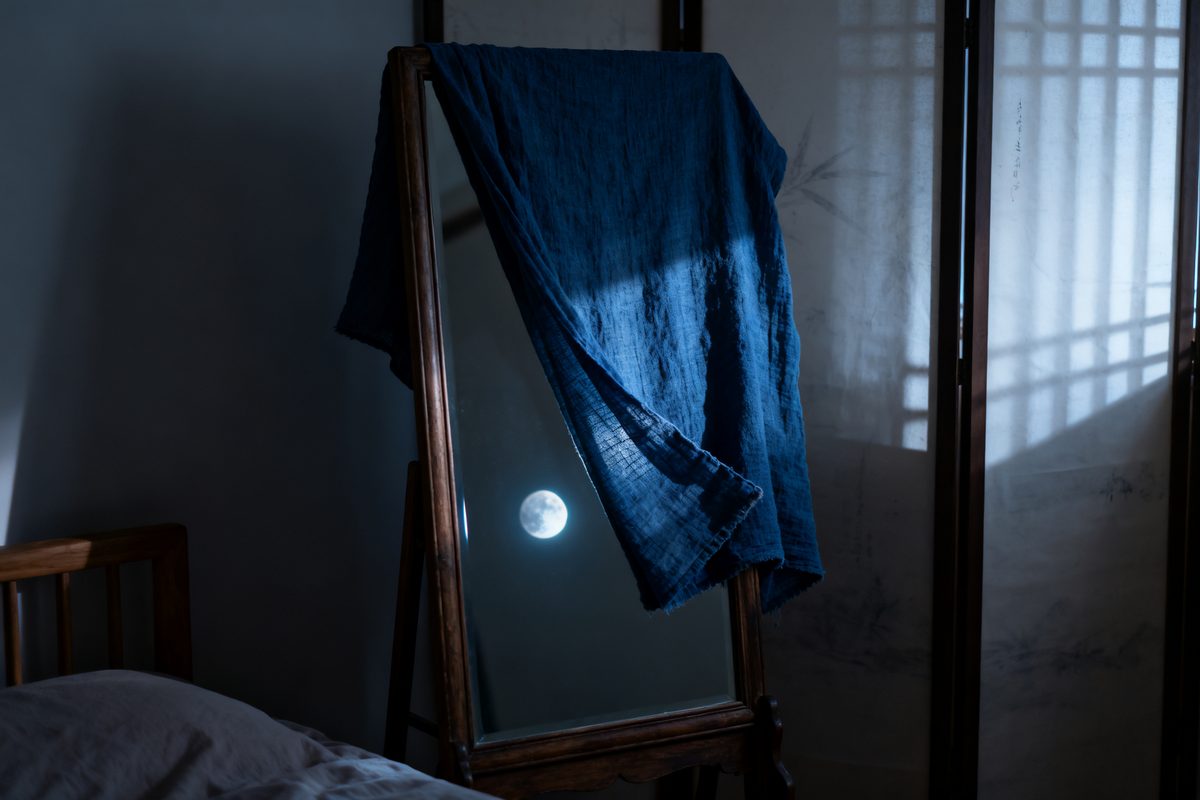
I told her to try covering the mirror.
She found a piece of cloth and hung it up. That night, she slept straight through till morning.
She asked: so are you a feng shui person or a science person?
I said: I don't fully believe in either. But this thing — my own experience tells me there's something to it.
How I Came to Know About It
When I was a kid, my room had a big mirror facing the bed. A full-length mirror, the kind you lean against the wall at an angle.
I must have been seven or eight. Every night after the lights went out, the room was never fully dark — a little light always came in through the window, from a streetlamp or the moon. And that mirror would throw the light back.
Do you know what a child's half-asleep mind does with those blurry shapes?
I would wake up in the middle of the night and see a vague figure standing at the foot of the bed.
Of course, there was no one there. The mirror was bending my own blanket, pillow, and coat on the hanger into some strange silhouette. But in that state, before the mind fully wakes, the feeling was very real. I would curl up under the covers, not daring to move, not daring to look, and wait for morning.
Later, my mother heard from somewhere that a mirror shouldn't face the bed. She moved the mirror out to the hallway.
After that, the nightmares stopped.
You can call it coincidence. But that event planted a question in me: why?
The Old Folks All Know This
Go ask any older Chinese person — can a mirror face the bed? Nine out of ten will shake their head.
But if you push them on why, the answers go all over the place.
Some say: a mirror facing the bed will reflect your soul right out of you. You get up in the night half-asleep and see someone in the mirror, it scares you, and your three souls and seven spirits scatter.
Some say: a mirror is a yin thing. It's not "solid," it's "reflection." When you sleep, that's when you're most relaxed, your defenses at their lowest. A mirror facing you is like it's always "absorbing" your essence.
Others say it from an even more mystical angle: a mirror can show things the eye can't see. When you sleep, what it reflects isn't your body — it's your qi once you've "loosened." A mirror facing the bed is like a window — and outside that window it's dark, and you don't know what's on the other side.
Believe these or don't. My own stance: I don't fully believe, but I don't mock either.
Because there's a thread running underneath, tying all these strange-sounding claims together —
The relationship between mirrors and sleep matters far more than we think.
What Chinese Medicine Has to Say
Later on, I went to see a Chinese medicine doctor because of my insomnia. A quiet old doctor, seeing patients in an old community clinic.
He took my pulse, asked a pile of questions. Then he asked: is there anything reflective in your bedroom?
I said there was a mirror, facing the bed.
He nodded, and said: it stirs things.
He said sleep, in Chinese medicine, is called "the spirit returning to its house." The heart holds the spirit. When you're awake, the spirit is out busy. When you sleep, the spirit has to come back to the heart and settle. This process needs quiet, needs darkness, needs "gathering in."
And what is a mirror? A mirror is "scattering."
It bounces light out, bounces images out. It's an active thing, an energy that won't stop moving — even when there's nothing visible on its surface, at its core it's a "reflector."
When you sleep you need to "gather in," and you put something across from your bed that's always "scattering." Your body is caught in a contradiction.
One side is trying hard to settle down. The other side has something over there reflecting, disturbing.
The old doctor put it plainly: it's not about ghosts or demons. It's that your spirit can't settle. When the spirit won't settle, you sleep light, dream a lot, wake easily. Over time, that becomes insomnia.
I was half-doubting at the time. But later I actually moved the mirror, and my sleep did get much better.
Modern Science Has Something to Say Too
Later I went and looked it up, and found that the West has similar studies.
In 2019 there was a sleep study on bedroom environments (not a huge study, but the logic holds). It found that subjects with reflective mirror surfaces in their rooms had a slightly lower proportion of deep sleep. The researchers' guess at the reason: even with eyes closed, faint reflected light can affect melatonin production.
There's also a 2015 study on "ambiguous perception" that's pretty interesting. During REM sleep — the dreaming stage — if a person is roused by faint shifts of light and shadow, even in a half-asleep state, the brain produces a brief "self-recognition error."
Translated into plain words: you groggily open your eyes, see a shape moving in the mirror, and before you can register that it's you, your amygdala — the fear-response part of the brain — has already sounded the alarm.
This mechanism is tied to our ancestors' survival instinct. In the ancient world, when you saw something moving in the dark, you didn't need to confirm what it was. You needed to run first.
That reaction is carved into our genes.
So it's not ghosts. It's you getting spooked by your own reflection — even if you don't know it.
What Feng Shui Actually Says
Since we're here, let me lay out the main feng shui rules about mirrors, and add my own take.
First, a mirror should not face the bed.
This is the most basic one. The reasons are above. The feng shui saying goes: "a mirror facing the bed brings discord between spouses and unrest of spirit." There's also a folk version: "a mirror facing the bed draws in yin." But the real core, I think, is this: it messes with your sleep.
Second, a mirror should not face the door.
Feng shui says a mirror facing the door bounces the incoming "qi" right back out. The door is the mouth of qi — good fortune comes in through it, and a mirror shoves it straight back, like it won't let you keep anything.
This one, if you think about it from psychology, makes sense too: you push open a door and a figure walks toward you head-on — nobody feels good about that. Even when you know it's yourself.
Third, a mirror should not face the stove.
This is probably the least known. The kitchen stove belongs to fire. A mirror reflecting the stove is called in feng shui "a mirror on the stove doubles the fire." The practical read might be: when you're cooking, with a mirror to your side or across from you, you keep catching a moving figure in the corner of your eye. It's distracting, and distractions cause accidents. Especially in a home with kids — hot oil, open flame in the kitchen — one lost moment of attention and someone gets burned.
Fourth, don't place two mirrors facing each other.
That's when you put two mirrors in a space, directly across from each other. Feng shui calls it "mirror facing mirror, endless reflections." Picture it: two mirrors bouncing back and forth, and between them opens up an infinitely receding corridor, filled with the reflection of the reflection of the reflection of yourself.
Hard to say what that feels like. Just wrong. Like a time loop.
What to Do If Your Mirror Already Faces the Bed
I know a lot of people reading this are already getting nervous, ready to go move their mirror.
But the reality is, a lot of the time you can't change it. Maybe your wardrobe has sliding doors with mirror set into them. Maybe you rent, and that mirror on the wall isn't coming down.
It's not the end of the world. There are a few simple fixes.
Simplest one: cover it before bed.
Hang a cloth, or buy one of those roll-up mirror covers. Pull it open to use the mirror during the day, pull it shut at night. You don't have to seal off the whole wall — the point is just that once you lie down, you can't see the mirror.
Second: turn the mirror a different way.
For a leaning full-length mirror, adjust the angle so the face doesn't point straight at the head of the bed. Turn it a little to the side, that's enough.
Third: nudge the bed.
If you can't move the mirror, move the bed. Shift the head of the bed to a spot where the mirror doesn't hit it directly. Even just a body's width over.
Fourth: put something between the mirror and the bed.
A folding screen, a taller plant, even a chair with a piece of clothing draped over it (not pretty, but it works). The principle: break that direct line of reflection between the mirror and the bed.
Really, Feng Shui Isn't Talking About Superstition
Writing this far, I want to say something deeper.
A lot of people think feng shui is superstition, a scam. I used to think so too.
But later I slowly realized that many of the rules in feng shui, if you strip away the mystical explanations, are all saying the same thing —
Your living environment is shaping your body and your mood, without you noticing.
A mirror facing the bed disrupts your sleep.
A beam pressing down over the bed makes you feel psychologically weighed down (there's research on this too — low ceilings really do raise cortisol levels).
A bed with its head facing the door leaves you without a sense of safety (sleeping with your back to the door is a primal human defense response).
These aren't superstition. This is thousands of years of people feeling out their environment with their own bodies and summing up what they learned — just in a language we moderns don't quite get: "qi," "yin and yang," "sha."
Change the language, and it's sleep science, environmental psychology, building biology.
It's the same thing.
What My Bedroom Looks Like Now
Having said all this, let me share my own bedroom.
Not big. Ten-odd square meters.
The head of the bed sits against a solid wall. No beam overhead, no paintings or photos hung there either. The old ones said the head of the bed should be still, and I think there's something to that — the simpler above your head, the better.
Across from the bed is a bare white wall. There used to be a full-length mirror there, long since moved to the entryway.
The curtains are dark, light-blocking. I hardly open them even during the day — I don't like sunning myself in the bedroom. The bedroom, to me, is "yin," a place for rest and recharging. Sun and liveliness belong to the living room.
On the nightstand there's a small warm-toned lamp. Not bright. Just enough to see your fingers by.
There's also an incense burner. Occasionally, before bed, I light a stick of agarwood.
Nothing special. But since I set it up this way, my sleep has genuinely gotten much better.
Sometimes I can't tell whether it's the change in the environment that lets me sleep well, or the peace of mind that lets me sleep well.
But maybe those were always the same thing.
A Final Word
Finishing this piece, I realize the topic of mirrors is actually pretty vast. Just the one rule about facing the bed took this many words, and there's still mirror material, shape, placement — each one could fill a lot more.
But I don't want to write a textbook. I just wanted to write down my own experience and thoughts, because when my friend asked me that day, I realized a lot of people share this trouble, but don't know why.
You don't have to believe in feng shui. You can think all of this is nonsense.
But if you're not sleeping well at night, and there happens to be a mirror facing your bed in your bedroom —
Try covering it.
Just in case.
Three questions to leave you with:
- Is there a mirror in your bedroom? Where is it?
- Have you ever woken up in the middle of the night and gotten scared by something you saw?
- If you could rearrange your bedroom, what would you change?