Zhaozhou Washes the Bowl: After Breakfast, Go Wash Your Bowl — That Is the Highest Practice
A young monk asked Zhaozhou how to practice. Zhaozhou simply said, "Go wash your bowl." One bowl of porridge, one alms bowl, one simple phrase — why did it bring sudden awakening? A deep exploration of this Zen koan's three layers of meaning.
Zhaozhou Washes the Bowl: The Highest Practice Is Simply Doing the Dishes After a Meal
A monk asked Zhaozhou: "I have just entered the monastery. I beg the Master to show me the Way." Zhaozhou said: "Have you eaten your porridge?" The monk said: "I have." Zhaozhou said: "Then go wash your bowl." At that moment, the monk suddenly awakened.
The Secret Hidden in a Bowl of Porridge
In the ninth century, at Bailin Temple in Zhaoxian, Hebei, a young monk — freshly ordained and brimming with fervor — presented himself before the abbot, Master Zhaozhou Congshen.
He bowed respectfully and asked the question every newcomer to the Buddhist path inevitably asks: "Master, I have just arrived at this monastery and understand nothing. Please show me the way of practice."
He expected a grand discourse — perhaps a profound teaching on emptiness, perhaps essential instructions on meditation, perhaps a single earth-shattering words of awakening.
Zhaozhou gave him a glance and asked the most ordinary of questions:
"Have you had your porridge?"
"I have."
"Then go wash your bowl."
The young monk stood stunned. He had traveled so far, endured so much hardship, shaved his head, bid farewell to his family — all to study the Dharma. And now he was told to wash dishes?
Yet just as he was about to turn away, something shifted inside him — as though a latch had quietly clicked open.
He suddenly understood.
Zhaozhou Congshen: The "Ancient Buddha" Who Lived to One Hundred and Twenty
To grasp the full weight of this koan, we must first understand the man behind it.
Zhaozhou Congshen (778–897) lived to the extraordinary age of one hundred and twenty, making him one of the longest-lived masters in Zen history. In his youth, he studied under Nanquan Puyan — the very master who declared, "The ordinary mind is the Way." After attaining awakening under Nanquan, Zhaozhou did not rush to teach. Instead, he spent decades wandering and studying, and it was not until the age of eighty that he was invited by lay devotees to serve as abbot of Bailin Temple in Zhaoxian.
Abbot at eighty. Still teaching at one hundred and twenty. In the annals of Zen, Zhaozhou is revered as the "Ancient Buddha of Zhaozhou" — not a title bestowed lightly.
Zhaozhou had one conspicuous trait: he never spoke in lofty terms.
Someone asked him, "What is the meaning of the Patriarch's coming from the West?" He answered, "The cypress tree in the courtyard." Someone asked, "What is the Way?" He said, "The one outside the wall." His most famous koan — "A dog has no Buddha-nature" — consists of a single word: Wu (No).
His words were plain enough for common folk to understand, simple enough for a child of three. Yet for over a thousand years, these very same utterances have left countless practitioners wracking their brains in vain.
Such was Zhaozhou's way — the Great Way is utterly simple.
What Does "Washing the Bowl" Really Mean?
Let us return to the koan. The young monk asks about practice; Zhaozhou tells him to go wash his bowl. What lies beneath this exchange?
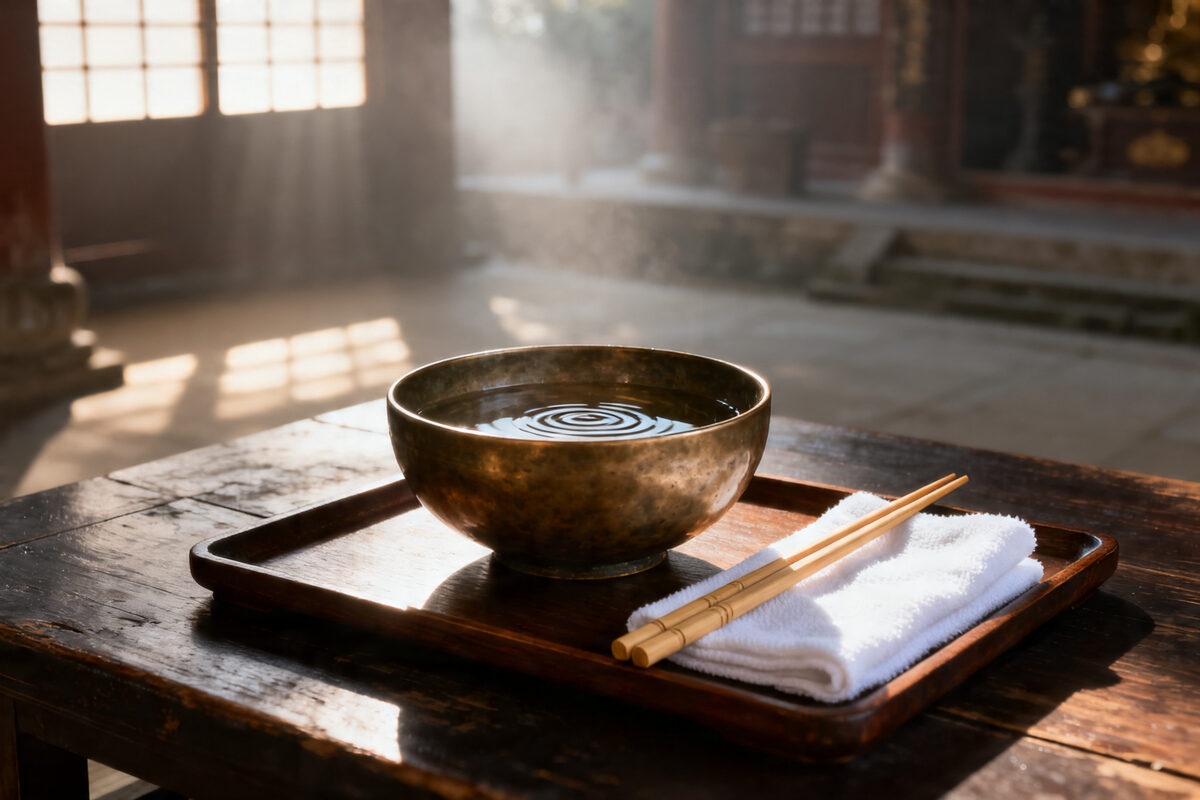
In the Zen tradition, the bo (钵, alms bowl) is the vessel a monastic uses for meals. "Washing the bowl" means exactly what it sounds like — cleaning one's own bowl after eating. It is the most mundane of temple routines, as ordinary as clearing the table at home.
Yet Zhaozhou presented this most ordinary act as his answer to the question of "practice."
There are three layers of meaning here, each deeper than the last.
The First Layer: Practice Is Not Something Mysterious
When the young monk asked about the "way" of practice, his unspoken assumption was that there must be a special path, a special method, a special state of being.
Zhaozhou's answer shattered that assumption. The path is not somewhere far away — it is right before your eyes. You ate your porridge; the bowl is dirty; go wash it clean. That is practice.
How closely this mirrors the mindset of so many people today. We are forever convinced that happiness lies elsewhere, that wisdom is hidden in books, that enlightenment awaits in some remote mountain retreat. We search in all directions, yet forget that the task at hand remains unfinished.
The Second Layer: "Washing the Bowl" Is a State of Mind
Washing dishes, too, can be done in many ways. One person does it impatiently, eager to be done; another does it absentmindedly, mind wandering elsewhere; still another does it quietly — feeling the cool water run over the bowl, sensing the texture of its surface, present with each movement.
When Zhaozhou said "wash the bowl," he meant more than the physical act. He was pointing to a quality of awareness — to do what is before you wholly, attentively, without judgment.
This is, in essence, the very heart of mindfulness.
Thich Nhat Hanh, teaching his students at Plum Village how to wash dishes, once said these famous words:
"While washing dishes, one should only be washing dishes. That might seem straightforward, but what does it mean? It means that while washing dishes, one must be completely aware that one is washing dishes."
Over a thousand years earlier, Zhaozhou was already saying the same thing.
The Third Layer: Eating Is Practice; Washing the Bowl Is Practice
At a still deeper level, Zhaozhou was pointing to a fundamental Zen insight — there is no distinction between "practice" and "not-practice."
We habitually divide life into two halves: one consisting of "important things" (work, study, meditation, spiritual cultivation), the other of "trivial things" (eating, washing dishes, sweeping the floor, using the toilet). We invest the former with meaning and dismiss the latter as a waste of time, wishing someone else would do them for us.
But Zen tells us: this habit of dividing is itself the obstacle.
In the Diamond Sutra, the Buddha taught, "Give rise to a mind that does not dwell anywhere." The Sixth Patriarch Huineng awakened upon hearing that single line. Zhaozhou did not cite sutras. He did not say "give rise to a non-dwelling mind." He simply asked, "Have you eaten your porridge?" — Eat when it is time to eat, wash the bowl when you are done, and when the bowl is clean, the mind is clean as well.
Life itself is the practice hall.
From "Wash the Bowl" to "Go Drink Tea": Zhaozhou's Zen of the Everyday
If you are familiar with Zen koans, you may notice that "wash the bowl" and "go drink tea" share a kindred spirit.
"Go drink tea" is another celebrated Zhaozhou koan. A visitor came to study with him. Zhaozhou asked, "Have you been here before?" The man said, "I have." Zhaozhou said, "Go drink tea." Another visitor came. Zhaozhou asked the same question; this one said, "I have not been here before." Zhaozhou said, "Go drink tea." The temple director was puzzled. "Why do you say 'go drink tea' to the one who has been here and also to the one who has not?" Zhaozhou called the director by name. The director answered. Zhaozhou said — "You, too. Go drink tea."
Three utterances of "go drink tea," and every last trace of discriminative thinking was swept away.
"Wash the bowl" is the same brushstroke on a different day — eating porridge is practice, washing the bowl is practice, drinking tea is practice. There is nothing that is not practice.
This was the teaching Zhaozhou offered, his whole life long, in a thousand variations. Yet he never resorted to words like "the Way," "the Dharma," or "emptiness." He spoke only of the everyday.
Later generations called this style the "Gate of Zhaozhou" — never speaking of the profound, speaking only of this moment.
Why Did the Monk "Suddenly Awaken"?
The final line of the koan is crucial: "At that moment, the monk suddenly awakened." The young monk had a sudden flash of insight.
But insight into what?
Not into some abstruse theory. Rather, he suddenly saw the workings of his own mind — that mind forever grasping outward. He had assumed that practice lay somewhere else: in the words of a master, in the pages of scripture, on a meditation cushion in some distant mountain. But with a single sentence, Zhaozhou pulled him back to the present moment: You finished your porridge, but the bowl is still unwashed.
What you have been searching for is right at hand.
This kind of insight is not an accumulation of knowledge but a shift in perspective. It is like searching the whole world for your spectacles, only to discover they have been sitting on the bridge of your nose all along.
Zen calls this kind of realization xing (省) — not full awakening (wu), but a sudden glimpse, as though perceiving the silhouette of mountains through fog.
"Washing the Bowl" in Modern Life
Over a thousand years have passed. Does Zhaozhou's words still hold meaning for us today?
Not only do they hold meaning — they may be more relevant now than ever.
1. How Many "Unwashed Bowls" Do You Have?
Think about it. How many things in your life have been left half-done? A half-finished meal, a half-read book, a half-spoken conversation, a half-begun plan…
We are forever chasing the next thing, forgetting that the thing at hand is not yet complete. Zhaozhou's "go wash your bowl" is a reminder: finish what is before you first.
This is not about productivity hacks or time management. It is a form of reverence for the present moment — when the bowl is used, wash it; when it is clean, put it back where it belongs. And the mind settles.
2. Can You "Just Wash the Dishes"?
Try, the next time you wash dishes, to simply wash the dishes. No phone, no podcast, no planning tomorrow. Just feel the water's warmth, the texture of the bowl, the slip of suds between your fingers.
You may find that what you thought was the most boring task in the world harbors an immense stillness within it.
Psychological research has shown that mindful housework — washing dishes, sweeping, folding clothes — can significantly reduce anxiety and enhance well-being. Hardly a new theory. Zhaozhou knew it a millennium ago.
3. Treat the "Ordinary" as Your Practice Hall
We are forever yearning for an "extraordinary" life — to travel to far-off places, to read the most profound books, to meet the most impressive people. But Zhaozhou tells us that the extraordinary is hidden within the ordinary.
Every bowl of porridge is a feast of the Dharma; every dish washed is an act of practice.
What matters is not what you do, but with what quality of mind you do it.
The Cypress Tree in the Courtyard, the Way Beyond the Wall
Zhaozhou's teaching had one consistent core: the Way is never far from where you are.
Asked, "What is the meaning of the Patriarch's coming from the West?" he pointed to the courtyard: "The cypress tree in the courtyard."
Asked, "What is the Way?" he said, "The one outside the wall."
Asked, "How should I practice?" he said, "Go wash your bowl."
His meaning was clear: the Way is not in the heavens, not under the earth, not in the sutras, not in the temple. The Way is right before you — in whatever you are doing at this very moment.
This sounds simple enough. But to truly live it requires an immense depth of awareness and steadiness of mind. For it asks us to relinquish all "seeking" — seeking enlightenment, seeking calm, seeking wisdom — and simply, plainly, do what is before us.
This is Zhaozhou's Zen of Washing the Bowl.
Reflections
-
Have you "washed your bowl" today? Think back — is there something you left half-done today? Try going back and finishing it now. Notice how it feels to complete something.
-
How hard is it to "just wash the dishes"? Next time you wash dishes, try it — no phone, no wandering thoughts, just the dishes. See how long you can sustain it, and notice what pulls you away from the present.
-
What are you "seeking"? Ask yourself: what is it you most want to attain right now? If Zhaozhou were standing before you, what would he say?
Master Zhaozhou Congshen (778–897), eleventh-generation successor in the Nanyue lineage of Zen, was venerated as the "Ancient Buddha of Zhaozhou." He served as abbot of Bailin Temple in Zhaoxian, Hebei, for forty years, teaching students in the language of the everyday and leaving behind countless koans. Among them, "A Dog Has No Buddha-Nature," "Go Drink Tea," "Wash the Bowl," and "The Cypress Tree in the Courtyard" are known as the Four Great Koans of Zhaozhou, and remain essential objects of contemplation for Zen practitioners to this day.