Before the Moon Landing, NASA Told the Astronauts to Watch Out for Chang''e and Her Rabbit
On the way to the Moon in 1969, Houston really did ask the Apollo 11 crew to watch for Chang''e and her rabbit. It''s still in the NASA archives. Before Mid-Autumn Festival, the whole story of the woman who lives on the Moon: she got forever — and lost everything else.
The mooncakes are stacked into little mountains at the supermarket. That''s how I realized Mid-Autumn Festival is almost here.
This year it falls on September 25th. Five days from now.
Around this time every year, my mother starts arranging mooncakes. She has one stubborn rule: there must be a box of five-nut ones, because my grandmother only ever ate five-nut. Nobody eats five-nut anymore. But she buys it every year. This year it occurred to me — some things aren''t bought to be eaten. They''re bought to be remembered.
What I want to write today isn''t about mooncakes, though. It''s about a conversation from 1969.
One
July 1969, during the Apollo 11 mission. The spacecraft was coasting between Earth and the Moon, the astronauts running their routine checks. Then Ronald Evans, the capcom in Houston, suddenly read something over the loop.
He read it carefully, like an official notice — and later everyone found out it actually was one. The transcript still sits in NASA''s archives. Anyone can look it up:
"Among the large headlines concerning Apollo this morning, is one asking that you watch for a lovely girl with a big rabbit. An ancient legend says a beautiful Chinese girl called Chang-o has been living there for 4,000 years. It seems she was banished to the Moon because she stole the pill of immortality from her husband. You might also look for her companion, a large Chinese rabbit, who is easy to spot since he is always standing on his hind feet in the shade of a cinnamon tree. The name of the rabbit is not reported."
Michael Collins''s reply is in the record too:
"Okay. We''ll keep a close eye out for the bunny girl."
The first time I read this, I laughed. Then I sat there for a while, and my eyes went a little hot.
The first time humans went to the Moon, they went carrying a Chinese name that was four thousand years old. And they didn''t even get it wrong — the pill, the exile, the Moon, the rabbit, the cinnamon tree. All of it, basically intact.
Only one word stayed with me. "Banished."
Banished — as in punished. For four thousand years, people seem to have assumed that Chang''e being on the Moon was a kind of punishment.
Two
Let me tell the whole story first.
Long ago, ten suns rose into the sky at once. The crops died, the rivers dried, and people couldn''t escape the heat even in the shade. An archer named Yi drew his bow and shot down nine of them. The world was saved.
Yi was given a pill of immortality from the Queen Mother of the West. Swallow it, the legend says, and you rise to heaven, forever deathless.
What happened next — the earliest records are not kind. The Huainanzi gives it one line: "Yi asked the Queen Mother of the West for the pill of immortality. Chang''e stole it and fled to the Moon." Stole. She took the pill, swallowed it herself, and flew to the Moon.
An even earlier text, the Lingxian, is harsher: when she reached the Moon, she turned into a toad.
A toad. A warty old toad.
The first time I read that version, I sat stunned for a long time. Why? Why did the story need to do that to her?
People kept asking the same question, apparently, for the next two thousand years. And generation by generation, the story was quietly rewritten. The version most widely told now goes like this: Yi had an apprentice named Peng Meng. While Yi was out hunting, Peng Meng broke into the house and demanded the pill at knifepoint. With no way out, Chang''e refused to let it fall into his hands — and swallowed it. Her body went light at once. She drifted out the window, up and up into the sky. She couldn''t bear to go too far from her husband, so she flew with all her strength to the nearest place to earth — the Moon — and stopped there.
When Yi came home and understood, he chased her into the yard. But the Moon was beyond reaching. All he could do was set out the fruits she loved on a table, and offer them to her from afar. Later people learned it from him: on the fifteenth of the eighth month, under the moonlight, set out a table of fruit.
The most moving change in this version is this: she went from "the thief who stole the pill" to "the one who kept it safe for everyone." Swallowing it wasn''t betrayal. It was protection — and the price of the protection was herself.
That first ending, where she turns into a toad? Almost nobody repeats it anymore. I think I know why. When someone takes a wound in your place, you cannot let her turn into a toad.
Myths are softened, generation by generation, by people who couldn''t bear it.
Three
Her home on the Moon is called the Guanghan Palace — the Palace of Vast Cold.
Vast, and cold. The name alone is the whole answer of this story.
She got "forever," and the price was "forever alone." Immortality wasn''t a reward. It was exile. When that NASA capcom read out the word "banished," he actually had it right.
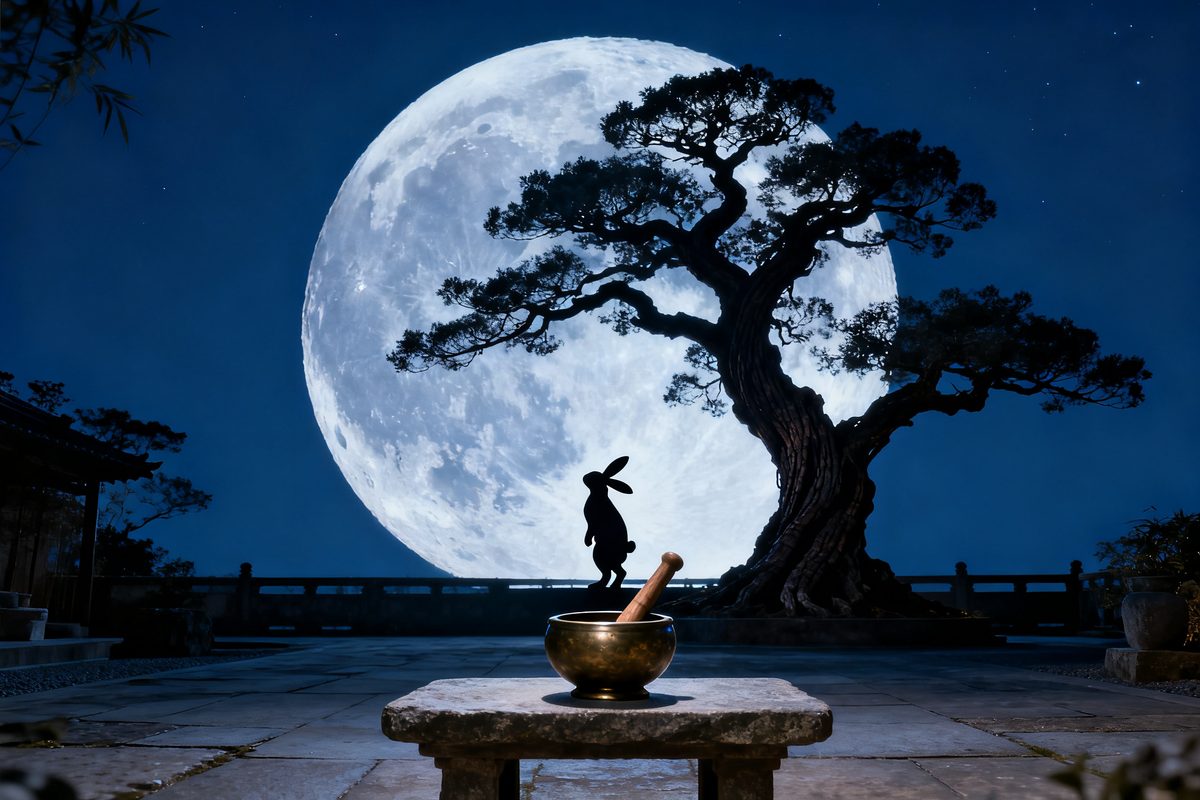
She isn''t alone up there, though. There''s a white rabbit, endlessly pounding medicine. That same elixir — with a mortar and pestle, stroke after stroke, for thousands of years, never finished.
And there''s a man named Wu Gang, punished for a fault while studying the Way, sent to the Moon to chop down a cinnamon tree. The tree is five hundred zhang tall, and worse: every time the axe falls, the wound closes at once. The tree can never be cut down.
Three residents on the Moon: one forever lonely, one forever pounding medicine, one forever chopping a tree.
I used to think these stories were bleak. I don''t anymore.
Because the to-do list is never finished, the messages are never all replied to, the mortgage is never done being paid, the work is never done. When did we start living like the people on the Moon? Inside one endless task, day after day, carrying on.
The difference, maybe, is this: the medicine the rabbit pounds, the legend says, is meant to heal others.
Four
In December 2013, a Chinese rover landed on the Moon. Its name was Yutu — Jade Rabbit.
The rabbit that had pounded medicine for thousands of years came back to the Moon. It flew with the Chang''e 3 mission, and in 2015 the region around its landing site was officially named by the International Astronomical Union — Guanghan Palace.
The archives have the names. Now the stars do too.
Yutu was designed to last three months. It worked for 972 days. On July 31, 2016, it went silent.
It had its own social media account, and it always spoke in first person. The night it stopped working, it posted two characters:
"Good night."
Hundreds of thousands of people left comments under that post. "Good night, little bunny." "You worked hard — sleep well." A lot of people said they cried.
Of course I know it was a machine. But the light that went out on the Moon that night carried a name that had been lit four thousand years earlier.
Chang''e flies to the Moon. The Jade Rabbit pounds medicine. Both became the names of spacecraft. The myth never died in the books — it kept rising into the sky, again and again, for real.
Five
By the time I got this far, it was dark.
I went downstairs for a walk. The moon isn''t full yet — a small piece missing, like a mooncake someone bit. But already beautiful to look at.
I stood below my building and looked up for a long time. I thought of the line by Li Bai: "People today have never seen the ancient moon, / but today''s moon once shone on the ancients." The moon we looked up at tonight is the same one Chang''e looked up at, the same one Yi could never reach from his yard, the same one Collins joked about watching for the bunny girl, the same one where the Yutu rover fell asleep.
The same moon. Equally full for everyone, and equally far.
Mid-Autumn this year is September 25th. If you look up that night, you can think of this: up there, by the count Chinese people have kept for thousands of years, lives a woman who tested "forever" on our behalf — and a rabbit who stays with her and refuses to sleep.
Why are mooncakes round? The grown-ups say it means reunion.
But I''ve come to think the most precious thing in this story isn''t reunion. It''s company. However alone you are, there is a rabbit keeping you company. Pounding medicine for ten thousand years — still keeping you company.
Maybe what a person truly needs was never "forever." Just "staying."
Three questions, for whoever read this far:
- If the price of living forever was leaving everyone you love, forever — would you swallow that pill?
- Is there something in your life that''s never finished, but you''re still willing to do a little of it every day?
- Who do you want to watch the moon with this year?