The Dragon Has Nine Sons. Not One Became a Dragon.
A foreign friend pointed at the little beasts on a temple roofline: dragons have sons? Nine of them — and as the old saying goes, not one became a dragon. None became a dragon; every one found his place.
It Starts Under an Eave
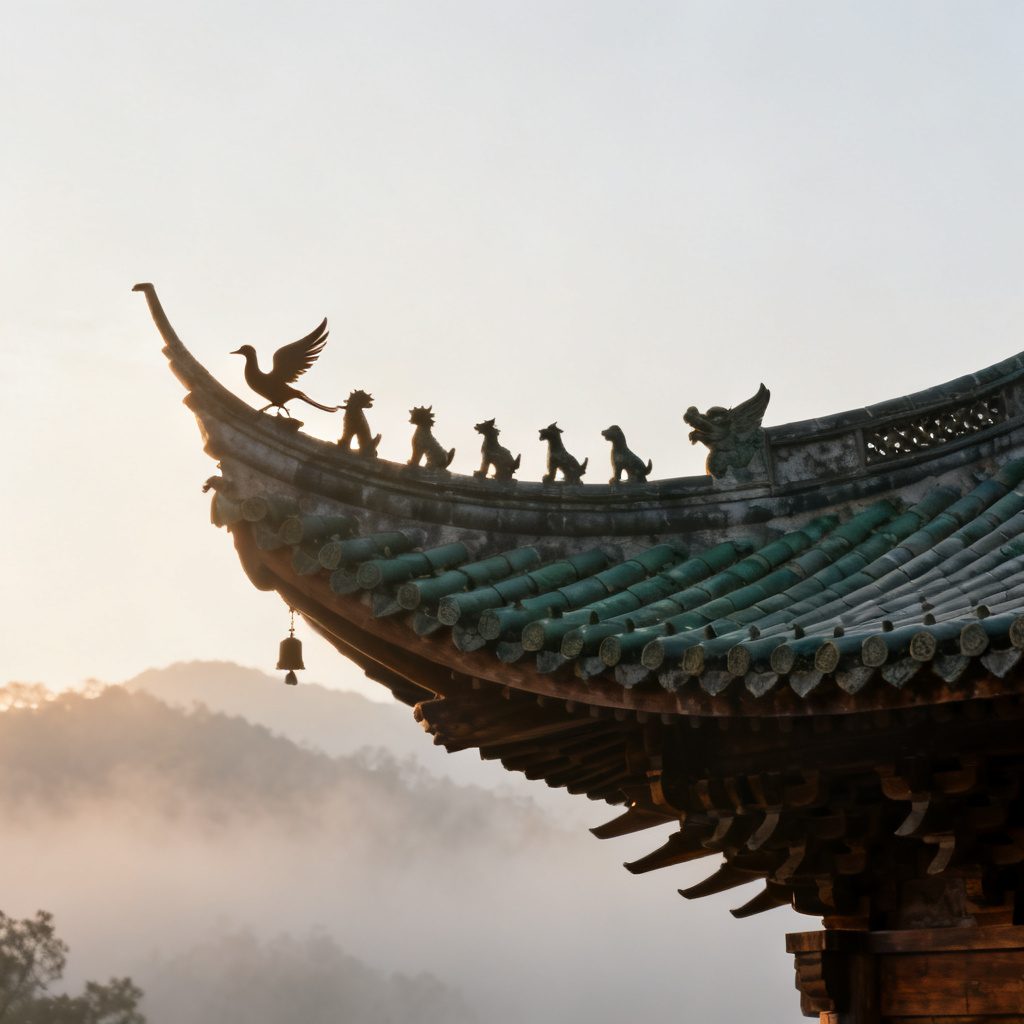
A few days ago I took a foreign friend to visit an old temple in my city. He was taking photos the whole way, then suddenly stopped in front of the hall and pointed up at the roofline: what are those little animals?
I looked up. Along the ridge of the hall sat a row of small beasts. At the front, an immortal riding a phoenix; behind him, a few odd-looking fellows — something of the dragon in them, but none of them quite a dragon.
I said: those are roof figures. And a few of them are, so to speak, the dragon's sons.
He froze. Dragons have sons?
Not just one, I said. Nine. And as the old saying goes, not one of the nine became a dragon.
He looked even more confused. Didn't become dragons? Isn't that a failure?
I couldn't answer right then. But on the way home, the question stayed with me. A failure? I had stood under that eave for a long time, and it suddenly seemed to me that this might be one of the gentlest sentences in Chinese culture.
The Dragon Has Nine Sons, and Each Loves Something Different
The story begins with a book from the Ming dynasty. In the Hongzhi era, the emperor one day wondered: the dragon has nine sons — who exactly are they? The question reached Li Dongyang, a grand secretary. He didn't know either. He went home, dug through old texts, asked around, and pieced together a "list," later collected in his writings. That list survived, and it is the version we still tell today.
Nine sons. Faces only a mother could love — and careers, each entirely his own.
The eldest is Qiuniu. Fearsome name, gentlest heart. He loves music, and he perches on the heads of instruments. Go to a museum and look at Ming or Qing huqin, or the Yi people's yueqin — the carved beast at the top of the neck is him.
The second is Yazi. He loves a fight. The idiom "Yazi always settles scores" is his temper. He sits on sword hilts and blade guards — in the museum's weapons hall, the one swallowing the blade in his jaws, that's him.
The third is Chaofeng. He loves heights and danger. He is among the beasts on the upturned corner eaves, keeping watch for the whole hall.
The fourth is Pulao. He lives by the sea and is terrified of whales; when frightened, he bellows. So people cast him on the top of great bells, and shaped the bell-striker like a whale — one strike, and the sound rings out. Every old bell you have ever heard, there is his fear inside its resonance.
The fifth is Suanni. He loves smoke and incense, and loves to sit still. He crouches on incense burners. The moment a temple fills with swirling incense smoke is his happiest hour.
The sixth is Bixi. The strongest of the nine, a carrier of weights. That turtle-like creature under stone steles all over China — that's him. He has carried words on his back for centuries, without moving. Many people call him "the turtle under the stele." He is a dragon's son.
The seventh is Bi'an. Loyal, and with a sharp sense of right and wrong. He sits on prison gates and beside the plaques of government offices — watching over the injustices of the human world.
The eighth is Fuxi. He loves writing. He coils along the top edges of stone steles, keeping company with the inscriptions.
The ninth is Chiwen. He is good at one thing: keeping fire away. He sits at both ends of the main roof ridge, jaws wide, biting down on the ridge. The ancients believed that with him there, fire would not dare come. Wooden houses have feared fire for thousands of years — and in the end, they entrusted their peace of mind to a dragon's son.
When my friend had heard all this, he asked a very good question: why did the Chinese put them in these places?
I said, think about it. The one who loves music guards the instrument. The one who loves battle guards the sword. The one who bellows guards the bell. The one who loves smoke guards the censer. The strongest carries the stele. The one who loves words keeps the inscriptions company. Each one was given the place he loved — and the place he was made for.
The Chinese handed over, one by one, everything that mattered in their daily lives — the instrument, the sword, the bell, the incense, the stele, the roof ridge — not to the dragon, but to the dragon's nine children.
None of Them Became a Dragon
The heaviest line in this story is the second half of the old saying: The dragon has nine sons, each with his own nature, and none became a dragon.
None became a dragon.
The first time I truly sat with that line was one Spring Festival. The whole family gathered around the table, and the talk slid, as it always does, to the children: whose child ranked first, whose got into the big company, whose child "made it." A cousin of mine sat in the corner, saying nothing. He repairs cars. His hands are always covered in grease, but everyone on that street takes their car to him when it breaks down.
At that table, the words "become a dragon" — make something of yourself — were said again and again.
I suddenly thought of those nine brothers.
By the world's standard, they had all failed. Their father is the dragon: the being who can grow vast or shrink tiny, who can rise into the sky or hide in the deep, who summons the clouds and the rain. And the nine of them — one perched on a instrument head, one biting a sword hilt, one lying under a stone stele. Not one can ride the clouds. Not one can call the rain.
But if the dragon kept an examination hall, I don't believe he would grade his sons. Because the errand he gave each son is exactly what each son was born loving. Qiuniu, who melts at music, does not envy Bixi hauling the stele. Suanni has no wish to stand on the roof and catch the wind — he wants that one breath of incense smoke.
None became a dragon. Every one found his place.
Now when I visit temples, I stand a little longer under the eaves. I watch Chaofeng on the corner, Chiwen biting the ridge, Suanni on the censer inside, Bixi under the stele at the gate. Each crouches in his own spot, bothering no one, standing there for centuries.
Not one of them is a dragon. But remove any one of them, and something in that place becomes incomplete.
Our Non-Dragon Hours
Honestly, writing this, I feel a weight on me.
Because I was raised on "hope my son becomes a dragon." I know that logic too well: be the best, the strongest, the one in front. Second-best equals failure. Different equals wrong.
I have watched too many people — myself included — spend ten years practicing "becoming a dragon," instead of spending a little time finding out: which of the nine am I?
The one who goes quiet the moment music starts? The one who cannot swallow an injustice? The one with the strength to carry things? Or the one who just wants to keep a censer lit and a scroll of writing, and live a quiet life?
Here is the cruelty of it: if you are Pulao, you can practice carrying steles your whole life and never out-carry Bixi. But go strike a bell — one toll, and the whole city hears you.
My cousin who repairs cars eventually opened his own shop. I saw him last year when I went home. He was lying half under an old engine, and when he slid out he was drenched in sweat — his eyes shining. In that moment I was certain: he had found his stele.
Not everyone has to become a dragon. Coming from someone raised on becoming a dragon, the words feel weightless. But those nine brothers, crouching under temple eaves for five hundred years, press the words down solid —
If a creature like the dragon can have nine sons, nine sons in nine shapes, not one a copy of himself — then who are we to demand that the children of ordinary families grow into one standard shape?
The Stone Pair at the Gate
I was about to end here. Then I remembered one more detail, and it has to be told.
You've seen the pair of drum stones flanking old gates, or the posts on bridge railings, lion-like figures — some of these are distant kin of the same family. (In some versions, Jiaotu and Taotie are counted among the dragon's sons, loosely.) Jiaotu's nature is to keep things closed. He dislikes strangers entering his home. So he was invited to guard the gate.
I used to think this was a little sad: because he disliked company, he was assigned to watch the door for all eternity.
Now I think it might be the deepest kind of self-knowledge — not that he was good at guarding gates, so he was made to guard one; but that he knew he had no love for crowds, so he found himself a gate.
To know yourself, and then to find a place that fits your nature, and to keep it well. That, I think, is the whole secret of the nine sons. As for the magic, the transformations, the clouds and rain — let the dragon attend to that.
That foreign friend took many photos under the eave that day. As we left, he asked: how does the saying go again?
I said: the dragon has nine sons, and each is different.
He tried to say it. Then he said: I don't think this is a story about failure.
No, I said. This is a story about how you're allowed not to be a dragon.
Three questions, for you, and for me:
- If you were one of the dragon's nine sons, which would you be — the one who loves the qin, the quiet one, the one who carries the stele, or the one who guards the gate?
- Is there one thing in your life that makes your eyes light up when you do it? Where does that thing sit in your life right now?
- If your child — or the child inside you — is destined "not to become a dragon," how will you tell them that?