Azure Dragon on the Left, White Tiger on the Right: The Map Ancient Chinese Drew in the Sky
That line from kung fu movies? It was never about tattoos. It comes from a 3,000-year-old sky map — four sacred beasts, four directions, a calendar written in stars.
When I was a kid watching Hong Kong movies, some character would roll up his sleeve — a dragon on the left arm, a tiger on the right — and the crowd would shout: Azure Dragon on the left, White Tiger on the right!
I always thought it was gangster talk. A way of saying "don't mess with me."
Only much later did I learn the line has nothing to do with tattoos. There are two more lines after it: Vermilion Bird in front, Black Tortoise behind. Four sacred beasts, four directions — a sky map the Chinese drew three thousand years ago.
First, be clear: they were stars
The ancients had no weather forecast, no calendar app. They only had the sky.
Every night the stars rose in the east and set in the west, one full circle a year. Someone slowly noticed a pattern: when certain stars appeared above the eastern horizon at dusk, it was a certain season on the ground.
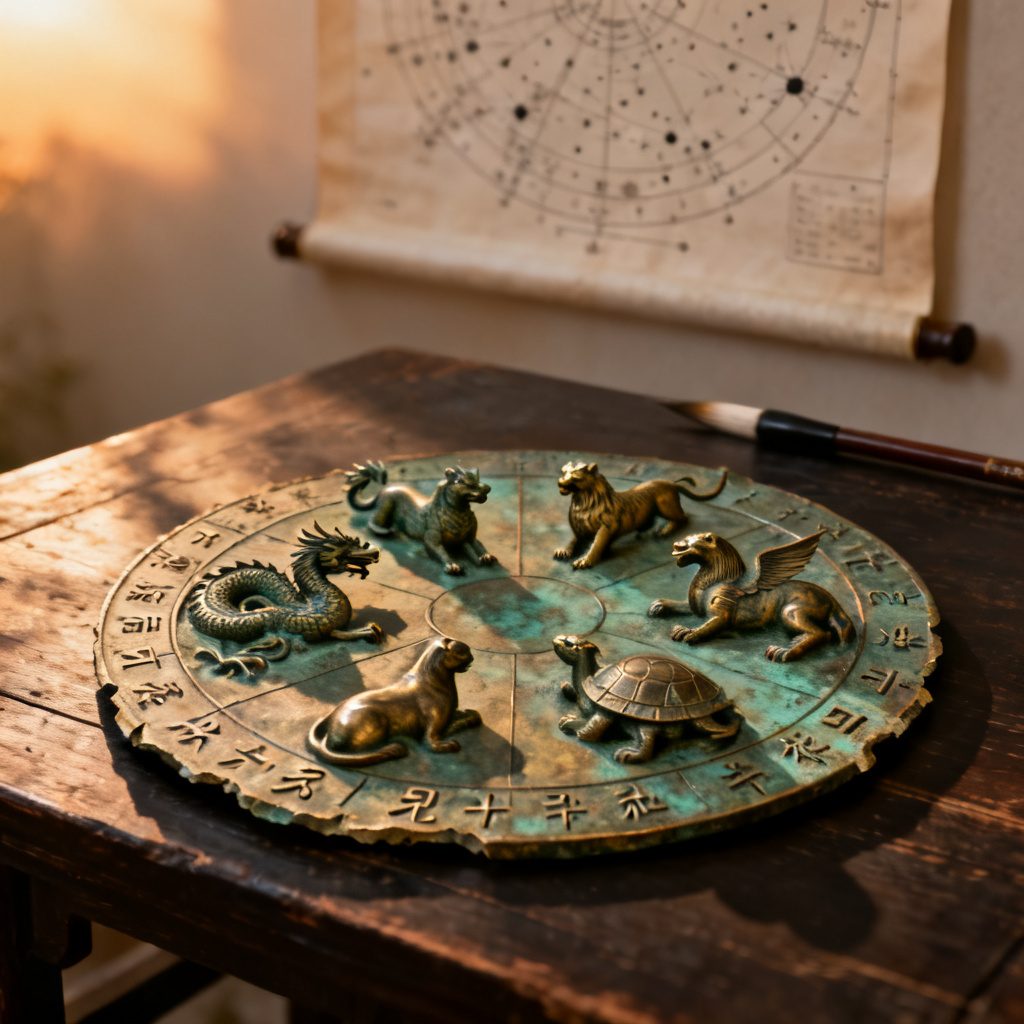
They grouped the stars into twenty-eight mansions, seven for each direction. The seven of the east, joined together, were imagined as a dragon. The west, a tiger. The south, a bird. The north, a tortoise entwined with a snake.
This wasn't idle imagination.
You've heard of the "dragon raising its head" on the second day of the second lunar month? That's not a dragon on the ground. It's the "horn" of the Azure Dragon constellation — the star called Jiao — just appearing on the horizon at dusk. When the dragon lifts its head, spring has truly settled in, and it's time to plough.
Farmers lived by the sky. That dragon in the heavens was their farming calendar. Miss it, and you missed a year.
Why these four colors
Why is the Azure Dragon azure? Why is the White Tiger white?
Because the colors aren't the animals' colors. They're the colors of the directions.
The Five Elements system divides the world into five directions: east belongs to wood, its color azure, its season spring; west belongs to metal, its color white, its season autumn; south belongs to fire, vermilion red, summer; north belongs to water, dark black, winter. The center belongs to earth, yellow — the seat of the emperor.
So the White Tiger actually corresponds to autumn. When the autumn wind rises and the plants wither, there is a certain killing restraint in the air, and the ancients felt it was tiger-like. That's why execution grounds were placed on the west side of cities, and executions were carried out in autumn — the "autumn verdicts."
Not a cruel coincidence. A whole worldview: what time, what direction, what to do, and what not to do.
Of the four beasts, the Black Tortoise (Xuanwu) is the strangest — a tortoise and a snake coiled together. Why two animals?
The north governs winter. Winter is when life hides: no growth to be seen, no movement, everything tucked underneath. The tortoise can hide, endure, live long. The snake sheds its skin each year, as if dying once and coming back to life.
Hidden at the deepest point, yet able to be reborn. The ancients put these two together in the north, in winter, in the place where nothing can yet be seen.
After thirty, I've grown fond of Xuanwu. When you're young, everyone wants to be the Vermilion Bird — bright, eye-catching, in the most prominent corner of the southern sky. Later you realize that three-quarters of any year belongs to the other three beasts.
And the "Azure Dragon left, White Tiger right" of feng shui?
Because Chinese houses traditionally face south.
Stand facing south: your left hand is east, your right hand is west. So the left of a house is the Azure Dragon position, the right the White Tiger position.
The old saying continues: better the Azure Dragon ten thousand feet high than the White Tiger raising its head — the buildings on a house's left (or your desk's left) may stand tall, but the right should stay lower and quieter.
Does it make sense? I tried explaining it to myself in a modern way: China's dominant winds blow from the north and northwest in winter, from the southeast in summer. Taller buildings on the left (east) block winter wind; lower on the right (west) lets summer breeze in.
Of course, that's my modern practical retrofit — the ancients may never have thought this way. But I like this stance: take an old saying, first read it as culture, then check whether it has practical value. If it does, pick it up; if not, set it down gently. No need to believe it all, no need to rush to mock it.
They're carved into your city
These four animals don't live only in feng shui manuals. They're carved into Chinese cities — you probably walk past them daily.
The north gate of the Forbidden City is called the Gate of Divine Prowess (Shenwumen). It was originally the Xuanwu Gate, renamed in the Qing dynasty to avoid the Kangxi emperor's personal name. The south gate is the Meridian Gate — "meridian" is noon, the south, exactly the Vermilion Bird's position.
Nanjing has Xuanwu Lake. Why? It lies north of the old city. Tang-dynasty Chang'an's grandest avenue was Vermilion Bird Avenue, running straight through the city from the south. Xi'an still has the Azure Dragon Temple in the city's southeast — where the Japanese monk Kukai studied esoteric Buddhism before carrying it home to Japan.
And not only China. Old Kyoto borrowed Chang'an's plan almost entirely and had its own Suzaku Avenue. The old gates of Seoul follow the same four-symbol layout.
These four beasts are the shared underlying code of East Asian cities. Most people simply walk over them without knowing.
What are they, really?
I know some will say: why talk about this in this day and age?
But sometimes I think the Four Symbols were never superstition. They're a combined "time + direction" map the ancients made.
In an age without writing, farmers looked up at the mansions and knew the season; the lost found north by the Big Dipper. The stars were their calendar and compass. The Four Symbols are four friendly names given to that system, with four memorable faces — a dragon, a tiger, a bird, a tortoise-snake.
No one can memorize twenty-eight groups of stars. Everyone can remember four animals.
And honestly — that person three thousand years ago, at dusk, who first saw the dragon's horn rise above the horizon and felt a stir in the chest, "time to sow," felt exactly what we feel today when our phone pings "White Dew begins." Both are just trying to find a reliable coordinate inside a chaotic flow of time.
As I write this, it's dark. I stood on the balcony for a while. The city lights are too bright; you can barely see any stars.
But I know they're there. Around dusk these days, the Azure Dragon is slowly sinking in the west — that's what autumn is: the dragon goes down, the tiger rises, the plants begin to fall.
Three thousand years now, every year the same. More punctual than any news.
Three questions to leave with you:
- Where did you first hear "Azure Dragon on the left, White Tiger on the right"? What did you think it meant?
- Does your city have a place name or street with "Vermilion Bird," "Xuanwu," or "Azure Dragon" in it? Look it up — does it happen to sit in that direction?
- If you had to choose one of the four beasts as your guardian, which would it be? I suspect many would pick the Black Tortoise — but have you thought about why?