Westerners Burn Sage on TikTok. I Lit a Stick of Incense.
A bundle of white sage sells for twelve dollars online, promising to cleanse negative energy. Watching that smoke, I thought of the bronze burner on my grandfather's desk. Chinese people have burned incense for thousands of years — but never to chase anything away. The Song Dynasty counted it among its four leisurely arts, agarwood is a tree's scar, and an incense seal makes time visible. They cleanse; we settle. That difference is what this piece is about.
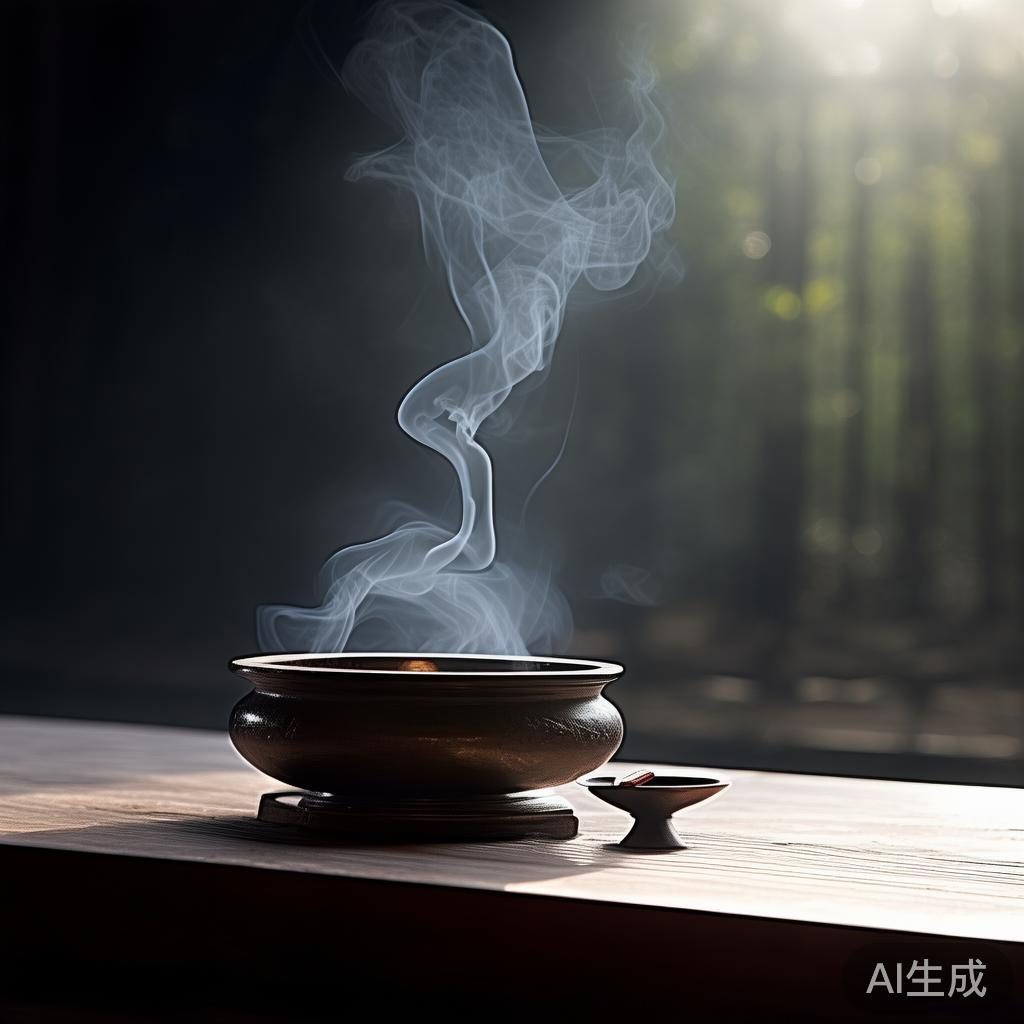
A bundle of white sage sells for twelve dollars, said to "cleanse negative energy." I watched that little thread of smoke and thought of the bronze incense burner on my grandfather's desk. Chinese people have been burning incense for thousands of years — but our incense was never about chasing anything away.
I watched the smoke for a long time
I was scrolling TikTok at night when I saw it: a blonde woman holding a bundle of dried herbs tied with cotton string. She lit it, fanned the smoke with a large feather, and walked slowly around her apartment. The comments were all saying: sage smudging, cleansing negative energy, ancient Native American wisdom. That bundle of herbs sells online for twelve dollars apiece.
I watched the smoke for a long time.
Not because it was funny. Because it looked familiar. It reminded me of my grandfather's desk. In his later years, there was always a small bronze incense burner on it. Before he sat down to write in the afternoon, he would light a stick first. The smoke rose in a thin, straight line, and then he began to write. We kids made noise around him; he didn't care. When the incense burned out, he put down his brush.
Back then I thought burning incense was something old people did for worship — superstition. Only much later did I learn how wrong I was.
The Four Leisurely Arts of the Song Dynasty
Chinese people wove incense into daily life much earlier, and much more deeply, than I imagined.
The Song Dynasty had what they called the "four leisurely arts": burning incense, whisking tea, hanging paintings, arranging flowers. Note — "leisurely arts," not "rituals." They were simply part of living, as natural as changing into slippers when you get home today. Friends came over — light a burner of incense. It's raining — light a burner of incense. Your heart is troubled — light a burner of incense.
Incense wasn't for asking for anything. Incense was just incense. When it was there, time slowed down.
The time it takes one stick to burn
The old Chinese phrase "the time of one stick of incense" wasn't vague. People really did measure time with incense — not the stick incense in temple burners, but "incense seals": fragrant powder pressed with a mold into one continuous pattern, usually a seal-script character or a lotus vine. You lit one end, and the fire slowly traveled along the pattern. One full loop took about an hour.
I once watched a friend make an incense seal at her home. She first leveled the ash in the burner, set the mold down, and filled the powder in bit by bit with a tiny spoon, then smoothed it gently with a small spatula. Nobody spoke through the whole thing. When it was done, she lifted the mold — the powder had left a complete character meaning "blessing" on the ash. She lit it, and the glowing head moved forward, slowly biting its way along the strokes.
I was transfixed. For that half hour, I didn't say a word, and didn't feel the need to.
Later I thought: this is probably the very thing foreigners pay a mindfulness subscription for. The Song Dynasty had it eight hundred years ago. The cost was a spoonful of incense powder.
Agarwood: incense is a tree's scar
When it comes to incense, I have to mention agarwood. I used to think agarwood was a kind of wood. It isn't.
When an agarwood tree is growing happily, there is no fragrance inside it. It has to get hurt first — struck by lightning, bored by insects, cut by a blade. The wound gets infected by certain fungi, and to heal itself, the tree begins to secrete resin. Year after year, the resin tangles with the wood until it becomes extremely hard and heavy — so dense it sinks in water and doesn't dissolve. Only what forms this way is called agarwood.
In other words: incense is a tree's scar.
The place where the tree hurt most becomes, over time, the most fragrant thing it carries.
When I first learned this, I sat still for a long while. Because my mother has a scar on her hand, from labor when she was young. And because of the few places in my own heart I'd rather not mention. Agarwood seems to be saying: it's all right to be wounded. The wounded place, slowly, may grow into something else.
Of course, it may not — not every wounded tree produces agarwood; very few do. Said more honestly: being hurt doesn't guarantee fragrance, but the possibility is there. And I find that "maybe" more comforting than any promise.
They cleanse. We settle.
Back to the sage.
I looked into it. Sage smudging really is a Native American tradition — burning white sage, "washing" rooms and people with the smoke, keeping harmful things away. That tradition deserves respect. TikTok turning it into a twelve-dollar bundle business is another matter.
What's interesting is the contrast. Their logic of smoke is "removal" — drive the bad away. The Chinese incense tradition is closer to "settling" — not chasing anything off, but keeping yourself company for a while. The incense is lit, a person sits down, the smoke goes straight, and the heart straightens a little with it.
Actually, China has a "cleansing" version too: mugwort. Hanging it on the door at Dragon Boat Festival, pressing moxa cones on the body in moxibustion — the same idea: use the scent of plants to keep harmful things away. Look closely and you'll see people all over the world, going around and around, want the same thing: a space where the heart can rest.
The only difference is that some hold a feather and fan smoke, and some press an incense seal.
If you want to try one stick
I don't sell incense, and I'm not here to persuade anyone. It's just that these past six months, I've added one small ritual before bed: the phone charges in the living room; a short stick of incense burns on the desk.
If you want to try, a few honest words:
Choose natural. Sandalwood, agarwood, mugwort — look for "natural incense powder" on the label. The big cheap boxes are mostly sawdust plus fragrance oil. They'll give you a headache. That isn't incense; that's chemistry.
You don't need expensive tools. A simple incense holder, or even an ordinary little dish, will do. A burner is icing, not a ticket.
Do it before bed or right after waking, when there's less in your head, and the smoke is easier to see.
The last one matters most: once it's lit, put the phone down. Just sit. Even five minutes.
Ash and fire
I sit there doing nothing, just watching the smoke. Sometimes it rises straight; sometimes the air-conditioner bends it, and I watch it bend. The ash grows longer and longer, curving but not breaking — every incense burner knows this small miracle: the ash stays ash, the fire stays fire, the ash follows the fire, and the fire never hurries the ash.
One stick takes about ten minutes. In those ten minutes I don't need to "cleanse negative energy" or "raise my vibration." I'm just sitting here, a person with a lit stick of incense.
When it goes out, I go to sleep.
The smoke takes a long time to fade. If you've ever lit incense, you know what I mean — the smoke never really leaves. It only turns into something you can no longer see.
Three questions, for whoever read this far:
- Was there something at home you thought was "superstition" as a child, and find "interesting" now?
- When was the last time you did nothing for ten minutes — no phone either?
- If something could grow out of your wounded places, what would you want it to be?