She Turned Her Life Choice Into a Spreadsheet. I Thought of Jung's Preface to the I Ching.
A friend spent a week torn between two offers — every time she changed a weight, the answer flipped. Three thousand years ago, a book of sixty-four situations appeared. It doesn't decide for you. It just tells you first: it's overcast today, and that's not your fault.
She Turned Her Life Choice Into a Spreadsheet. I Thought of Jung's Preface to the I Ching.
A friend was deciding between two job offers. Company A paid more. Company B was closer to home. She built an Excel sheet with a dozen rows: salary, commute, manager, industry outlook, overtime, benefits, even how good the cafeteria was. Score every row, weight every score. She spent a whole evening tuning the weights, and A won. The next morning she changed the weight of "commute" from 3 to 5, and B won.
She sent me the sheet and asked: what am I doing wrong?
I stared at it for a long time, and then I thought of the I Ching on my bookshelf. Not because I wanted to divine an answer for her — honestly, I wouldn't know how — but because of a preface in the front of that book. The man who wrote it was Carl Jung.
A Western psychologist speaks up for a "book of divination"
Carl Gustav Jung. If the name means nothing to you, you've probably heard of his teacher, Freud. One of the most influential psychologists of the twentieth century. "Collective unconscious," "archetypes" — those are his words.
And this man wrote the preface to the German translation of the I Ching.
The translator was his friend Richard Wilhelm, a German missionary who had lived in China for over twenty years and translated China's oldest book into German. After Wilhelm died, Jung wrote the foreword for that edition. When the English edition came out, the preface stayed right at the front, and it has been printed there for decades.
A Western scientist who believed in evidence, vouching for a "fortune-telling book" — that was risky at the time. Jung knew it. He wrote in the preface that he knew what his colleagues would think of him. One student asked him directly: how can you believe in this stuff?
Jung's answer was interesting. He didn't say "I believe it," and he didn't say "it's superstition." What he said was: the I Ching gives you a different way of facing a question.
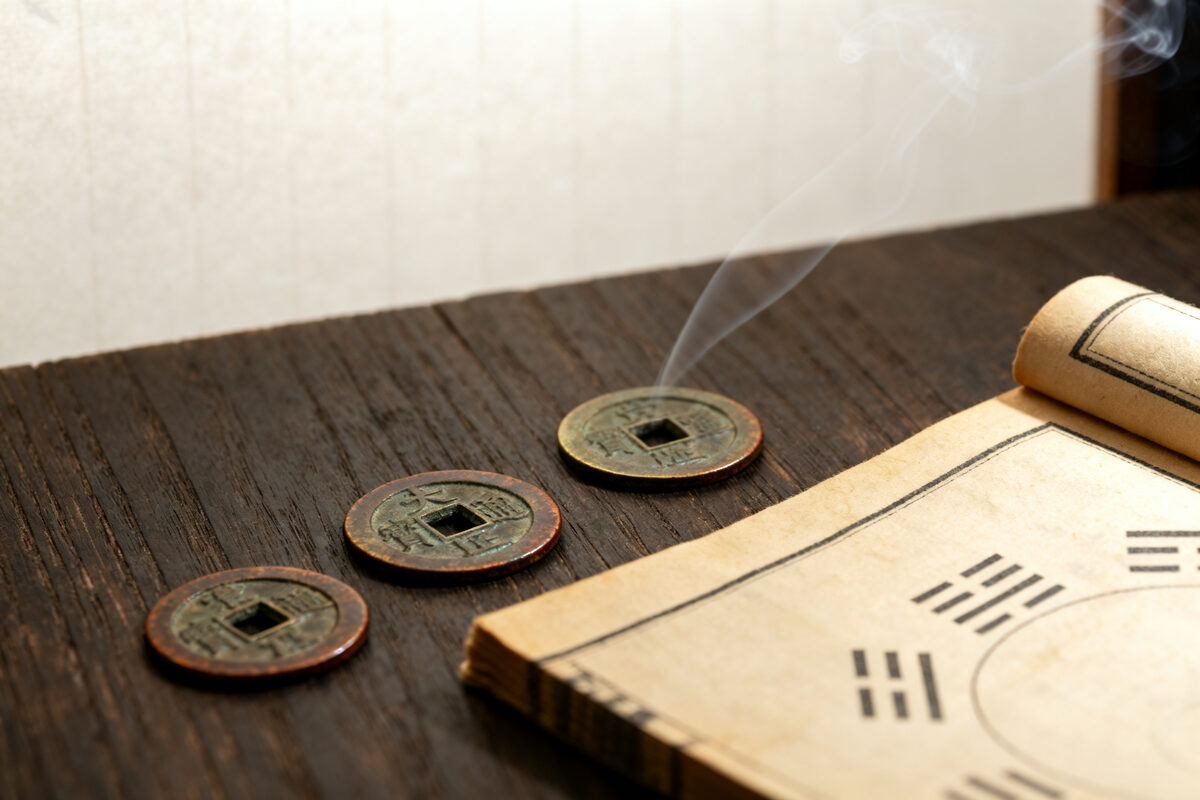
He told a story about himself in that preface. A patient came to him about a relationship, and Jung suggested casting a hexagram with the I Ching — the old way, three coins, thrown six times. The hexagram was Ding, the Cauldron, an ancient cooking vessel. The text spoke of a broken vessel ear and a stable jade handle. Jung said the answer was so precise it gave him chills — in that relationship, there really was a "broken ear" (someone who wouldn't listen) and a "stable handle" (the one holding everything together).
You can call that coincidence. Jung admitted it might be. But he later coined a word for it: synchronicity — some coincidences carry meaning. Not cause and effect. Resonance.
I'm not going to argue here whether synchronicity is science or not. Honestly, I can't. I want to talk about something else.
Six lines, three thousand years old
So what is the I Ching?
Many people think it's a fortune-telling book. I'd rather say it is a book about change. The word "Yi" was explained by the ancients as "change" — the world is always moving, the ground under your feet is always shifting.
Its basic units are incredibly simple: one unbroken line, one broken line. Yang and yin. Doesn't it look like the 1s and 0s of binary code? That's not my discovery — three hundred years ago, the German mathematician Leibniz saw a diagram of the sixty-four hexagrams that a missionary had sent him, and wrote excitedly that it matched his binary arithmetic perfectly. Six lines, two states each, two to the sixth power — exactly sixty-four. The Chinese of three thousand years ago and the German of three hundred years ago drew the same structure in two completely different languages.
But the sixty-four hexagrams weren't trying to do math. What they do is this: they give names to situations.
Think about how remarkable that is. When a person is anxious, the hardest part isn't having no answer — it's not being able to say what situation you're actually in. "Things haven't been going well lately." Going how? Can't say it. What the I Ching does is trace out those unspeakable situations, one by one, and give each a name: Qian, Kun, Zhun, Meng, Xu, Song...
Sixty-four situations. Like sixty-four kinds of weather.
Clouds in the sky, rain coming but not yet fallen — that's Xu, the hexagram of waiting. And the text doesn't tell you to wait around doing nothing. It says this is the time to eat and drink and enjoy yourself, to store up your strength. The dragon is still under the water — that's the first line of Qian: "the dragon lying low, do not use it." Not that you're not good enough. The moment hasn't come. Your task right now is to dive.
You see, it never makes the decision for you. What it does first is tell you: it's overcast today, and that's not your fault, and it doesn't mean you're not good enough.
So what was wrong with the spreadsheet?
Back to my friend's Excel.
I told her: nothing is wrong with the sheet. It just can't answer your question.
A scoring table assumes that everything you're weighing can be quantified, and that the weights are fixed. But real people don't live that way. The day you work until ten at night, "close to home" is worth ten points; the day the bonus lands, "more money" is a nine again. You weren't tuning the weights. You were tuning your mood. You're using a static table to fit a self that keeps changing — no adjustment will ever be right. Not because the table is wrong, but because this was never that kind of task.
She asked: then how is it done?
I said I don't know. (True.) Then I told her about Jung's preface, and the three coins.
Here's my own experience. For a while I went back and forth over one thing, and one night I tried casting a hexagram for myself, in the crudest way. Before you throw the coins, you have to state the question clearly in your mind — one sentence, no vagueness.
And in the very moment of stating that question clearly, I suddenly realized — I hadn't truly faced that question in three months. I had been agonizing over it, but I had never once said, in one complete sentence, what exactly I was hesitating about. Was I unwilling to give up that safety, or did I not trust myself to handle a new difficulty? Those two things were tangled together like a ball of yarn. I thought I was thinking about the problem. Actually I was just rolling the yarn in place.
I've almost forgotten which hexagram it was. But that moment of being forced to compress a fog of anxiety into a single sentence was worth every bit of my hesitation.
At the end of his preface, Jung wrote that he hoped this book would leave a place in Western hearts for Eastern wisdom. When I read that line, I thought: it doesn't really matter where the I Ching ends up living. What matters is the reminder it carries:
People aren't stuck because they lack answers. People are stuck because they can't form the question.
Afterwards
My friend took the job at Company B.
Not because of the spreadsheet, and not because of any hexagram. She said she printed both offers out, laid them on the table, stared at them for a long time — and suddenly saw that she'd been scoring Company A so high because turning down more money "would look stupid." She was wrestling with looking stupid, not making a choice.
That thing wasn't in the spreadsheet. No weighting system can compute "what am I wrestling with."
Three coins might not either. But this three-thousand-year-old book and Jung's eighty-year-old preface are at least saying the same sentence: see clearly what weather you're standing in, then decide where to walk.
When the rain hasn't stopped, running faster only gets you wetter.
Three questions, left for you too:
- That decision you've been chewing on lately — if you could only say it in one sentence, what would that sentence be?
- Among all the rows you scored, was one of them secretly "what will people think"?
- When was the last time you admitted, "this is not the time to move"?