What an Eight-Year-Old Girl Taught Me About Becoming a Buddha
I read a story from the Lotus Sutra today, and after I finished, I sat there for a long while.
What an Eight-Year-Old Girl Taught Me About Becoming a Buddha
I read a story from the Lotus Sutra today, and after I finished, I sat there for a long while.
Honestly, I'd come across this story before but never paid much attention. I probably thought the "dragon girl" was too far removed from me — I'm neither a dragon nor a girl. What could a story about an eight-year-old becoming a Buddha have to do with me?
But today, for some reason, I stopped mid-read. Maybe it's because I've been thinking a lot lately about this word: "qualification."
The Story Goes Like This
While the Buddha was teaching the Lotus Sutra, Manjushri — one of his great bodhisattva disciples — returned from the Dragon Palace. Shariputra, one of the wisest monks in the Buddha's circle, asked him: "How many beings did you teach in the Dragon Palace?"
Manjushri said: "Countless. And there's one — an eight-year-old dragon girl. Her wisdom is sharp, her understanding deep. She has already awakened."
Shariputra, hearing this, was not convinced. He said things that sounded very "reasonable" — Women carry heavy karmic burdens. How could she become a Buddha? The Buddha's state requires countless eons of practice. How could an eight-year-old girl have achieved it? Never in history has a woman been a world-turning king, let alone a Buddha.
Everything he said made sense. According to the teachings of the time, according to every known rule, he was right.
Then the dragon girl did something.
She didn't argue.
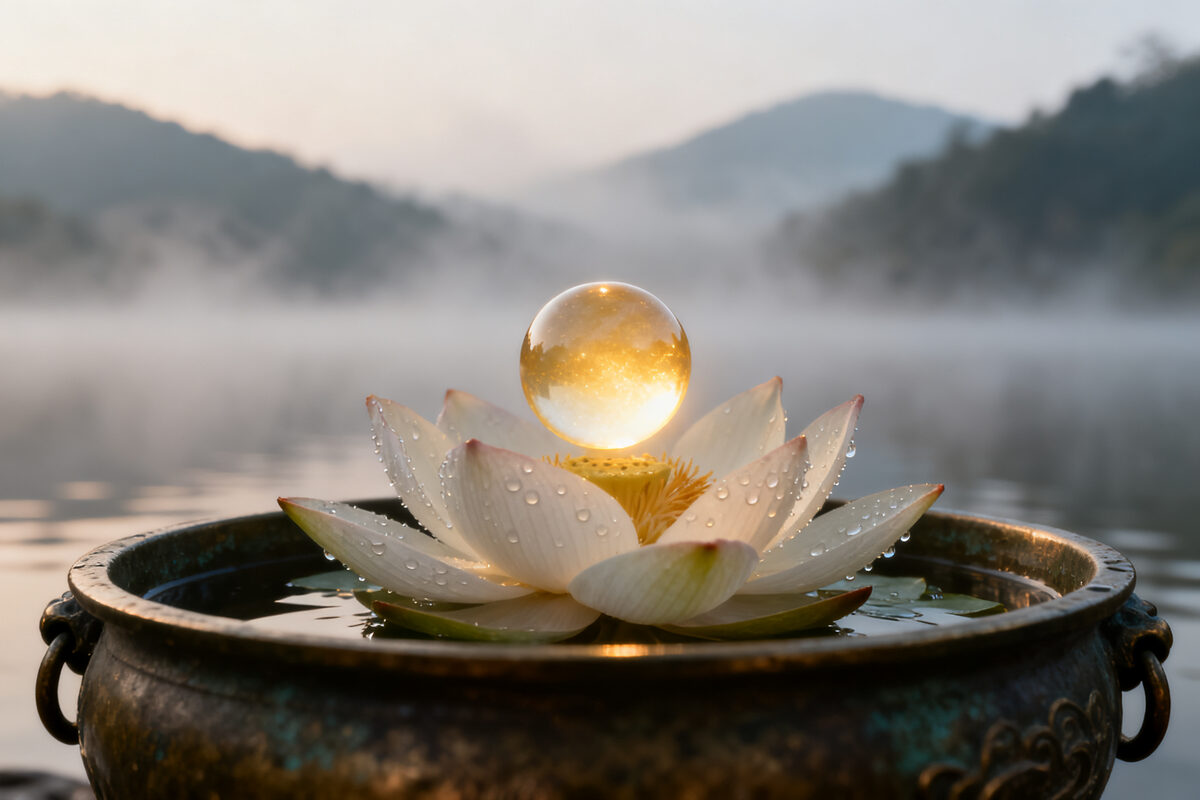
She took out a jewel — said to be worth three thousand great worlds — and offered it to the Buddha. The Buddha accepted it.
Just like that. Offered. Accepted.
Then the dragon girl said something like this: "I offer this jewel, and the Buddha accepts it — how fast is that? Becoming a Buddha is just as fast."
After she spoke, she transformed, sat upon a lotus throne, and went to the southern world of Adorned-with-Purity to become a Buddha. All the celestial beings and humans watching from afar saw her there, teaching the Dharma.
Shariputra stood there, speechless.
What Stopped Me
It's not the part where the dragon girl changes form — that detail has been debated endlessly. Some say the Lotus Sutra was still influenced by the social views of its time. Others say it was just a symbolic expression. I don't really want to dwell on that.
What stopped me was the moment Shariputra's "reasonableness" collapsed.
Shariputra wasn't a bad person. He was one of the Buddha's wisest disciples, known as "foremost in wisdom." Every word he spoke had scriptural basis, traditional support, and logic behind it. In the social and religious context of that era, his doubts were "correct."
But it was exactly this "correctness" that prevented him from seeing the truth right in front of him.
This reminds me of many things.
When we judge whether something is possible, what do we rely on? Past experience. Learned rules. "That's how it's always been." These conventions do help us understand most of the world. But occasionally, they become walls.
Shariputra's wall was: Women cannot become Buddhas. An eight-year-old child cannot awaken. Practice must take countless eons.
The dragon girl simply walked around that wall.
She didn't debate Shariputra. She didn't quote scriptures to prove herself. She just did one thing, and it was done.
This Question of "Qualification"
What I've been thinking about lately isn't really about becoming a Buddha. I'm thinking about "qualifications" in daily life.
Who is qualified to study Buddhism? Who is qualified to talk about practice? Who is qualified to say "I understand"?
Have you ever been in a situation where you had a genuine feeling, something real you wanted to express, but suddenly thought, "I'm not qualified"? Or you mentioned something about the Dharma to someone, and they said, "You haven't even ordained. You haven't practiced for years. What do you know?"
Shariputra is that voice.
And the dragon girl is the one who doesn't argue — she just acts.
I remember once at a temple, I heard an old woman tell a master: "Master, I don't understand anything. I just recite Amitabha's name every day. I've been doing it for years." The master said, "You're better than me. When I recite, my mind still wanders."
In that moment, I felt that this old woman was closer to the truth than many who "understand" Buddhism.
Fast and Slow
The dragon girl's metaphor is really brilliant.
Offering the jewel and the Buddha accepting it — that happens in an instant. How fast? A snap of the fingers. Becoming a Buddha can be just as fast.
But let's not misunderstand — this doesn't mean practice has shortcuts. The reason the dragon girl could awaken in a flash was because, in that instant, she truly let go. Let go of what? Of the very thought: "Can I?"
Shariputra kept thinking "can she or can't she," so he got stuck. The dragon girl didn't think about it. She simply offered the most precious thing she had, and the Buddha received it.
Sometimes practice really is fast. Not fast in terms of time, but fast in terms of a shift of mind. One turn of thought, and it's done.
But before that one turn, there may be a very long preparation. The dragon girl listened to Manjushri teach in the Dragon Palace — hearing, reflecting, practicing. None of that was wasted. It's just that the final moment was like a spark — snap, and it lit up.
It's like cooking. Chopping and prepping ingredients might take an hour, but the actual cooking takes just a few minutes. You can't say those few minutes came from nothing, but you also can't say the hour was more important than those minutes.
That Jewel
The jewel the dragon girl offered was worth three thousand great worlds. What does that even mean? It means something more valuable than the entire universe.
She took it out and gave it to the Buddha. He accepted.
I keep wondering — what is this jewel?
Some say it represents wisdom. Others say it represents the pure mind. These are good interpretations.
But to me, personally, I think that jewel might be — the feeling of "I am enough."
Every one of us has a jewel inside. But we often feel it's not worth much. "I'm not good enough." "I'm not smart enough." "I don't have the qualifications." "My practice isn't deep enough." These thoughts are like hiding the jewel away, afraid to take it out.
The dragon girl took hers out.
Not because she thought she was extraordinary. On the contrary — it was because she had stopped clinging to the question of "am I good enough." The jewel is the jewel — just give it.
When you stop asking "am I worthy," you become worthy.
A Final Thought
Writing this today isn't about saying "See? Becoming a Buddha is easy." It's not easy at all.
I just want to remember one thing: the people who seem least likely to get it are sometimes the closest to the truth. An eight-year-old girl. An illiterate woodcutter. An old woman who only knows how to recite one Buddha's name. Where is their "qualification"?
Maybe this whole idea of qualification is itself a wall.
The dragon girl walked around it. Shariputra walked into it.
I'd like to try walking around it, too.
Three questions for you:
- Have you ever given up on something you truly wanted to do because you felt "not qualified"?
- What is the jewel inside you? Do you dare to take it out?
- If you stopped asking "can I?" and just did it — what would be different?