Sudhana's 53 Teachers: A Boy Who Learned from Everyone
In the Avatamsaka Sutra, a young man walks a very long road to meet fifty-three teachers. Not a list of great masters - but a boatman, a doctor, a merchant, a king. Each one taught him a new way of seeing the world.
Sudhana's 53 Teachers: A Boy Who Learned from Everyone
I was flipping through a sutra at the temple recently and came across the "Entry into the Dharma Realm" chapter of the Avatamsaka Sutra. That's where I found the story of a boy.
A boy — though maybe not that young. The text calls him "Sudhana," a youth from the city of Dwipa. But what he did kept me thinking long after I put the book down.
Here's the story.
When Sudhana was born, all kinds of precious things appeared in his family's home — gold, silver, lapis lazuli, the seven treasures. So his parents named him Sudhana, which means "Good Wealth." But as he grew up, he had no interest in any of it.
One day, the bodhisattva Manjusri came to Dwipa to teach the Dharma. Sudhana went to listen, and something lit up inside him. He asked Manjusri: How should I practice? What should I do to truly understand the Buddha's teaching?
Manjusri didn't hand him a sutra. He didn't tell him to stay and become his disciple. Instead, he said one thing:
Go seek out spiritual friends.
That one sentence sent Sudhana on a long, long journey.
How many teachers did he visit? Fifty-three.
Fifty-three teachers. Fifty-three different lives.
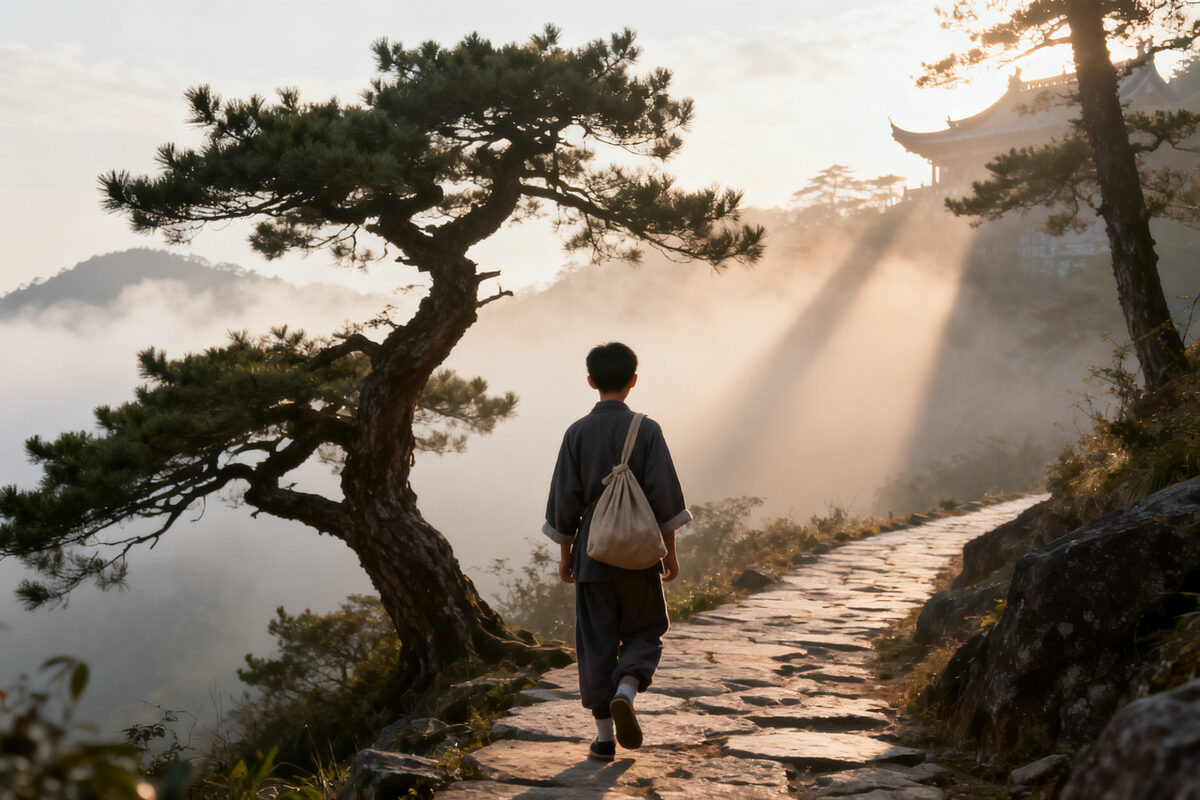
The first was a monk named Cloud of Virtue. Sudhana walked a long way to find him, up on a mountain. Cloud of Virtue taught him the practice of "mindfully recollecting all buddhas." Sudhana learned it. But he didn't stop. He asked: Who should I seek out next?
Cloud of Virtue said: Go find the monk Cloud of the Ocean.
And so it went. One person pointing to the next, one connection leading to another.
The people Sudhana found are what make this story so interesting to me. Because it's not a list of great masters.
He found a boatman. Someone who ferried people across a river, day in and day out, wind and rain, dawn to dusk. What did Sudhana learn from the boatman? He learned about "ferrying others" — carrying people from one shore to the other, day after day, without asking for reward, without asking why.
He found an incense merchant. The merchant taught him: Good incense doesn't need to announce itself. The fragrance carries on its own. Practice is the same way. It's not about declaring how well you practice. It's about what naturally radiates from you.
He found a doctor. A physician who saw all kinds of patients every day. Sudhana asked him about practice. The doctor said: Every day I see patients, and what I see is — everyone has their own cause of illness, everyone needs a different prescription. The Dharma is the same. There is no single medicine that cures everyone.
He found a king. Not a king in peaceful times, but one who governed with strict measures. Sudhana was confused at first — how could a practitioner use punishment? The king told him: Sometimes severity itself is compassion. Like a parent who shouts at a child reaching for fire, or taps their hand. Not out of hatred, but out of love.
He found women. The text mentions quite a few female teachers Sudhana visited — night goddesses, a city guardian spirit, and others. These names are long and unfamiliar, but each of them offered Sudhana a way of seeing the world, grounded in her own experience.
He found non-Buddhists. That's right — not all fifty-three were Buddhists. Some came from other traditions. Sudhana went to learn from them. Nobody stopped him. Nobody said, "Why are you going to those people?" Because from the very beginning, Manjusri had simply said "spiritual friends." He never said "Buddhist spiritual friends."
That stayed with me for a long time.
In our world today, we seem more and more accustomed to picking sides. Which camp are you in? Which tradition do you follow? Who is your teacher? Which book do you read?
As if you need to establish your affiliation before you can begin learning.
Sudhana wasn't like that. When he went to meet each person, he didn't first ask, "Do you believe what I believe?" He just went. He listened. He learned. Then he carried what he'd learned to the next person.
Fifty-three teachers, and each one taught him only a part. Not one of them said, "What I've taught you is enough. You don't need to look further." Each one said: You've learned something. Good. But you need to keep walking.
This makes me think about how I learn. Sometimes I read a book that's so good, I want to find every answer in that one book. Sometimes I meet a teacher who says something so true, I want to stay with them forever.
But Sudhana's story tells me: Every connection has its value, but no single connection gives you everything.
You have to keep walking.
The last teacher Sudhana visited was the bodhisattva Samantabhadra.
Samantabhadra didn't point him to the next person. Standing before Samantabhadra, Sudhana finally understood: all along this journey, the fifty-three teachers — each one was a door. Opening a door didn't reveal a destination. It revealed another path.
All the paths together — that was the "Dharma Realm."
The Dharma Realm isn't a place. It isn't a concept. The Dharma Realm is the sum of all these paths. Every door, every person, every experience — each is part of the Dharma Realm.
Sudhana walked so far, met so many people, and what he finally understood wasn't some profound doctrine. It was this: Everyone is worth learning from. Every experience is part of who you are.
After I finished reading this story, I sat for a long time.
I thought about the people I've met over the years. Some were formal teachers, in classrooms. But more often, they were people you wouldn't call "teachers" — an uncle in a taxi, an auntie selling vegetables at the market, an old man who struck up a conversation in the park.
They taught me more than many classrooms did.
The taxi uncle said: Don't be in such a hurry. A road is walked step by step, not thought into existence.
The vegetable auntie said: Look at this vegetable. It's best when it's fresh today. Tomorrow it's different. Everything is like that. The present moment is best.
The old man in the park said: When I was young, I was like you. I always thought there was a "best one" waiting for me to find it. Later I realized, the "best one" is the one in your hands.
They didn't know they were teaching me anything. I'm not even sure they were right. But these words stayed with me, resting alongside lines from sutras, and I can't tell which are more precious.
Maybe that's what Sudhana's story is about.
You don't necessarily have to find fifty-three great masters. Every person around you might be showing you a door you never noticed.
The question is — are you willing to push it open?
Sometimes I wonder, during Sudhana's fifty-three visits, walking all those roads — was he ever tired? Did he ever doubt?
The sutra doesn't really describe his exhaustion. But I imagine he must have been tired.
By the twentieth person, maybe he thought: That's enough, isn't it? I've learned so much already. By the thirty-fifth, maybe he thought: Is this ever going to end?
But he kept going.
Not because his willpower was extraordinary, I think, but because — every time he reached someone, he genuinely learned something new. That feeling of "oh, so that's how it is" made it impossible to stop.
It's like reading. When a book truly opens a new world for you, the excitement makes you reach for the next one. It's not a task. It's a hunger.
Sudhana's journey wasn't asceticism. It was longing.
I'm writing this today because lately I've been feeling like I've slowed down. Not my footsteps — the drive to learn, that urgency inside, seems less intense than it used to be.
Maybe I've gotten comfortable with my rhythm. Maybe I feel like this is enough. I don't need to look for new doors.
But Sudhana's story reminds me: There's always a next door. There's always scenery you haven't seen. There's always an ordinary person who can make you say, "Oh, so that's how it is."
The important thing is — you have to step outside.
Three questions I'm sitting with:
-
Are there "spiritual friends" around me I've been overlooking? People who aren't teachers — have they been teaching me something all along?
-
Am I so fixated on finding the "one right path" that I'm missing the doors right in front of me?
-
If Sudhana walked up to me today, would I be his fifty-fourth teacher? What would I teach him?