He Finished Black Myth: Wukong, Then Asked: Where Does This Monkey Come From?
An American streamer finished the game, actually read all hundred chapters of Journey to the West, and said: I thought it was a superhero story — turns out it's a story about how to keep yourself in check. Hanuman, Wuzhiqi, the monkey of the mind, and a headband whose real name means 'settling the heart.'
A few nights ago I was scrolling YouTube and came across a video. An American streamer was playing Black Myth: Wukong. Halfway through Chapter Three, he suddenly stopped, looked straight into the camera, and asked: "Wait. Where does this monkey actually come from? Why was he born from a stone? Why is he called 'Wukong'?"
Someone in the chat told him: go read Journey to the West. A hundred chapters, written in the Ming dynasty. He said fine, I will. The next day he actually started a livestream reading the original, got through one chapter, and said, completely lost: "Every single name in this book means something, right? I feel like I'm missing it."
You're not missing anything. Or rather — you're missing the one thing the Chinese have spent five hundred years slowly trying to tell you:
This monkey might not live in Flower-Fruit Mountain.
A Monkey's Nationality
Scholars have argued about Sun Wukong's origins for a hundred years.
Hu Shi said he came from India. The Ramayana has a divine monkey called Hanuman — he can fly, he has monstrous strength, he leapt across the sea and burned the city of Lanka. Sound familiar? Isn't that just Havoc in Heaven? Hu Shi believed the Hanuman stories traveled in along the Silk Road, took root in China, and grew a native monkey.
Lu Xun disagreed. Lu Xun said: we have our own monkey, thank you. An old text records a water demon of the Huai River called Wuzhiqi — "shaped like an ape, flat-nosed, high-browed, blue-bodied, white-headed, golden eyes, snow teeth" — chained by Yu the Great under the foot of Turtle Mountain for centuries. Pinned under a mountain. That plot point — sound familiar?
The two camps argued for decades. Later, Ji Xianlin, who studied Sanskrit, said: maybe both are right, and maybe neither is the whole answer. The shadow of Hanuman, the skeleton of Wuzhiqi, plus one word from the Buddhist sutras — together they make the complete monkey.
That word matters far more than the monkey's passport.
By the way, someone in the chat — a Japanese viewer — said he'd known Wukong since elementary school, from Dragon Ball. He probably doesn't know that Toriyama's little Goku, name and character design, was borrowed straight out of that Ming dynasty book.
The Monkey of the Mind
In the Buddhist sutras, the human mind is compared to a monkey.
The Mahavairocana Sutra is a very old text. It describes sixty kinds of mind, and one of them is called "monkey-mind" — the mind is like a monkey in a tree, leaping from branch to branch, never able to stay put. Before you even open your eyes in the morning, it's already jumping: what time is the meeting, did I say the wrong thing yesterday, the mortgage, the checkup results, the kid's grades, a parent's illness. Within one minute it can leap from your desk to a summer ten years ago.
Those four characters became an idiom: xin yuan yi ma — the mind a monkey, the will a horse. Neither can be tied down.
The author of Journey to the West (let's call him Wu Cheng'en, though even that is an open question) took the phrase and ran it into the ground. Open the original and look at the chapter titles — "monkey of the mind" appears again and again:
"The monkey of the mind returns to the right path; the six thieves vanish without a trace."
Chapter Fourteen. Wukong has just become the monk's disciple. On the road they meet six bandits. The bandits announce their names: "Eyes-Delight," "Ears-Anger," "Nose-Love," "Tongue-Thought," "Mind-Desire," "Body-Sorrow."
Eyes, ears, nose, tongue, body, mind — the six senses in Buddhist teaching. When the six senses touch the world, craving arises. The sutras call them the six thieves. What do they steal? Your mind.
Wukong raises his staff and kills all six.
Many readers, over the centuries, decided this was cruel. But read the chapter title together with the scene: "the monkey of the mind returns to the right path, and the six thieves vanish." When the mind settles, the noise of the six senses simply stops. He isn't killing bandits. He is doing housecleaning — on the inside.
The Headband's Real Name
The streamer asked one more question: "Why does Guanyin give him a ring that tightens? That seems cruel."
I almost laughed at my screen. And then almost didn't.
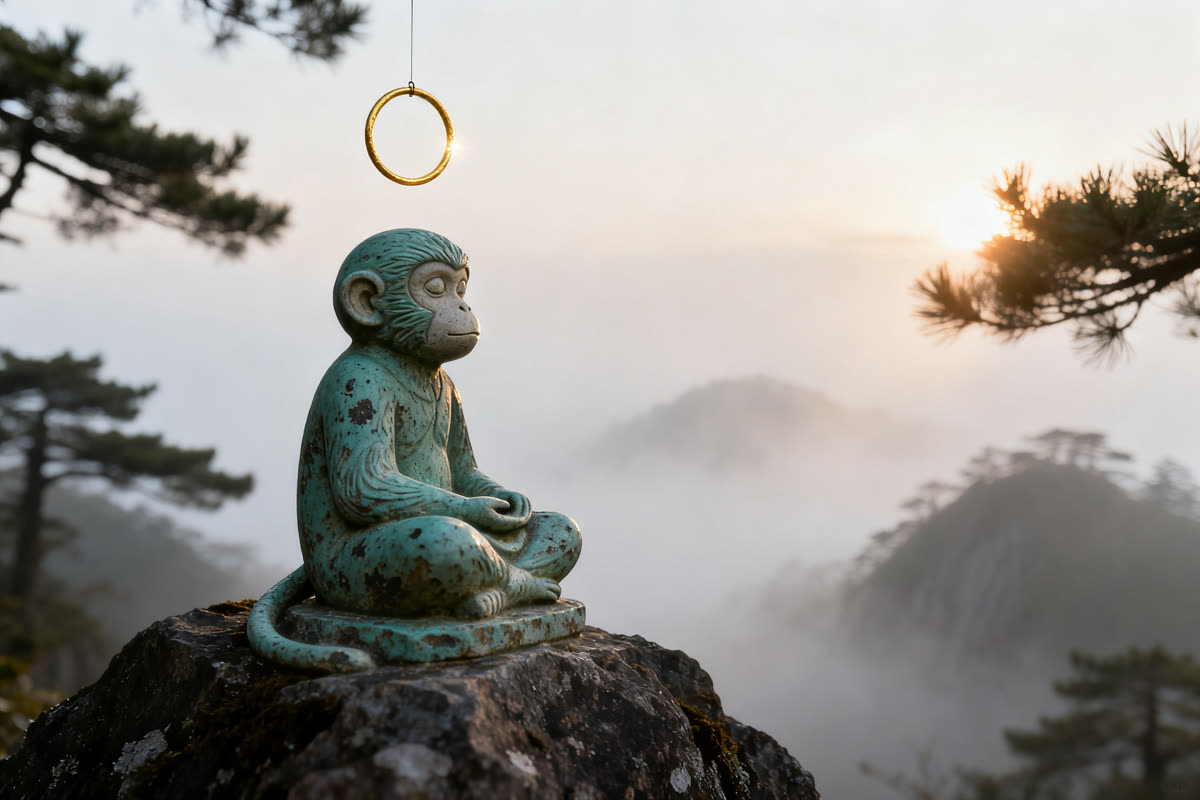
What he doesn't know is that in the original, the tightening spell has another name. It's called the True Words for Settling the Mind.
Not restraint — settling. What it circles isn't the head. It's that leaping, restless ape.
And what does Wukong do after he puts it on? He walks the road. A hundred and eight thousand li, fourteen years, eighty-one ordeals. People call it a monster-slaying adventure, but look at the monsters along the way: the Yellow Wind Demon is anger, Six-Eared Macaque is the divided self, the Lion-Camel Ridge is greed, the Women's Kingdom is love... The demons come layer by layer, and each layer peels something off — all the things in your heart that were never looked at.
At the foot of Vulture Peak, there's the Cloud Ferry. A single-log bridge, and the ferry that comes to carry them is a bottomless boat. Wukong jumps on first, steady as stone. Why isn't he afraid anymore? Because by this point in the road, the monkey of the mind has settled.
The original's lightest — and heaviest — line comes at the very end. On the day he becomes a Buddha, Wukong says to the monk: Master, you can take the ring off now. The monk says: reach up and feel for yourself.
Wukong touches his head —
There's nothing there.
The ring had been gone a long time. No one took it off. The day the monkey finally no longer needed to be circled, he discovered that what had circled him was never the ring at all.
Why a Monkey
I got up here and went to refill my water.
Coming back, I kept turning over one question: why did Wu Cheng'en pick a monkey? Why not a tiger? A dragon? A qilin?
Maybe because a monkey is too much like the human heart.
It's clever, learns everything fast — Patriarch Subodhi teaches it the seventy-two transformations and it picks them up instantly. That's us: skills, certificates, job-hops, quick studies at everything. It can't sit still; the moment it has real power it wants to be "Equal to Heaven" — that's us too: one small win and suddenly the room is too small for us. When it wrecks Heaven, that "this sky shall no longer cover my eyes" arrogance — no one in their twenties watches it without their blood rising.
Then it's pinned under a mountain. Five hundred years.
Then it wears the ring, and walks a hundred and eight thousand li.
I've always believed the best part of Journey to the West isn't the Havoc in Heaven. It's the road. A monkey who can cover a hundred and eight thousand li in a single somersault — and the road to the scriptures is exactly a hundred and eight thousand li — could just somersault to the Thunderclap Monastery and carry the sutras back. Why walk beside a mortal, one step at a time?
In the book, Bajie actually asks Wukong this. Wukong answers: Master is made of flesh, heavy as a mountain; I cannot carry him. This road, he has to walk himself.
Whatever a shortcut can get you — it can't keep the monkey in your heart quiet.
The Streamer, Continued
I followed the video to the end.
He really did finish Journey to the West — the Anthony Yu translation, four volumes, two months. After the last chapter he sat silently on stream for a long time, and then said one line I haven't been able to forget:
"I thought this was a superhero story. It turns out it's a story about how to keep yourself in check."
Someone in the chat replied: Welcome to Chinese literature.
On my side of the screen, alone, I nodded.
That stone monkey leapt out of the rock on Flower-Fruit Mountain, was pinned under a mountain, wore a ring, walked a hundred and eight thousand li, and in the end became the Victorious Fighting Buddha. Every demon he fought, we carry in our hearts. The years he spent under the mountain — we've all had those years, in our own low places.
So when foreigners ask who this monkey is, where he came from — Hanuman or Wuzhiqi, let the scholars keep arguing. But in the Chinese heart the answer has been there all along:
He is us. Every one of us — clever, restless, ambition higher than the sky, forever learning, slowly, how to become quiet.
Outside the window the sky has gone completely dark. Writing this, the monkey in my own head leapt around all evening — I checked my phone twice mid-paragraph, got a cup of water, looked to see if anyone had said anything in the group chat. You see? Even the person writing about "settling the mind" can't fully settle.
But that's all right. Wu Cheng'en probably couldn't either.
Three Questions for You
- How did you first meet Sun Wukong — a video game, an anime, or the TV series that reran every summer and winter holiday?
- When was the last time the monkey in your heart wrecked its own Heaven?
- If the headband really existed — a ring that could settle your mind — would you dare put it on?