The Ghost Festival Isn't Scary: It's Just Someone Finding Their Way Home
Every year before the fifteenth of the seventh lunar month, my mom calls to tell me to come home early. The day that scared my whole childhood has a real name: the Zhongyuan Festival. Only after reading the story of Mulian saving his mother did I realize — there isn't a single frightening word in this so-called Ghost Festival. It's about a son trying everything to get his dead mother one full meal.
The Ghost Festival Isn't Scary: It's Just Someone Finding Their Way Home
The night before last, my mom called. Nothing urgent, just chatting. Right before hanging up, she suddenly said: "The day after tomorrow is the seventh month, half moon. Come home early that night. Don't wander around outside."
I said okay.
After we hung up, it hit me — I'm a grown adult, and I'm still being told to "come home early." But I've heard this line my whole life. Every year, before the fifteenth day of the seventh lunar month, my mom says it once. As a kid, I was genuinely scared. The adults said that night the streets "weren't clean," that you mustn't step on the paper-burning piles at intersections, that you mustn't stare at other people's fires. I'd walk home fast with my head down, feeling like something was following me.
Only later, after reading a bit, did I learn that this day that scared me through my entire childhood has a formal name: the Zhongyuan Festival. In Daoism it's called Zhongyuan. In Buddhism, the Ullambana Festival. Among ordinary people, "the Half of the Seventh Month" — or simply, the Ghost Festival.
And its original face is about as far from "scary" as it gets.
First, a story
There's a short Buddhist sutra called the Ullambana Sutra. It tells one story.
The Buddha had a disciple named Maudgalyayana — Mulian in Chinese — said to be the foremost in supernatural powers among all the disciples. After he attained his abilities, the first thing he wanted to do was find his mother, who had passed away. Indians and Chinese are alike in this: we believe the dead go somewhere, and we all want to know whether our loved ones are doing okay there.
Mulian searched everywhere with his divine eye, and finally found his mother — in the realm of hungry ghosts.
What is the realm of hungry ghosts? Beings who can never eat. Food turns to burning coals the moment it reaches their mouths. Mulian filled his alms bowl with rice and used his powers to send it before his mother. She grabbed it and shoved it toward her mouth — and before the rice got in, it turned into a lump of red-hot ash.
Mulian, foremost in supernatural powers, could not save his own mother.
Crying, he went to the Buddha. The Buddha said: your mother built up too much karma in her life. Your power alone cannot save her. But on the fifteenth day of the seventh month, when the monks finish their summer retreat, prepare food of a hundred flavors and make offerings to the monks of the ten directions. Through their combined purity, she can be delivered.
Mulian did as he was told. That day, his mother was freed from the realm of hungry ghosts.
Overjoyed, he asked the Buddha: in the future, can other people use this method to save their own parents? The Buddha said yes. Even parents seven generations back.
That is the origin of the Ullambana Festival. "Ullambana" is a Sanskrit word that means roughly "hanging upside down, released" — imagine someone suspended upside down in agony, and finally being let down. And a child's love is the rope that lets them down.
The first time I read this story carefully, I sat still for a long time. Because there isn't a single frightening word in it. It's about a son who tried everything he could think of, just to get his dead mother one full meal.
A ghost festival that isn't about ghosts
Later I looked into why such a day came to be called the "Ghost Festival," why it terrified kids like me.
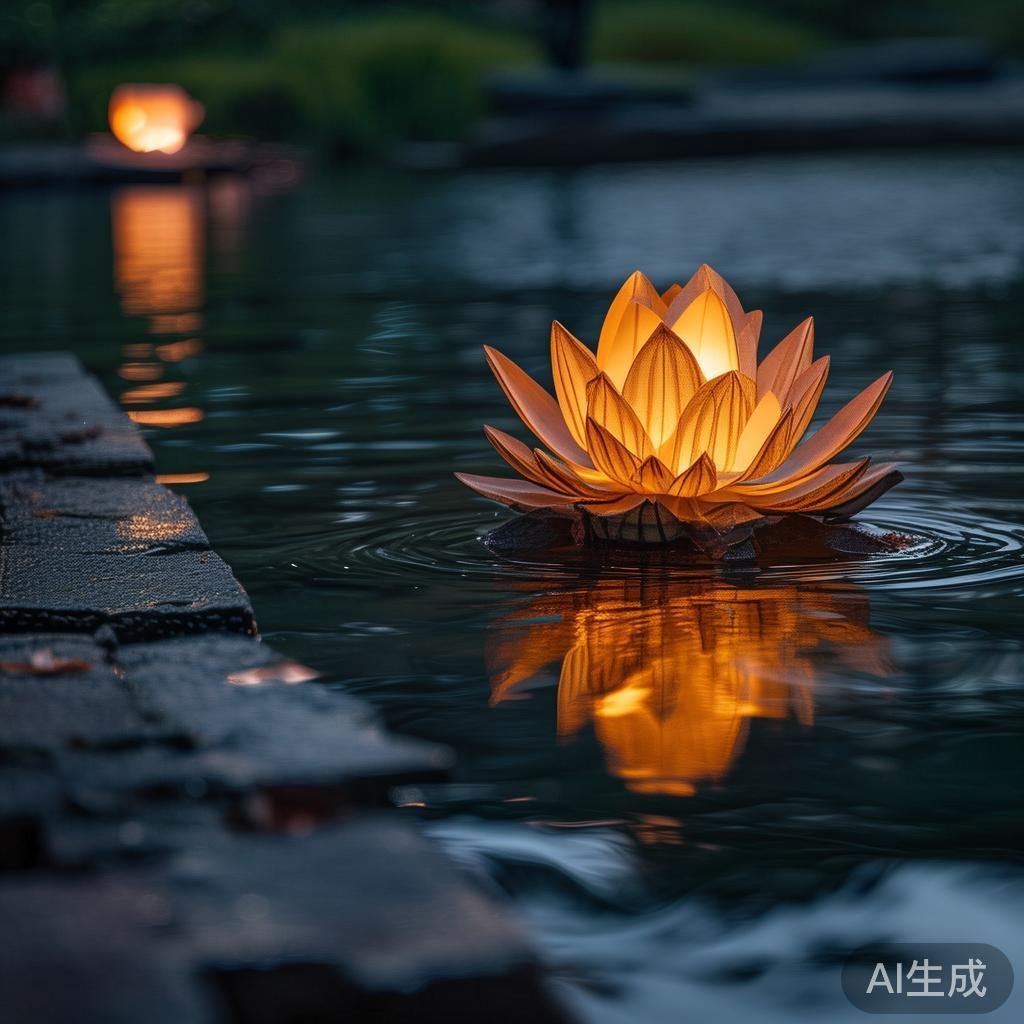
The truth underneath is simple. The ancients believed that in the seventh lunar month, the gates of the underworld open, and the souls of ancestors return to the world of the living — to look in on their descendants, to look in on home. People call it "welcoming the ancestors." Families set out offering meals. At intersections, people burn paper money. On rivers, they float lanterns — the river lanterns light the way home for the returning souls; as the lights drift downstream, it's like seeing them off again.
Look closely: not one part of these customs is about "defending against ghosts."
Every part is about welcoming, and seeing off.
The paper money is for their journey. The offering food is so they won't go hungry. The lanterns are so they can see the road. Even the rules of the day — don't step on the burning paper, don't run around at night — weren't originally because "ghosts will harm you." It's because those are other families' loved ones collecting their things, walking their roads. Barging through would be rude.
It's like when guests come to your house: you tidy up beforehand, you cook, you walk them to the door when they leave. The Half of the Seventh Month is a meal and a lantern that Chinese people set aside for their departed family.
I once explained this to an American friend. He said: we have Halloween, that's also a festival of ghosts. I said, not quite the same. The logic of Halloween is "the ghosts are coming, we must scare them away" — so kids dress up as something even scarier, and jack-o'-lanterns exist to ward off evil. The logic of Zhongyuan is "our loved ones have come back, we should host them well."
One defends. The other waits.
He was quiet for a moment, then said: yours is gentler.
I thought about it. It really is. The Chinese attitude toward death is often not confrontation but continued correspondence. The ancestors are gone, but the relationship isn't. Qingming is when we go visit them. The seventh month is when they come back to visit us. Back and forth, like two families exchanging visits. Death doesn't sever the bond; they've just moved to another place to live.
After my grandmother passed away, I suddenly understood all of this. Burning paper used to feel like superstition to me, a formality. On the first Zhongyuan after she was gone, I stood at an intersection burning paper, and as the fire rose, all I could think was: is she cold over there, does she have enough money, did she get to eat her favorite sticky rice lotus root?
When those paper ashes spiraled up into the sky, I didn't feel afraid. I only felt that there was still a thread that hadn't been cut.
Mom's "come home early"
Thinking back on my mom's "come home early on the seventh month's half," I've come to sense another layer in it.
Of course she means the surface: the streets "aren't clean," don't run into anything. But deeper down, it may be a mother's plain wish — on a day when "the ancestors come home," she wants her child to be home too. Home, where there's a light on, food on the table, people around. That simple presence is itself a kind of memorial, a kind of peace.
The Chinese obsession with "reunion" isn't only at Mid-Autumn. New Year's Eve calls for reunion, Mid-Autumn calls for reunion — and the Half of the Seventh Month is, in a sense, also a reunion: the living and the dead both converging, on this one day, on the coordinates called "home."
So if you pay attention on the night of the seventh month's half, you'll see small fires glowing at many intersections. The people crouched beside them don't look frightened. Most are quiet. Some murmur, as if talking to someone.
They really are talking to someone. To their mother, their grandfather, an old friend.
Those people are just gone. Not gone.
This year, I'll burn a set of paper too
As I write this, I've made myself a plan: this Zhongyuan, I will burn paper properly, with my full attention.
When I buy the paper, I'll pick up a river lantern too, if there's water nearby. My grandmother liked things clean and plain when she was alive — the lantern should be a simple one.
I'm not sure whether she receives it. Honestly, I still don't know whether this works "physically." But over these years I've slowly come to see that the meaning of a ritual may not lie in whether it's delivered, but in how it forces you to stop and spend twenty minutes solely on one person.
Three hundred sixty-five days a year — how much of that time do we set aside for the family we've lost? Almost none. Busy, running forward, no time to look back. A day like Zhongyuan is an anchor the old ancestors left for every Chinese person, written right into the calendar: these few days, pause. Think of them.
Paper burns with a yellow flame that sinks quickly into a bed of glowing ash. The wind comes, the ash lifts, and in that instant you truly feel something has been received and taken away.
Maybe nothing has. But your heart is soft in that moment, and that is enough.
The night after next, go home early. If you're missing someone too, buy a stack of paper at an intersection, or light a lantern on your windowsill.
Don't be afraid. It's only someone finding their way home.
Three questions, for you:
- When you were little, did your family have rules for the seventh month's half? Do you remember the adults' faces back then — frightened, or quiet?
- If you could send one sentence to a departed loved one, what would you say?
- Do you think "fearing ghosts" and "missing someone" might actually be the same feeling?